
Taweret (Egyptian Goddess of Childbirth)
A hippopotamus standing upright on lion's legs with a crocodile down her back — Egypt's oddest goddess, and its most trusted guardian of pregnant women.
Statuette of Taweret, Egyptian faience (Walters Art Museum) · Public domain · source
The Great One
Taweret — Egyptian Taweret, "the great one," a name that reads almost like an understatement once her actual appearance is taken into account — is the composite hippopotamus goddess who watched over pregnancy, labour, and the vulnerable first days of an infant's life 4,5. Female hippopotamuses were genuinely observed by Egyptians to be fiercely protective of their young, ready to attack anything that came near a calf, and that specific, real behaviour is the animal fact underneath the whole deity: a creature terrifying to outsiders and devoted to its own 4. Male hippopotamuses, by contrast, were dangerous and destructive on the Nile and could stand for chaos itself — Set takes hippopotamus form to be hunted down and defeated by Horus at Edfu — so Taweret's femaleness is not incidental to her goodness; in Egyptian symbolic logic, it is the whole reason she is safe 4,5.
A Body Assembled From Danger
Her iconography is a deliberate assembly of the Nile's most hazardous animals, redirected into protection. Taweret is shown standing upright on lion's hind legs, with a hippopotamus's head and pendulous, heavily pregnant belly, human or leonine breasts, and a crocodile — sometimes just its tail, sometimes its whole back and head — riding down her spine like a second, watchful creature 4,5. She is frequently shown resting a hand on the sa sign, the hieroglyph for protection, or gripping a knife, the standard equipment of an Egyptian household guardian rather than a temple god 3,4. The composite demon Ammit, devourer of unworthy hearts at the Weighing of the Heart, is built from the same three animals — crocodile, lion, and hippopotamus — arranged into a very different creature: proof that Egyptians read this particular combination as raw, dangerous power that could be turned toward destruction or toward guardianship, depending entirely on the figure's intent 4,5.
Equipment for the Birthing Room
Taweret's cult left its clearest traces not in temple archives but in the physical tools of Egyptian domestic magic. Curved wands of hippopotamus ivory, carved with rows of protective animals and deities including Taweret and Bes, were kept in Middle Kingdom households and are usually interpreted as instruments for tracing a protective circle around a sleeping child or a woman in labour, their worn surfaces suggesting real, repeated handling rather than purely symbolic deposit 2,3. Amulets of Taweret, often carved as a free-standing pendant rather than a flat plaque, are among the most common protective objects recovered from Egyptian settlement sites of every period, worn by pregnant women and hung near infants long after the wands themselves went out of fashion 3,4.
A Goddess of the Household, Not the State
Like Bes, with whom she is constantly paired in both art and function, Taweret had no major state temple and no significant independent priesthood; she belonged to the home rather than to royal theology, which means her worship is documented mainly through the huge quantity of small objects ordinary Egyptians commissioned and kept rather than through inscriptions commemorating royal patronage 3,4. That popular devotion did not stop individual queens from adopting her image for their own purposes — sculptures and objects associating royal women with Taweret's protective power survive from more than one period, evidence that her appeal reached every social level even without an official cult to organise it 4,5. Funerary use followed the same pattern: Taweret appears in Book of the Dead vignettes and on coffins as a guardian figure invoked for safe rebirth into the next world, extending the same protective logic that guarded a birth in this one 1,5.
Taweret in the Sky
Egyptian astronomy folded Taweret into its picture of the heavens as well as its picture of the home. She appears among the northern circumpolar stars on New Kingdom and later astronomical ceilings, identified by some Egyptologists with the constellation broadly corresponding to Draco, permanently visible in the Egyptian night sky and therefore, in Egyptian cosmological terms, permanently on watch 5. A goddess associated with the pole of the sky fit naturally with a goddess already understood as a fixed, dependable presence at the household's most anxious hours; both roles asked the same thing of her, which was simply never to look away 4,5.
A Long, Quiet Career
Taweret's popularity barely wavered across three thousand years of Egyptian religious history, a durability rarer than it sounds among Egyptian deities, whose fortunes usually rose and fell with dynastic politics and royal favour. Because her authority never depended on a king's patronage or a priesthood's fortunes, she had nothing to lose when either declined, and her amulets continued to be produced through the Late Period and into the Ptolemaic era essentially unchanged in form 3,4. She survives today mostly as a curiosity of Egyptian art, a goddess whose sheer visual strangeness tends to overshadow how seriously and how consistently ordinary Egyptian households actually relied on her — not as an abstraction of order like Ma'at, but as the specific, physically present guardian standing between a family and the single most dangerous ordinary event in ancient life 3,4.
Continue Exploring
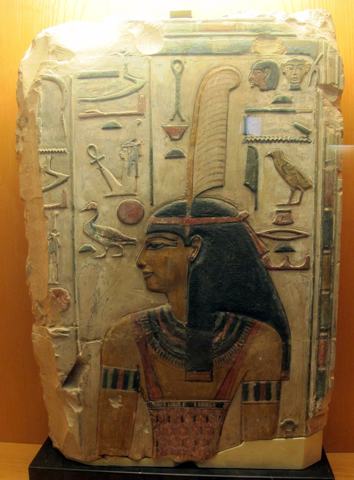
Truth and cosmic order personified — the goddess whose feather weighed every dead Egyptian's heart, and the standard every king swore to uphold.
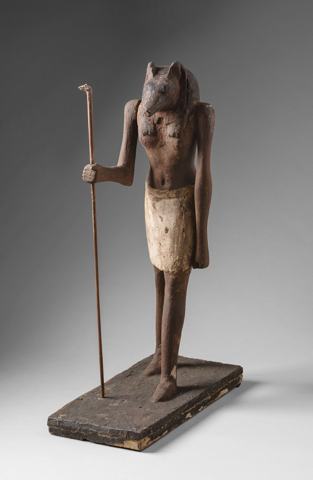
God of chaos — the red god of storm and desert who murdered Osiris, yet stood in the sun's boat each night to spear the serpent of nonexistence.
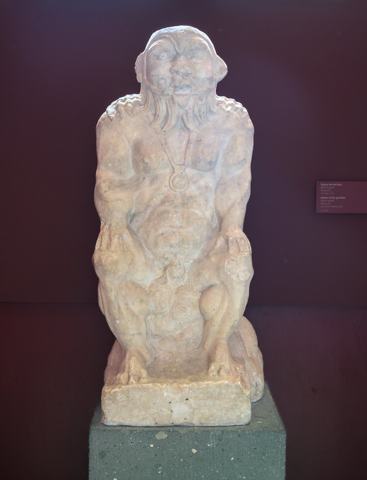
The grinning dwarf god who guarded bedrooms rather than temples — a fierce, funny protector of mothers and infants, armed with noise and a terrifying face.
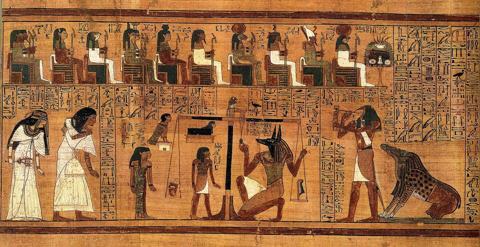
Devourer of the dead — the crocodile-lion-hippopotamus hybrid who crouched beside the scales and swallowed the hearts that failed the weighing.
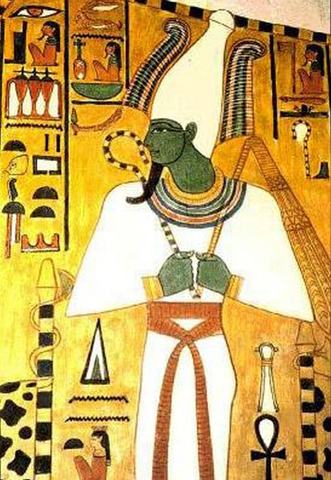
Lord of the afterlife — the murdered king remade as the first mummy, whose resurrection promised every Egyptian a life beyond the grave.
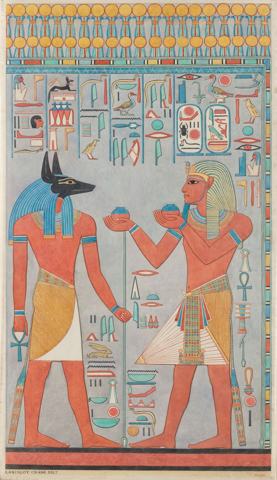
Guardian of the dead — the black jackal god who embalmed Osiris, watched over the necropolis, and weighed the heart against the feather of truth.
Sources & Further Reading
- 1.The Egyptian Book of the Dead (Book of Going Forth by Day), New Kingdom.
- 2.Middle Kingdom apotropaic wands ("birth tusks"), hippopotamus ivory, 12th-13th Dynasty.
- 3.Pinch, Geraldine. Magic in Ancient Egypt. British Museum Press, 1994.
- 4.Wilkinson, Richard H. The Complete Gods and Goddesses of Ancient Egypt. Thames & Hudson, 2003.
- 5.Pinch, Geraldine. Egyptian Mythology: A Guide to the Gods, Goddesses, and Traditions of Ancient Egypt. Oxford University Press, 2002.
Spot an error or have a source to suggest? Write to info@viseterna.com. We cite primary sources and modern scholarship, and we correct fast.