
Hunab Ku
"The one god" of Yucatec Maya colonial texts — a name most scholars now read as a missionary translation for the Christian God, not an ancient Maya deity.
The Book of Chilam Balam of Chumayel, page 50, opening the prophecy for Katun 1 Ahau (Princeton University Library) · Public domain · source
A Contested Entry
Hunab Ku is widely repeated in popular writing as the supreme creator god of the Maya: a single, formless, unknowable divinity standing above the whole crowded pantheon. It is one of the most persistent claims about Mesoamerican religion, and most specialists today do not accept it 5,6,7.
The reasons are worth setting out plainly, because the entry is a good case study in how a god can be manufactured. There is no known pre-Columbian attestation of the name — nothing in the surviving hieroglyphic corpus, nothing in the Dresden, Madrid or Paris codices, nothing in the monumental inscriptions 6,7. The phrase appears only in colonial-period documents written in Yucatec Maya using the Latin alphabet, produced under Spanish missionary supervision 1,2,5.
What the Name Says
The words themselves are ordinary Yucatec. Hun is the numeral one; ku (more precisely k'uh) is the general word for god or divinity; and the -ab element is usually read as forming something like "sole" or "only" 3,5. Hunab ku therefore parses as "the one god" or "the only god" — which is exactly the phrase a translator would need if he were trying to render the Christian God into Maya for people who had not previously had a word for such a being 5.
That is the core of the modern argument. The anthropological linguist William Hanks has described the colonial religious vocabulary of Yucatan as maya reducido: a deliberately engineered register of the language, built by Franciscans and their Maya assistants to carry Christian doctrine, and increasingly distinct from ordinary speech 5. On his reading hunab ku belongs to that engineered vocabulary rather than to inherited Maya theology 5.
Where It Actually Appears
Two colonial sources carry most of the weight. The Diccionario de Motul, a Yucatec–Spanish dictionary compiled by missionaries in the late sixteenth century, glosses the phrase as the sole living and true god, in language borrowed straight from catechism 1. And the Books of Chilam Balam — a family of Yucatec manuscripts copied and recopied in Maya towns through the eighteenth and nineteenth centuries, mixing prophecy, chronicle, calendar lore, medicine and Christian material — use it repeatedly, above all the Chilam Balam of Chumayel 2,3.
Ralph Roys, whose 1933 translation of the Chumayel manuscript remains a standard reference, and the scholars who have followed him generally read those occurrences in their immediate contexts as designating the Christian God, in a document that is openly syncretic and in places explicitly anti-colonial 3,5. The Chumayel book is a fascinating record of Maya people making sense of an imposed religion; it is not a window onto Classic-period belief 3,5.
Notably, Diego de Landa — the Franciscan whose Relacion is the single richest colonial account of Yucatec religion, and who had every reason to record a native high god if one had been described to him — names Itzamna, Kinich Kakmo, Chaac and many others, but does not present Hunab Ku as the head of the system 4,6.
The God Who Grew
How did a dictionary gloss become a Maya creator? By stages, and mostly outside scholarship.
Nineteenth- and early twentieth-century writers, working from the Chilam Balam texts and inclined to look for a monotheistic core beneath "primitive" polytheism, took the phrase at face value and promoted it 3,6. Later compendia added genealogy that no colonial source supplies — most commonly making Hunab Ku the father of Itzamna — and the claim then circulated by repetition 6,7. Some traditions among contemporary Maya communities do use the name, but a living usage that postdates four centuries of Christian instruction cannot by itself establish a pre-conquest original 5.
The last stage was esoteric. In the 1980s the American writer Jose Arguelles, whose "Mayan calendar" material fed the 2012 phenomenon, attached to Hunab Ku a distinctive black-and-white quartered emblem now sold across Mexico as an ancient Maya symbol. The design is not Maya and not a deity sign: it is taken from a textile pattern in the Codex Magliabechiano, a sixteenth-century central Mexican manuscript, hundreds of kilometres and a different language family away from Yucatan 6,7. Anything presenting that emblem as an ancient glyph of a Maya supreme god is wrong on both counts.
Why It Still Matters
None of this makes the entry worthless. Hunab ku is a genuine artefact of Maya history — just of the wrong century and the wrong process. It documents the moment when Yucatec speakers were handed a vocabulary for a god they had not previously conceived, and then used that vocabulary in books of their own, alongside their own calendars and prophecies, sometimes to argue against the people who had supplied it 3,5.
Scholars continue to debate the finer points: whether any pre-contact notion of a unifying divine principle existed that the phrase could have latched onto, and how much weight to give continuities in modern Maya religious practice 5,6. What almost no Mayanist now defends is the version in the popular sources — an ancient, supreme, invisible creator at the top of the Classic Maya pantheon 6,7. The gods that pantheon actually documents, in its own writing and its own art, are figures like Itzamna, Kinich Ahau, Chaac and Ixchel.
Continue Exploring
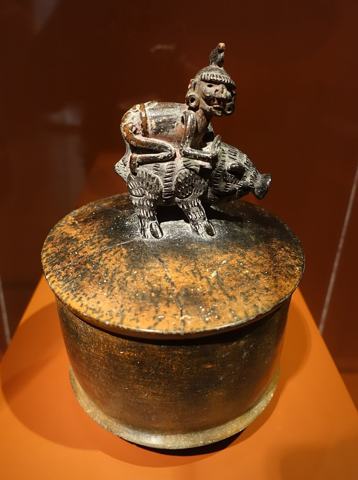
The aged creator — supreme sky god of the Maya, patron of writing, healing and divination, and the old man scholars know as God D.
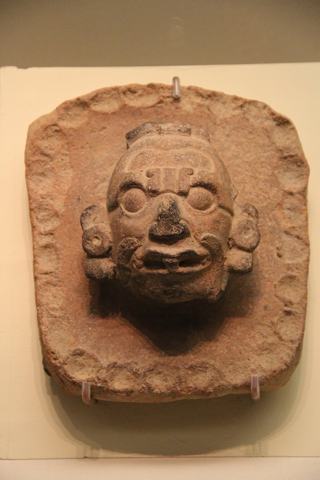
K'inich Ajaw, the Maya sun god — crossed-eyed lord of day and kingship, who sinks each night into Xibalba and crosses it as a jaguar.
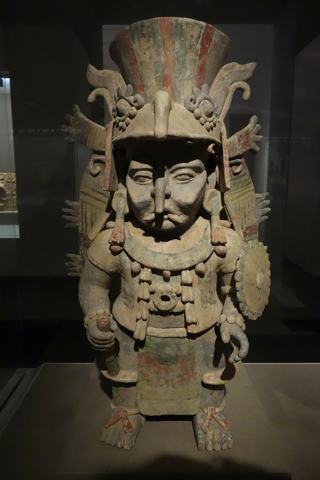
The rain god who splits the clouds with a lightning axe — one god and four, the most frequently depicted deity in the surviving Maya books.
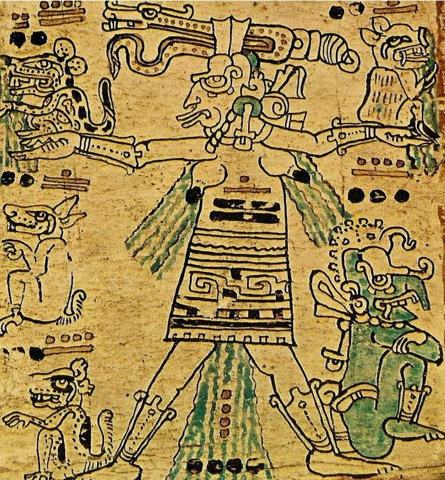
"Rainbow Lady" — the Maya goddess of childbirth, weaving, medicine and divination, and the two distinct goddesses tangled together behind her name.
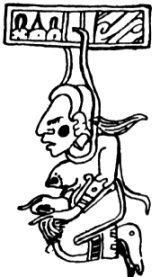
The "suicide goddess" of a single Landa passage and one Dresden Codex image — an identification recent scholarship seriously disputes.
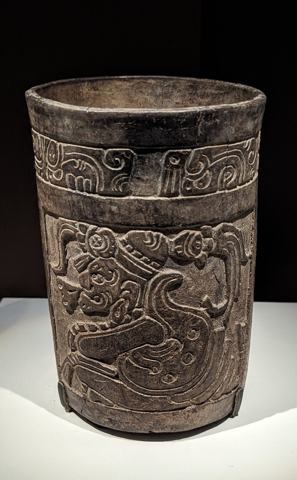
The four brothers who hold up the sky at the world's corners, tied to colours and directions in Landa's account of Maya cosmology and calendar.
Also mentioned inThe Books of Chilam BalamThe Maya Long Count Calendar
Sources & Further Reading
- 1.Diccionario de Motul (Yucatec Maya–Spanish, c. late 16th century), entry hunab ku.
- 2.The Book of Chilam Balam of Chumayel (Yucatec Maya, 18th-century manuscript of older material).
- 3.Roys, Ralph L. (trans.). The Book of Chilam Balam of Chumayel. Carnegie Institution of Washington, 1933.
- 4.Diego de Landa, Relacion de las cosas de Yucatan (c. 1566).
- 5.Hanks, William F. Converting Words: Maya in the Age of the Cross. University of California Press, 2010.
- 6.Taube, Karl. The Major Gods of Ancient Yucatan. Dumbarton Oaks Research Library and Collection, 1992.
- 7.Miller, Mary & Karl Taube. The Gods and Symbols of Ancient Mexico and the Maya. Thames & Hudson, 1993.
Spot an error or have a source to suggest? Write to info@viseterna.com. We cite primary sources and modern scholarship, and we correct fast.