
Ah Puch (Maya Death God)
Schellhas's God A, the skeletal Maya death deity behind the name Ah Puch — a label colonial and modern sources actually apply in different ways.
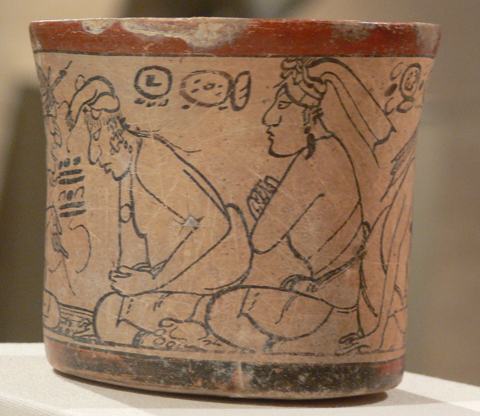
Detail of a Classic Maya vessel showing God A (Kimi), rollout photograph (Justin Kerr, The Maya Vase Book, vol. 6, 2001) · Public domain · source
God A
When Paul Schellhas set out in 1904 to catalogue the recurring divine figures of the surviving Maya codices, he had no way to read their names, so he assigned them letters instead. The very first figure he identified — skeletal or grotesquely bloated, marked with black spots of decay, often paired with a screech owl and a collar of eyeless bells — became God A, and the label has stuck ever since as the standard reference for the principal death deity of the Postclassic Yucatec books 3. He appears repeatedly in the Dresden and Madrid codices, in almanacs concerned with sacrifice, disease, and destruction, more often as an agent of misfortune than as a character with a story of his own 2,5,6.
The Names Problem
Popular writing gives this god one settled name, "Ah Puch," and treats it as simply factual. The sources are messier. Sixteenth-century material already records a Yucatec death figure called Ah Pukuh — arguably the origin of the modern spelling — mistreating and then reviving one of the Bacabs in a short mythic episode 4. Colonial Yucatec ethnography and dictionaries also preserve Cizin or Kisin, usually derived from a root meaning flatulence or stench, an epithet of decay rather than a formal name, and Yum Kimil, "Lord of Death," built on the ordinary word for death, kimi 4,5. None of these terms is simply another spelling of the same word; they come from different periods, different regions of Yucatan, and different kinds of source — an early missionary account, a friar's chronicle, modern ethnographic fieldwork — and treating them as interchangeable labels for one unchanging god flattens real gaps in the record 4,5.
What Landa Actually Wrote
Diego de Landa, whose Relacion remains the richest single colonial account of Yucatec religion, does not use the name "Ah Puch" at all. He names the ruler of the lowest level of the underworld — which he calls Mitnal, borrowing the Nahuatl term Mictlan — as Hunhau, master of devils who punish the wicked with hunger, cold, and exhaustion without end 1. That underworld and its ruler belong to the Yucatec colonial record specifically; they are a separate tradition from the K'iche' Xibalba of the Popol Vuh, with its own named lords and its own bat-demon, Camazotz, and the two should not be treated as regional dialects of one single Maya underworld 1.
A Classic-Period Name, Still Unsettled
Whether any of this reaches back to the Classic period by a fixed proper name is a harder question. The skull-faced head of this god supplies the hieroglyph for the day Kimi, "death," in the Classic calendar, and epigraphers have connected inscriptions near his image to the verbal root cham, "to die" 5. That is a real and useful association, but it falls short of the kind of settled reading epigraphers have achieved for gods like Chaac or K'inich Ajaw, whose Classic names are simply read off the glyphs. No comparable single proper name for God A has been agreed on, and the surviving Classic material may distinguish more than one death-associated supernatural where the codices later show what looks like a single recurring figure 5,6,7.
More Than One Death God
The codices themselves hint at this plurality. Alongside God A, specialists recognise a second, closely related skeletal figure sometimes labelled God A', tied more specifically to violent, sacrificial, or drunken death rather than death and decay in general 5,6. Landa's report likewise pairs Hunhau with a second underworld power, Uacmitun Ahau 1. How exactly the codical "A" and "A-prime," and the colonial Hunhau and his companion, map onto one another is argued rather than agreed 5,6. What the sources support is not one death god wearing several names but a cluster of related death figures, recorded across different centuries and regions and only loosely tied to the goddess of self-inflicted death, Ixtab, whose own record is thinner still — a cluster that later popular writing has compressed into a single character called Ah Puch 4,5,6.
Continue Exploring
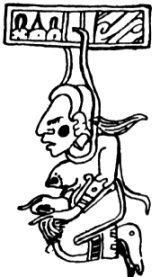
The "suicide goddess" of a single Landa passage and one Dresden Codex image — an identification recent scholarship seriously disputes.
"Place of Fear" — the K'iche' Maya underworld of the Popol Vuh, a court of disease lords whose houses of trial the Hero Twins survived and overturned.
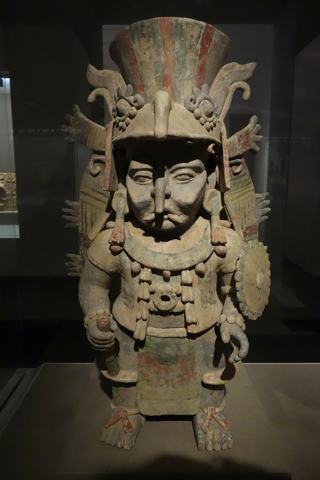
The rain god who splits the clouds with a lightning axe — one god and four, the most frequently depicted deity in the surviving Maya books.
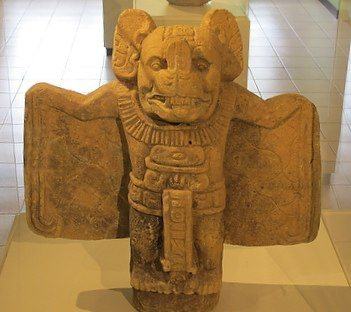
The death bat — the snatching bat-demon of the K'iche' underworld who takes off a hero's head in the dark, and the long Mesoamerican cult behind him.
The youthful Classic Maya god of maize, God E of the codices, whose death and rebirth many scholars connect to the Popol Vuh's Hun Hunahpu.
The K'iche' Maya storm god who speaks the world into being in the Popol Vuh — and the contested claim that he gave the hurricane its name.
Sources & Further Reading
- 1.Diego de Landa, Relacion de las cosas de Yucatan (c. 1566).
- 2.The Dresden Codex and the Madrid Codex (Postclassic Maya screenfolds).
- 3.Schellhas, Paul. Representation of Deities of the Maya Manuscripts. Peabody Museum, Harvard University, 1904.
- 4.Thompson, J. Eric S. Maya History and Religion. University of Oklahoma Press, 1970.
- 5.Taube, Karl. The Major Gods of Ancient Yucatan. Dumbarton Oaks, 1992.
- 6.Miller, Mary & Karl Taube. The Gods and Symbols of Ancient Mexico and the Maya. Thames & Hudson, 1993.
- 7.Sharer, Robert J. with Loa P. Traxler. The Ancient Maya, 6th edition. Stanford University Press, 2006.
Spot an error or have a source to suggest? Write to info@viseterna.com. We cite primary sources and modern scholarship, and we correct fast.