
The Bacabs (Sky-Bearers of the Four Directions)
The four brothers who hold up the sky at the world's corners, tied to colours and directions in Landa's account of Maya cosmology and calendar.
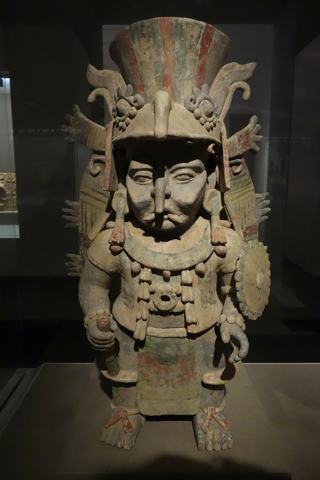
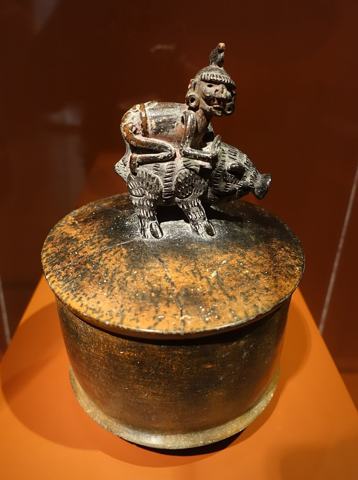
Vessel with God N (the aged Mountain God), Guatemala, Maya, 650-850 CE (de Young Museum, San Francisco) · CC0 · source
Four Brothers at the Corners
Diego de Landa's Relacion gives the clearest surviving statement of the myth: at the creation, God set four brothers at the four corners of the world to hold up the sky so that it would not fall. Landa names them Hobnil, Canzicnal, Saccimi, and Hosanek, and calls them collectively the Bacabs 1. Each is tied to a compass direction, a colour, and one of the four "Year Bearer" days that could open the 365-day Yucatec calendar round — red and east, white and north, black and west, yellow and south — in a scheme repeated with variations across colonial Yucatec sources 1,3. The Bacabs are gods of orientation as much as of support: the corners they hold are also the corners by which time itself was reckoned to turn over each New Year 1.
Pauahtun and God N
In Classic and Postclassic art, the figure filling this quadripartite sky-bearing role is usually identified as Pauahtun, catalogued in the Schellhas system as God N: an old man, often wearing a netted headdress, frequently shown emerging from a turtle shell, a conch shell, or a spider's web, and repeatedly appearing in sets of four 5,6,7. Most specialists treat Pauahtun and the colonial Bacabs as versions of the same underlying complex — an aged, quadripartite power supporting the sky and associated with the interior of the earth and with mountains — rather than as two unrelated traditions that happen to share a job description 5,6. Matching a Classic-period iconographic type to a set of colonial Yucatec names is still an inference bridging many centuries, and should be stated as one rather than as settled fact 5.
Holding Up the Corners
The idea shows up literally in Maya architecture. Carved figures at the corners of buildings and altars — old, often bearded, arms raised as if bearing weight — are conventionally read as Bacab or Pauahtun supports, a Maya version of the "Atlantean" figure found across Mesoamerica 5,6. The cosmology behind the image extends outward from any one building: Maya thought placed a great ceiba tree at each of the four world directions, with the Bacabs bound to those corner trees, around a fifth, central tree marking the axis of the world 5. Sky, calendar, architecture, and the shape of the earth itself are organised around the same four-cornered structure in this material, and the Bacabs are one name for the power that keeps the corners standing 1,5.
The Ritual of the Bacabs
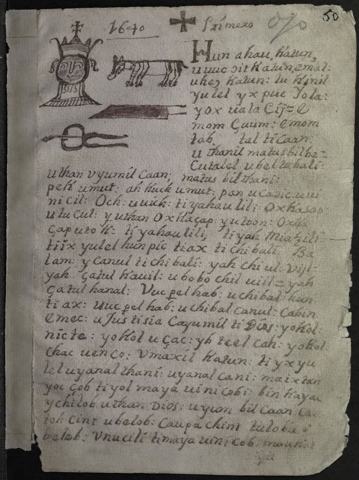
The richest single source for how these gods were actually invoked is a colonial Yucatec manuscript now known as the Ritual of the Bacabs, a collection of curing incantations first translated in full by Ralph Roys in 1965. It contains dozens of spells against specific afflictions — convulsions, snakebite, "snake-belly" and other named illnesses — many of which call on the four directional powers by their colours and quarters to draw the sickness out 2. In practice these incantations do not keep the Bacabs in a tidy box separate from the four Chaacs: the two sets of directional gods are invoked side by side, and sometimes the same titles are applied to both, a genuine entanglement in the sources rather than a mistake later scholars introduced 1,2,3.
What a Colonial Snapshot Can and Cannot Show
Unlike Heart of Sky, a K'iche' highland tradition known mainly from one book, the Bacabs are lowland Yucatec figures documented continuously from Landa through Postclassic art and colonial ritual texts alike 1,5. But Landa's tidy list of four names, four colours, and four directions is still exactly that: one Franciscan's mid-sixteenth-century summary of a system that other colonial sources render with different names and different emphases. The Books of Chilam Balam, compiled and copied by Maya scribes across Yucatan in the following centuries, preserve variant year-bearer patrons and calendrical detail that does not always match Landa's scheme point for point 4. That variation is what should be expected of a tradition documented across regions and generations rather than fixed in a single official text — the same caution, in miniature, that applies to the invented genealogy later stacked onto Hunab Ku — and it warns against treating any one colonial list, Landa's included, as the whole of Maya belief about who, precisely, held up the sky 1,4,5.
Continue Exploring
The rain god who splits the clouds with a lightning axe — one god and four, the most frequently depicted deity in the surviving Maya books.
"The one god" of Yucatec Maya colonial texts — a name most scholars now read as a missionary translation for the Christian God, not an ancient Maya deity.
The K'iche' Maya storm god who speaks the world into being in the Popol Vuh — and the contested claim that he gave the hurricane its name.
The Feathered Serpent of the Maya — creator's voice in the Popol Vuh, patron of Chichen Itza, and the shadow that descends its pyramid at the equinox.
The aged creator — supreme sky god of the Maya, patron of writing, healing and divination, and the old man scholars know as God D.
Schellhas's God A, the skeletal Maya death deity behind the name Ah Puch — a label colonial and modern sources actually apply in different ways.
Sources & Further Reading
- 1.Diego de Landa, Relacion de las cosas de Yucatan (c. 1566).
- 2.Roys, Ralph L. (trans. and ed.). Ritual of the Bacabs: A Book of Maya Incantations. University of Oklahoma Press, 1965.
- 3.The Dresden Codex and the Madrid Codex (Postclassic Maya screenfolds).
- 4.The Books of Chilam Balam (colonial-era Yucatec Maya).
- 5.Taube, Karl. The Major Gods of Ancient Yucatan. Dumbarton Oaks, 1992.
- 6.Miller, Mary & Karl Taube. The Gods and Symbols of Ancient Mexico and the Maya. Thames & Hudson, 1993.
- 7.Schellhas, Paul. Representation of Deities of the Maya Manuscripts. Peabody Museum, Harvard University, 1904.
Spot an error or have a source to suggest? Write to info@viseterna.com. We cite primary sources and modern scholarship, and we correct fast.