
The Dresden Codex
The oldest surviving book of the Americas — a Maya screenfold of astronomical tables, deciphered by a Dresden librarian, that survived a 1945 firestorm.
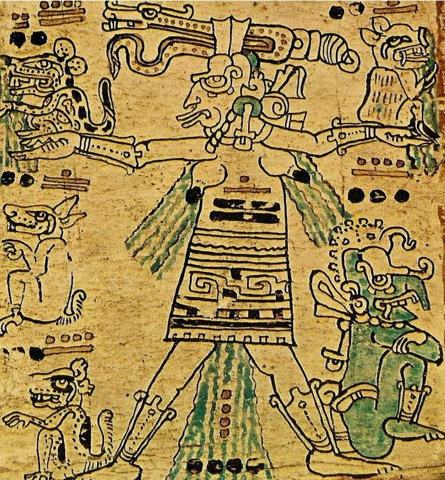
Dresden Codex, page 9, Postclassic Maya (reproduced from Ernst Forstemann's 1880 facsimile; original in the Saxon State and University Library, Dresden) · Public domain · source
The Last of Four
Only four Maya screenfold books are known to have survived the conquest and the centuries after it: the Dresden, Madrid, Paris, and the more recently authenticated Grolier codices 3,6. Of these, the Dresden Codex is the oldest, the best preserved, and the most studied 1,6. It is painted on a single long strip of bark-paper (amate) coated in fine white lime plaster and folded accordion-style into 39 leaves, most painted on both sides, running to 74 pages of hieroglyphic text and imagery 1,4,6.
Stylistic and iconographic study places its present copying in the Postclassic period, with connections to the art of Chichen Itza suggesting a date around 1200-1250 CE — a copy, most specialists agree, of an older document whose own compilation may reach back centuries further into the Classic period 4,7. No named scribe or patron is recorded anywhere in it 6.
How a Maya Book Reached Saxony
The Dresden Codex's road to Germany is not documented at the Maya end at all. It surfaces in 1739, when Johann Christian Gotze, director of the Royal Library at Dresden, bought it from an unnamed private owner in Vienna and later listed it in his own hand as "an invaluable Mexican book with hieroglyphic figures" among books delivered to the library 4. How the manuscript got from Mesoamerica to a private collection in Vienna is unrecorded; one long-standing guess ties it to the Mexican objects sent to the Habsburg court by Hernan Cortes in the early sixteenth century, but this is speculation rather than documented provenance 4. Gotze formally gave the book to the Royal Library in 1744, and it has stayed in Dresden ever since 4.
What the Pages Track
The codex is not a narrative text; it is a working set of astronomical and divinatory tables, organized into roughly thirteen sections dealing with different subjects 4,6. Its almanacs govern the 260-day ritual calendar, correlating days with deities, offerings, and prognostications for planting, rain, hunting, disease, and marriage 4,6.
Its most celebrated section is the Venus table, which tracks the planet's synodic period of about 584 days across five cycles — a scheme that returns to the same station relative to the 260-day calendar after 104 years — and links each phase of Venus's appearance and disappearance to a different deity and a different omen 3,6. Later pages carry eclipse tables predicting the syzygies of sun and moon, and a Mars table tracking that planet's own cycle; taken together they represent the most sophisticated naked-eye astronomical record to survive from the pre-Columbian Americas 3,4.
Forstemann's Breakthrough
For over a century after its rediscovery in Europe, the codex was an admired curiosity nobody could read. That changed with Ernst Forstemann, librarian at the Royal Public Library in Dresden from 1865, who spent the 1880s and 1890s working out the codex's numerical system without any comparative Maya text to check his results against 2,4. His 1880 facsimile, the page reproduced with this article among them, made the manuscript available to scholars outside Dresden for the first time, and his subsequent papers correctly identified the bar-and-dot numerals, the vigesimal place system, and the structure of the Venus table years before Maya hieroglyphic writing in general could be read 2,4. Forstemann's work on this one book remains one of the foundational achievements of Maya epigraphy 4.
A Night in February 1945
The codex nearly did not survive the twentieth century. During the Allied firebombing of Dresden on the nights of 13-15 February 1945, the library building holding the manuscript was struck, and the vault in which it was stored was flooded by the water used to fight the resulting fires 4. The codex came through with significant water damage — several pages show staining and pigment loss that Forstemann's earlier facsimile, made 65 years before, does not show 4. It remains in the collection of the Saxon State and University Library Dresden (SLUB), now digitized and viewable online, and is generally regarded as the single most important surviving witness to Maya astronomical science 4,7.
Reading It Against the Other Books
The Dresden Codex does not stand alone. Its almanacs frequently invoke the rain god Chaac, and its imagery of an aged goddess pouring water from an overturned jar on page 74 — read by most specialists as a flood scene — belongs to the same figure treated at length in the entry on Ix Chel 5. Later Yucatec sources copied in the colonial period, among them the Books of Chilam Balam, preserve calendar lore that overlaps with the codex's concerns even though the two traditions were recorded centuries apart and by very different means 4,7. Bricker and Bricker's modern reanalysis of the codex's astronomy, drawing on both epigraphy and computed planetary positions, remains the standard reference for what the tables do and do not actually predict 3.
Continue Exploring
Colonial Yucatec Maya town books mixing prophecy, history, medicine and Christian material — named for a jaguar-priest said to have foreseen the Spanish.
The rain god who splits the clouds with a lightning axe — one god and four, the most frequently depicted deity in the surviving Maya books.
"Rainbow Lady" — the Maya goddess of childbirth, weaving, medicine and divination, and the two distinct goddesses tangled together behind her name.
K'inich Ajaw, the Maya sun god — crossed-eyed lord of day and kingship, who sinks each night into Xibalba and crosses it as a jaguar.
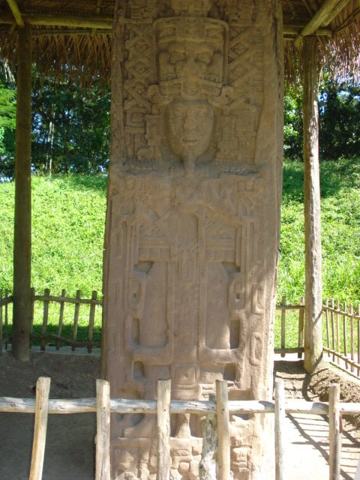
The Maya's linear day-count from a mythical zero date — the calendar a 2012 doomsday craze misread, though Classic scribes never treated it as an ending.
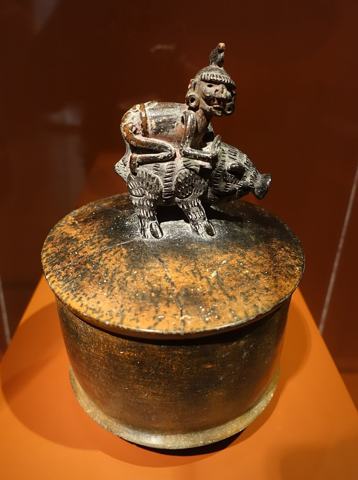
The aged creator — supreme sky god of the Maya, patron of writing, healing and divination, and the old man scholars know as God D.
Sources & Further Reading
- 1.The Dresden Codex — Postclassic Maya screenfold manuscript (Saxon State and University Library Dresden, SLUB Mscr.Dresd.R.310).
- 2.Forstemann, Ernst. Die Maya-Handschrift der Koniglichen offentlichen Bibliothek zu Dresden. 1880.
- 3.Bricker, Harvey M., and Victoria R. Bricker. Astronomy in the Maya Codices. American Philosophical Society, 2011.
- 4.SLUB Dresden. 'The Maya Codex in the SLUB Dresden' (manuscript description, provenance, and content).
- 5.Miller, Mary & Karl Taube. The Gods and Symbols of Ancient Mexico and the Maya. Thames & Hudson, 1993.
- 6.Coe, Michael D., and Stephen Houston. The Maya, 9th edition. Thames & Hudson, 2015.
- 7.Sharer, Robert J. with Loa P. Traxler. The Ancient Maya, 6th edition. Stanford University Press, 2006.
Spot an error or have a source to suggest? Write to info@viseterna.com. We cite primary sources and modern scholarship, and we correct fast.