
The Sacred Cenote of Chichen Itza
The natural sinkhole at Chichen Itza where the Maya threw offerings of jade, gold, and people, dredged by an American consul in the early 1900s.
The Sacred Cenote, Chichen Itza, Yucatan (photograph by Gary Todd) · CC0 · source
A Sinkhole Turned Shrine
Northern Yucatan is a limestone shelf riddled with cenotes, sinkholes formed where the roof of an underground aquifer has collapsed, and Chichen Itza was built around two of the largest 6. One, closer to the city centre, supplied ordinary drinking water. The other — roughly 60 metres across, its sheer walls dropping some 27 metres to dark water — received no buildings, no houses, and, so far as excavation has found, no domestic use at all. It was reserved for offerings, and the Maya threw a remarkable range of objects and people into it across several centuries 1,2,6.
A causeway nearly 300 metres long runs from the plaza in front of El Castillo directly to the cenote's edge, a piece of deliberate urban planning that makes the sinkhole's ceremonial importance to the city legible in stone 6. Small platforms and a sweat-bath structure near the rim point to ritual preparation before whatever was to follow 6.
Landa's Account, and Thompson's Dredge
Diego de Landa, writing a Franciscan's account of Yucatan roughly two centuries after Chichen's political decline, reports a Maya tradition that in times of drought people were thrown into the well alive, along with rich offerings, to petition the rain gods 1. His account went untested until the very end of the nineteenth century, when Edward H. Thompson, an American serving as United States consul in Merida, bought the hacienda that included the ruins and spent years dredging the cenote with grabs and, later, diving gear of his own design 2.
Thompson shipped a large share of what he recovered to the Peabody Museum at Harvard without Mexican government authorization, a fact that shaped Mexican cultural-property law for decades afterward and that modern accounts of the excavation cannot honestly skip 2,6. Later, more controlled investigations — dredging and diving projects through the twentieth century — recovered further material and refined the picture Thompson's haul had opened up 3.
What the Cenote Held
The objects catalogued from the well span an extraordinary range: gold and copper bells and discs (many made elsewhere in Mesoamerica and brought to Chichen as tribute or trade), jade beads and figurines, flint and obsidian eccentrics, wooden objects and remnants of textiles and basketry preserved by the anaerobic mud, and quantities of copal incense 3,6. The definitive publication of this material, edited by Clemency Chase Coggins for the Peabody Museum, treats the assemblage as a dateable ritual deposit spanning the Late Classic into the Postclassic, rather than a single event 3.
Human remains were recovered throughout, consistent with Landa's report, though in smaller numbers relative to the artifact haul than popular retellings often imply 1,3.
Who Actually Went In
Older popular writing settled quickly on an image: young virgin women, richly dressed, cast in to please a rain god. The skeletal evidence does not support that picture as a general rule. A 2019 isotopic and osteological study by T. Douglas Price, Vera Tiesler, and Carolyn Freiwald examined the human remains recovered from the cenote and found a majority to be non-local individuals — people who had grown up outside the Chichen Itza region before ending their lives in the well, suggesting long-distance movement of sacrificial victims tied to the city's wide political and trade reach rather than a purely local rite 4. Earlier osteological work on the assemblage had already established that both sexes and a wide range of ages, including many children, are represented among the remains, complicating any single simple narrative of what the offerings meant 3,4.
Cenotes in the Wider Maya World
The Sacred Cenote is the most famous example of a much broader Maya pattern: treating openings in the earth — caves, sinkholes, standing water — as points of contact with the supernatural world, ruled in myth by beings like the rain god Chaac and bound up with the watery, cave-riddled geography the Maya associated with the underworld, Xibalba 5,6. What makes Chichen's well exceptional is not the practice but its scale and its centuries-long continuity, still visible today in the causeway, the platforms at its rim, and the water itself, greenish now with algae but unmistakably the same pool Thompson's dredge once worked 2,6.
Continue Exploring
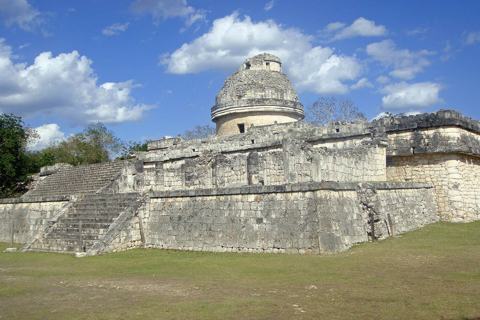
The great Postclassic Maya city of Yucatan — home to Kukulkan's pyramid and the Sacred Cenote, and a decades-long argument over how "Toltec" its art really is.
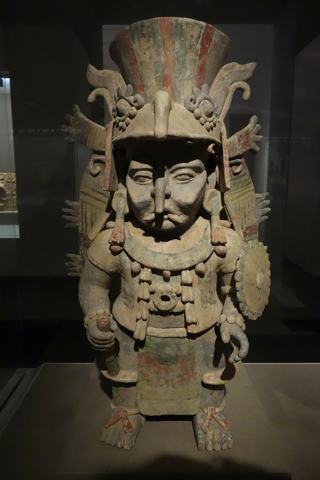
The rain god who splits the clouds with a lightning axe — one god and four, the most frequently depicted deity in the surviving Maya books.
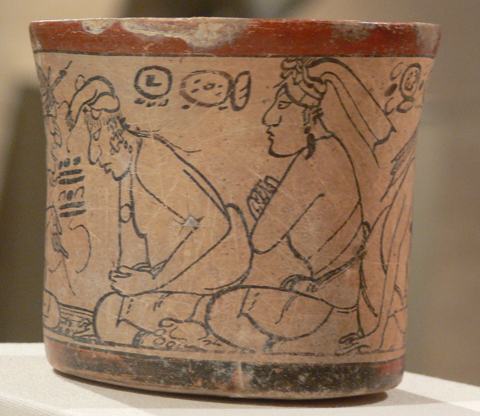
"Place of Fear" — the K'iche' Maya underworld of the Popol Vuh, a court of disease lords whose houses of trial the Hero Twins survived and overturned.
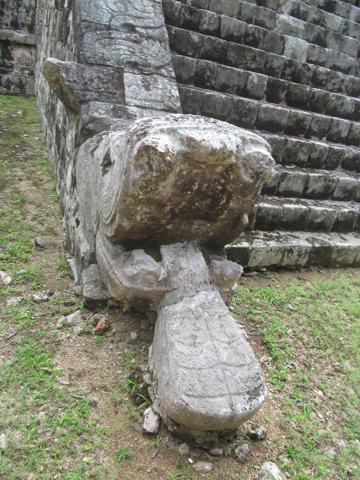
The Feathered Serpent of the Maya — creator's voice in the Popol Vuh, patron of Chichen Itza, and the shadow that descends its pyramid at the equinox.
The K'iche' Maya storm god who speaks the world into being in the Popol Vuh — and the contested claim that he gave the hurricane its name.
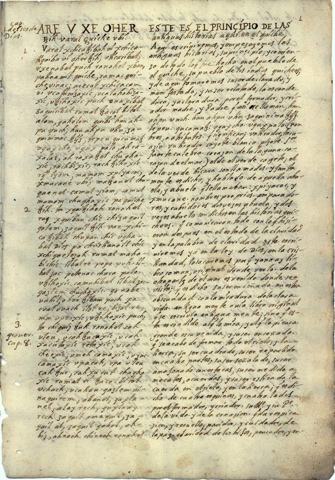
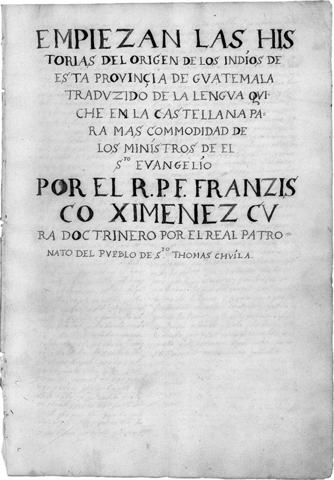
The K'iche' Maya "Book of Council" — creation, the Hero Twins, and a dynasty's history, saved by one Dominican friar's copy of a lost original.
Sources & Further Reading
- 1.Diego de Landa, Relacion de las cosas de Yucatan (c. 1566).
- 2.Tozzer, Alfred M. Chichen Itza and Its Cenote of Sacrifice: A Comparative Study of Contemporaneous Maya and Toltec. Peabody Museum Memoirs, Harvard University, 1957.
- 3.Coggins, Clemency Chase (ed.). Artifacts from the Cenote of Sacrifice, Chichen Itza, Yucatan. Peabody Museum of Archaeology and Ethnology, Harvard University, 1992.
- 4.Price, T. Douglas, Vera Tiesler & Carolyn Freiwald. 'Place of Origin of the Sacrificial Victims in the Sacred Cenote, Chichen Itza, Mexico.' American Journal of Physical Anthropology 170, no. 1 (2019): 98-115.
- 5.Miller, Mary & Karl Taube. The Gods and Symbols of Ancient Mexico and the Maya. Thames & Hudson, 1993.
- 6.Sharer, Robert J. with Loa P. Traxler. The Ancient Maya, 6th edition. Stanford University Press, 2006.
Spot an error or have a source to suggest? Write to info@viseterna.com. We cite primary sources and modern scholarship, and we correct fast.