
The Egyptian Book of the Dead
The New Kingdom funerary spells the Egyptians called "Going Forth by Day" — copied for the dead, and renamed the Book of the Dead by Lepsius in 1842.
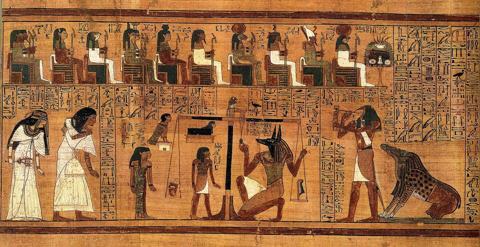
Judgment scene, Papyrus of Ani, c. 1250 BC (British Museum EA10470) · Public domain · source
Not a Book, and Not a Bible
"The Egyptian Book of the Dead" is a modern label, not an Egyptian one. What it names is a body of roughly two hundred spells the Egyptians called ra nu prt m hrw, "Spells for Going Forth by Day," meant to guide the dead through the dangers between burial and a renewed existence 3,6. No papyrus contains all of them, no two copies agree on which ones to include or in what order, and there was never a single authoritative edition for a scribe to copy from 5,6. A buyer selected from a workshop's stock of spells, in a version that fit the length of papyrus purchased and the depth of the buyer's purse, and a blank was usually left in the text for the scribe to fill in the owner's name at the point of sale 1,6.
From Pyramid Wall to Papyrus Roll
The spells did not appear from nowhere. Old Kingdom kings alone were entitled to have funerary spells carved on their burial-chamber walls — the Pyramid Texts, first opened to modern eyes in the pyramid of Unas at Saqqara 4. In the Middle Kingdom, regional elites without royal privilege adapted a large share of that material, added new compositions, and had it painted on the inside of wooden coffins as the Coffin Texts 4,6. By the New Kingdom the same tradition had migrated again, now onto papyrus rolls that any Egyptian who could afford a scribe's fee might commission, illustrated with coloured vignettes above the columns of text 5,6.
The Papyrus of Ani
The best-known single copy is the Papyrus of Ani, made around 1250 BCE for a royal scribe named Ani and his wife Tutu, and acquired for the British Museum from Luxor dealers in 1888 1,2. Unrolled, it runs to roughly seventy-eight feet of hieroglyphic text and painted scenes, and its most reproduced image is the vignette to Spell 125: Ani's heart set on a balance against the feather of Maat while Anubis tends the scale, Thoth records the verdict, and the hybrid devourer Ammit waits beside it — a single scene covered in full at The Weighing of the Heart 1,2.
Lepsius Gives It a Name
The name "Book of the Dead" is barely two centuries old. In 1842 the Prussian Egyptologist Karl Richard Lepsius published the first complete edition of a Book of the Dead papyrus, a Ptolemaic-era scroll numbered Papyrus Turin 1791, under the title Das Todtenbuch der Ägypter — "The Book of the Dead of the Egyptians" 3. Lepsius numbered the 165 spells he found in that one manuscript in sequence, and Egyptologists still cite spells by his numbers today, even though the overwhelming majority of surviving papyri neither contain nor order their spells that way 3,5.
Reading It Today
For over a century the standard English version was E. A. Wallis Budge's 1895 translation and facsimile of the Papyrus of Ani, still the text quoted on most Book of the Dead pages online because its copyright has long expired 2. Egyptologists now treat Budge's prose as badly dated and several of his readings as simply wrong, a product of how young the decipherment of Middle Egyptian grammar still was in the 1890s 4,5. The translations scholars actually use are Raymond Faulkner's, reissued with the Ani papyrus's images restored to their original places in 1994, alongside exhibition catalogues such as John Taylor's and Foy Scalf's that set the spells against the archaeology of the burials they came from 4,5,6.
What It Isn't
Treating the collection as a single scripture is the most common modern misreading. There is no fixed canon, no central doctrine binding every spell to every other, and no period in which "the" Book of the Dead stopped changing 5,6. Later in the first millennium BCE, priests reorganised the spell sequence yet again into what modern scholars call the Saite recension, cutting some material, expanding other spells, and settling an order that most Late Period and Ptolemaic copies then followed 5,6. What survives, across thirteen centuries of copying, is not a book Egyptians read for guidance in life but equipment they expected to need after it 5,6.
Continue Exploring
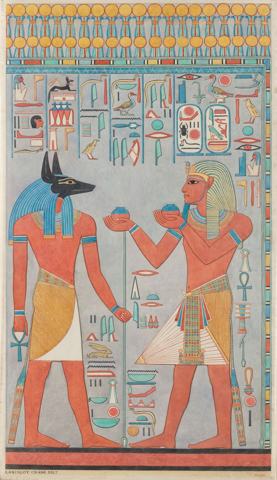
Guardian of the dead — the black jackal god who embalmed Osiris, watched over the necropolis, and weighed the heart against the feather of truth.
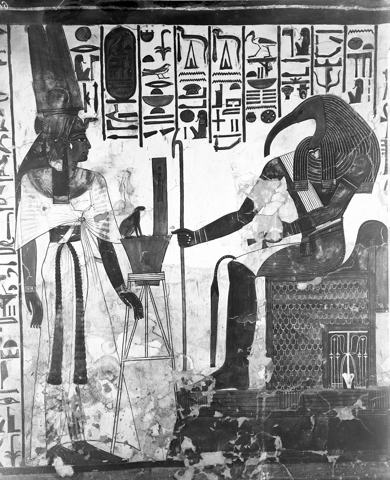
Ibis-headed lord of writing, reckoning and the moon — Thoth keeps the record at the judgment of the dead and settles the quarrels of the gods.
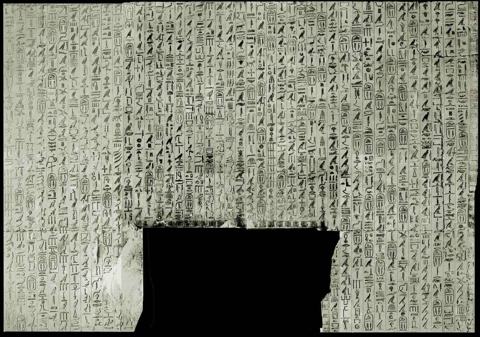
The oldest surviving body of religious literature on Earth — spells carved inside Old Kingdom pyramids to launch the king into the sky as a god.
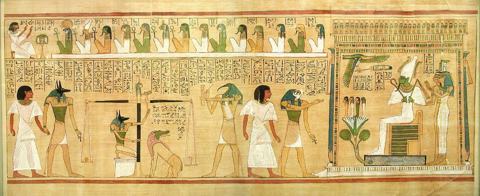
Egypt's judgment of the dead: the heart set on a scale against the feather of Maat, with oblivion waiting for whichever side tips wrong.
Devourer of the dead — the crocodile-lion-hippopotamus hybrid who crouched beside the scales and swallowed the hearts that failed the weighing.
The Egyptian underworld — the night country crossed by the sun in twelve hours and by every dead Egyptian hoping to come out reborn at dawn.
Also mentioned inThe Opening of the Mouth Ceremony
Sources & Further Reading
- 1.The Book of the Dead of Ani (Papyrus of Ani), British Museum EA10470, c. 1250 BCE.
- 2.Budge, E. A. Wallis, trans. The Book of the Dead: The Papyrus of Ani in the British Museum. London: British Museum, 1895.
- 3.Lepsius, Karl Richard. Das Todtenbuch der Ägypter nach dem hieroglyphischen Papyrus in Turin. Leipzig, 1842.
- 4.Faulkner, Raymond O., trans. The Egyptian Book of the Dead: The Book of Going Forth by Day. Ed. Ogden Goelet, Carol Andrews and James Wasserman. Chronicle Books, 1994.
- 5.Taylor, John H., ed. Journey through the Afterlife: Ancient Egyptian Book of the Dead. British Museum Press, 2010.
- 6.Scalf, Foy, ed. Book of the Dead: Becoming God in Ancient Egypt. Oriental Institute Museum Publication 39. University of Chicago, 2017.
Spot an error or have a source to suggest? Write to info@viseterna.com. We cite primary sources and modern scholarship, and we correct fast.