
Ma'at
Truth and cosmic order personified — the goddess whose feather weighed every dead Egyptian's heart, and the standard every king swore to uphold.
Relief of the goddess Maat, Tomb of Seti I, c. 1279 BC; photo Sailko, 2014, CC BY 3.0 · CC BY 3.0 · source
Truth, Order, and a Goddess Both
Maat is unusual among Egyptian concepts because it names a principle before it names a person. The word maat denotes truth, justice, correct measure, and the right order of the cosmos — the state the world is in when everything, from the flooding of the Nile to the verdict in a law case, is doing what it should 7,8. Egyptian religion personified that order as a goddess: a seated or standing woman, one ostrich feather set upright on her head, sometimes winged, most often shown small, in the palm of a king's outstretched hand, being offered up rather than approached 7. The image is the theology in miniature. Maat is not merely worshipped; she is presented, over and over, in a ritual gesture that runs through every reign for which evidence survives 5.
Her opposite is isfet — disorder, injustice, the chaos that presses in from outside the created world. Egyptian ethics rarely frames good and evil as competing moral choices in the abstract; it frames them as maat against isfet, an order that must be actively maintained against a chaos that never stops testing it 6,7. The frame is old. The king is already described as "one who is united with maat" in the Pyramid Texts, and by the Middle Kingdom the vindicated dead of the Coffin Texts are said to "live on maat" exactly as the sun god does — the earliest funerary literature Egypt produced already treats order as something the dead, not only the living, have to keep 1,2.
Daughter of the Sun
Maat is regularly called the daughter of Ra, born with creation itself and carried in the sun god's boat as he crosses the sky, sustaining him the way offerings sustain other gods — funerary and temple texts speak of Ra "living on maat" 7,8. The pairing runs deep: the sun's daily circuit is at once powered by maat and a proof of it, since a cosmos still obeying its order is a cosmos the sun can still cross correctly 6. Her frequent companion is Thoth, god of writing and measurement, and the two share a governing idea more than a marriage — order, and the record that order was kept 7.
What the King Owed Her
No Egyptian institution depended on Maat more directly than kingship. Temple reliefs from the Old Kingdom onward show the pharaoh kneeling to present a tiny image of the goddess to the greater gods, a rite Emily Teeter's study identifies as central to how kingship justified itself: the throne existed to keep maat in force, and returning her image to the gods was the proof that the job had been done 5. Royal titles say the same thing more bluntly. Kings styled themselves "beloved of Maat" or claimed to rule "in maat," and even Akhenaten, who dismantled almost every other convention of traditional religion at Amarna, kept this one, describing his reign as lived ankh em maat, "on maat" 6,7.
The Verdict in the Hall of the Two Maats
Maat's best-known appearance is also her most literal. Spell 125 of the Book of the Dead, the fullest surviving account of judgment after death, sets its scene in the "Hall of the Two Maats" and places a single feather — hers — on one pan of a balance, with the deceased's heart on the other 3. Anubis adjusts the scale, Thoth records the outcome, and the hybrid devourer Ammit waits beside it for any heart too heavy with wrongdoing to balance against the feather 3. Before the scale is even read, the dead person recites the "negative confession," a long list of offences against maat specifically — theft, violence, false witness, disturbing the order of the community — addressed one by one to forty-two divine assessors 3. A favourable verdict is recorded as being "true of voice," a phrase that ties moral standing directly to accurate speech, the linguistic form maat takes in a living mouth 3,8.
Wisdom Literature and Everyday Maat
Long before the New Kingdom funerary industry standardised that scene, Middle Kingdom wisdom literature already made maat the whole point of living well. The Instruction of Ptahhotep, a manual of practical ethics framed as an old vizier's advice to his son, returns again and again to maat as the one investment that never fails — more durable than wealth, and the thing a person's actual standing in the community is built from 4. This is Maat's least dramatic and most persistent form: not a scene in the underworld but a standard for a scribe's report, a boundary stone, a magistrate's ruling, and an ordinary transaction, all of which Egyptians understood as small acts of keeping — or breaking — the same order the gods maintained in the sky 4,6.
A Concept That Outlasted Its Temples
Maat had no major cult centre on the scale of Amun's Karnak or Ra's Heliopolis; she was worshipped everywhere kingship and law were exercised, because that was her actual domain 7. Priests bore the title "prophet of Maat," judges could be described as her priests by function, and viziers wore a small image of her as a badge of office well into the New Kingdom 5,7. Assmann's study of the concept treats this diffusion as the point rather than a gap in the evidence: maat is what Egyptian civilisation called its own coherence, and it needed no single building because it was claimed to run through every building, every verdict, and every reign at once 6.
Continue Exploring
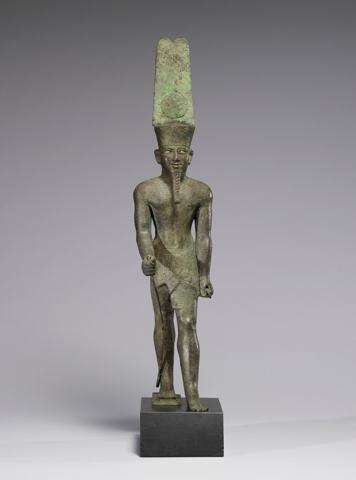
The imperial god of the New Kingdom — a once-minor Theban god whose name means "hidden," fused with Ra until Akhenaten tried to erase him from Egypt.
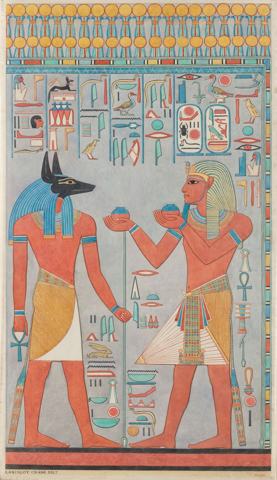
Guardian of the dead — the black jackal god who embalmed Osiris, watched over the necropolis, and weighed the heart against the feather of truth.
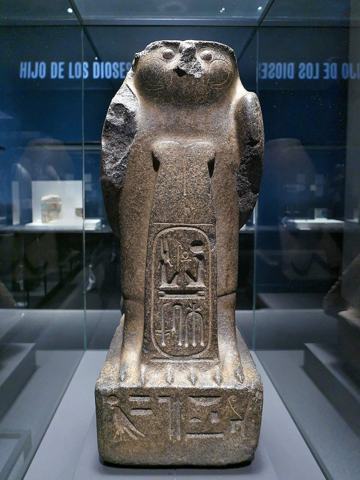
The sun itself as a god — Ra sails the sky by day, fights the serpent of chaos by night, and is reborn on the horizon every dawn.
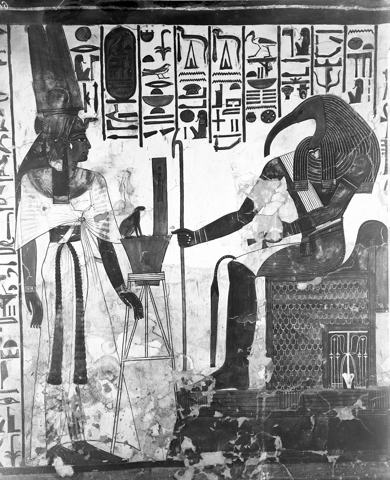
Ibis-headed lord of writing, reckoning and the moon — Thoth keeps the record at the judgment of the dead and settles the quarrels of the gods.
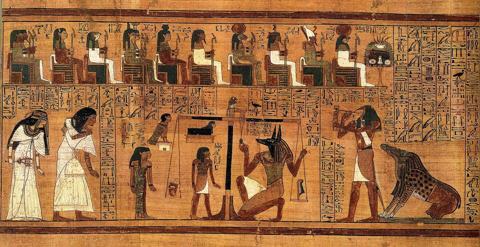
Devourer of the dead — the crocodile-lion-hippopotamus hybrid who crouched beside the scales and swallowed the hearts that failed the weighing.
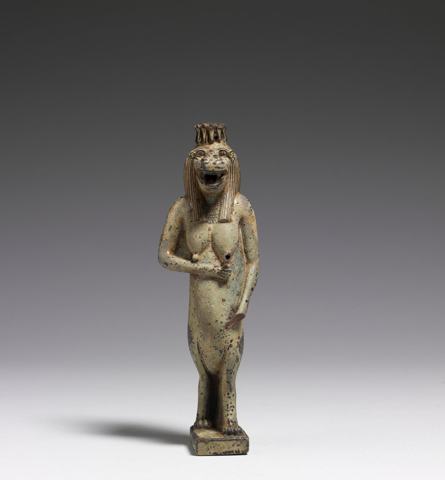
A hippopotamus standing upright on lion's legs with a crocodile down her back — Egypt's oddest goddess, and its most trusted guardian of pregnant women.
Sources & Further Reading
- 1.Pyramid Texts (Old Kingdom, c. 2400-2300 BCE).
- 2.Coffin Texts (Middle Kingdom, c. 2100-1800 BCE).
- 3.The Egyptian Book of the Dead (Book of Going Forth by Day), New Kingdom -- esp. Spell 125.
- 4.The Instruction of Ptahhotep (Middle Kingdom wisdom text, Prisse Papyrus).
- 5.Teeter, Emily. The Presentation of Maat: Ritual and Legitimacy in Ancient Egypt. Oriental Institute of the University of Chicago (SAOC 57), 1997.
- 6.Assmann, Jan. Ma'at: Gerechtigkeit und Unsterblichkeit im Alten Aegypten. C.H. Beck, 1990.
- 7.Wilkinson, Richard H. The Complete Gods and Goddesses of Ancient Egypt. Thames & Hudson, 2003.
- 8.Pinch, Geraldine. Egyptian Mythology: A Guide to the Gods, Goddesses, and Traditions of Ancient Egypt. Oxford University Press, 2002.
Spot an error or have a source to suggest? Write to info@viseterna.com. We cite primary sources and modern scholarship, and we correct fast.