
Tlazolteotl
The Aztec goddess of lust and vice who is also the goddess of confession — the one being who can absorb a person's wrongdoing and leave them clean.
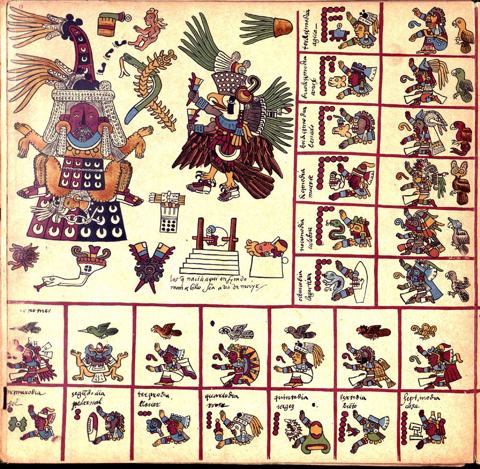
Tlazolteotl giving birth to Centeotl, Codex Borbonicus, page 13, early 16th century · Public domain · source
Eater of Filth
Tlazolteotl, "Filth Deity," is more fully titled Tlaelcuani, "eater of ordure," a name that sounds like an insult and was not meant as one 1,5. Her Nahuatl epithets describe her purifying office directly: she eats what a person has done wrong, taking it into herself the way a body takes in food, and leaves the penitent clean 1,5. Her worship reached central Mexico from the Gulf Coast Huastec region, where she was known as Ixcuina, "Cotton Woman" — an origin Sahagun's informants recorded plainly rather than disguising as native Mexica invention 1,4.
She governs sex, desire, adultery, and the vices that flow from them, but the same domain that makes her dangerous makes her useful: a goddess who inspires transgression is also the one equipped to absolve it, and Mexica religion did not treat that as a contradiction so much as a job description 1,6.
The Four Sisters
Under the name Ixcuina she was sometimes described not as one goddess but as four sisters of ascending age — Tiacapan the eldest, Teicu, Tlaco, and Xocotzin the youngest — a quadripartite group some sources call the tlazolteteo collectively 1,4. Sullivan's study of the group reads the age-graded sisters as tracking a woman's whole reproductive life in a single figure, from the vigor of youth through the authority, and the danger, Mexica culture assigned to an older woman who had already borne children 4.
That same cluster is Tlazolteotl's link to spinning and weaving, the two central crafts of Mexica women's domestic and ritual labor, and to the raw cotton the Huastecs who first worshipped her as Ixcuina supplied to central Mexico as trade goods 4,6. A goddess who processes raw, tangled fiber into ordered thread was a natural patroness for a religious system that already imagined moral filth as something to be carded out and cleaned away.
Confession to the Priest of Tlazolteotl
The clearest evidence of what she meant in practice is the confession rite Sahagun's informants describe in Book 1 of the Florentine Codex. A person burdened by serious transgression, usually sexual, could approach a priest trained to serve Tlazolteotl, the tlapouhqui, who consulted the day-count to fix an auspicious date and then heard the confession in full and in private 1,5. Tlazolteotl herself was believed to absorb the offense the way her name promised, and the penitent emerged genuinely cleansed rather than merely forgiven 1,5.
The mercy had a hard limit built into it: most accounts agree it could be claimed only once in a lifetime, which meant confession was a resource generally saved for later years, when the accumulated weight of a whole life's conduct, rather than any single incident, was what needed lifting 1,6. Read and Gonzalez note this made the rite less like routine religious practice and more like a last recourse, used with the caution a person might apply to any tool that only works once 6.
Mother of the Maize
Sahagun's informants also name her as a parent: by the minor solar deity Piltzintecuhtli she bore Centeotl, the young maize god, a parentage the Florentine Codex states directly even though other colonial sources give Centeotl different parents entirely 1,7. The pairing makes a kind of sense within Mexica thought, where fertility of a field and fertility of a body ran through a shared set of goddesses regardless of which appetite was actually in question 5,7.
That birth is exactly what the Codex Borbonicus paints on the page reproduced as this entry's image: Tlazolteotl squatting in the act of labor, wearing the flayed skin of a sacrificial victim, delivering Centeotl into the world 2. The flayed skin ties her directly to the cult of Xipe Totec and to Ochpaniztli, the "sweeping" harvest festival at which a woman impersonating Tlazolteotl was ritually sacrificed and flayed, her skin worn afterward by a priest in the same renewal logic that governs Xipe's own rites 1,5.
Patroness of the Thirteenth Trecena
In the 260-day tonalpohualli, Tlazolteotl presides over the thirteenth trecena, the block of days beginning 1 Earthquake, paired there with the jaguar as her associated day-sign animal — a beast Mexica symbolism generally linked to night, earth, and the unregulated appetite her own cult managed rather than denied 3,6. Codex Vaticanus B, one of the surviving pre-Columbian divinatory books, shows her presiding over this stretch of the calendar in the same birth-giving pose repeated across her iconography, reinforcing that her authority over sexual transgression and her authority over fertility were, for the Mexica, a single office rather than two 3,5.
She belongs, finally, to the loose cluster of Mexica earth and mother goddesses whose names and attributes overlap so heavily that colonial writers used them almost interchangeably — Coatlicue, Toci, Tonantzin, Tlazolteotl herself — figures modern scholarship generally treats as aspects of one shared complex rather than fully separate persons 5. The Florentine Codex, the single richest surviving source for how that complex was described to Spanish friars in the first place, remains the starting point for untangling her from her sisters 1.
Continue Exploring
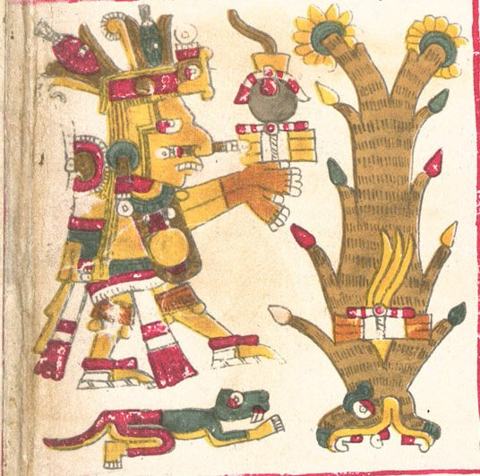
The Aztec maize god, born of two rival colonial traditions and honored at both the spring planting and the harvest festival that bracket his short green life.
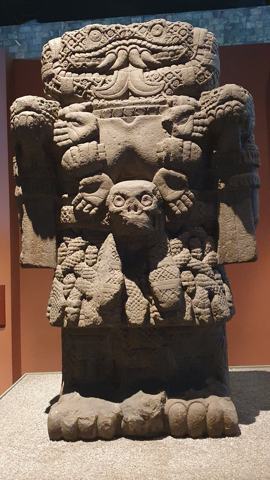
She of the Serpent Skirt — the Mexica earth mother who conceived Huitzilopochtli from a ball of feathers, and the colossal monolith that carries her name.
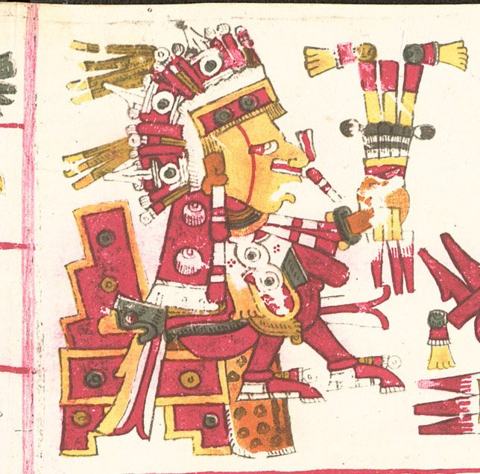
Our Lord the Flayed One — the Mesoamerican god of spring, seed and renewal, whose priests wore the skins of sacrificial victims for twenty days.
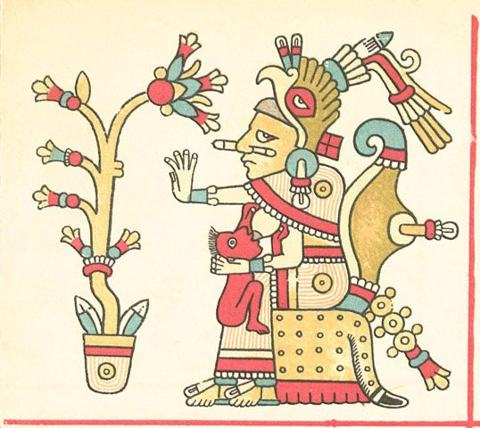
The Aztec goddess of beauty, love, and the household arts — patroness of weavers and courtesans, married to Tlaloc until Tezcatlipoca took her for himself.
The 260-day sacred count that set every Aztec's birth-fate, built from 13 numbers and 20 day-signs, inherited from far older Mesoamerican tradition.
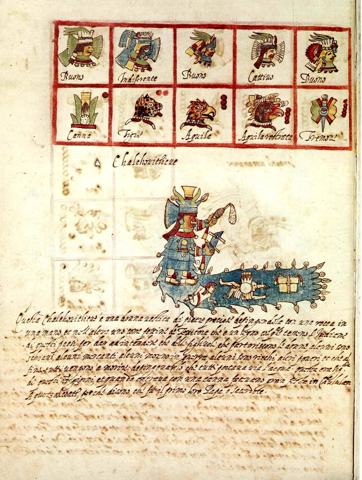
Tlaloc's consort and goddess of lakes and rivers, who ruled the Fourth Sun that ended in flood, and whom midwives invoked to bathe every newborn child.
Sources & Further Reading
- 1.Bernardino de Sahagun, Florentine Codex — General History of the Things of New Spain (c. 1547-1579), Book 1.
- 2.Codex Borbonicus (pre-Columbian / early colonial ritual manuscript).
- 3.Codex Vaticanus B (pre-Columbian ritual manuscript).
- 4.Sullivan, Thelma D. 'Tlazolteotl-Ixcuina: The Great Spinner and Weaver', in The Art and Iconography of Late Post-Classic Central Mexico, ed. Elizabeth Hill Boone. Dumbarton Oaks Research Library and Collection, 1982.
- 5.Miller, Mary & Karl Taube. The Gods and Symbols of Ancient Mexico and the Maya. Thames & Hudson, 1993.
- 6.Read, Kay Almere & Jason J. Gonzalez. Handbook of Mesoamerican Mythology. ABC-CLIO, 2000.
- 7.Taube, Karl. Aztec and Maya Myths. British Museum Press / University of Texas Press, 1993.
Spot an error or have a source to suggest? Write to info@viseterna.com. We cite primary sources and modern scholarship, and we correct fast.