
Centeotl (Aztec Maize God)
The Aztec maize god, born of two rival colonial traditions and honored at both the spring planting and the harvest festival that bracket his short green life.
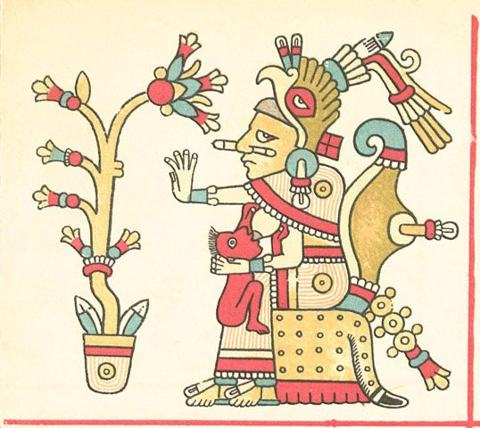
Centeotl, Codex Borgia, pre-Conquest central Mexico (Biblioteca Apostolica Vaticana) · Public domain · source
A Name for the Dried Ear
Centeotl, sometimes spelled Cinteotl, joins cintli, a dried ear of maize still on the cob, to teotl, deity — "Maize Ear God," the personification of the plant that fed central Mexico 5,7. He is generally shown as a youthful male figure, his body painted yellow like ripe corn, with a distinctive black line running from eyebrow to jaw and an ear of maize rising from his headdress 3,5.
That "generally" covers real scholarly disagreement. Centeotl's gender is not treated as settled in the literature: several specialists argue the young maize god functions, in some contexts, as a male counterpart or later development of an older female maize deity, Chicomecoatl, "Seven Serpent," whose own worship is independently well attested and never in doubt as female 5,7. The two are sometimes worshipped as a pair and sometimes described as aspects of one figure, and the sources do not resolve which relationship is correct 5.
Born of Filth, or Born of Flowers
Colonial sources disagree even about his parents. Sahagun's informants name his mother as Tlazolteotl, goddess of filth, vice, and confession, and his father as the minor solar deity Piltzintecuhtli — an unglamorous origin for a god whose whole purpose was nourishment 1,7. Other colonial material instead gives Piltzintecuhtli a different consort, Xochiquetzal, goddess of beauty and flowers, as Centeotl's mother, a version this Codex's own Xochiquetzal entry records as an alternative tradition rather than a settled genealogy 2,5.
Neither account was written to agree with the other, and nothing in the surviving record breaks the tie. What both traditions share matters more than the specific names: Centeotl is fathered by a solar figure and born of a goddess who governs some other form of fertility or appetite — sex and confession in one telling, beauty and desire in the other — which fits a broader Mexica habit of routing every kind of growth, vegetable or human, through the same small set of goddesses 5,7.
The Sweeping of Ochpaniztli
Centeotl's public cult was tied closely to the agricultural calendar. At Ochpaniztli, the "sweeping" festival held around the maize harvest, ritual cleaning of streets and temples accompanied ceremonies dedicated jointly to the earth-mother complex and to the harvest itself; colonial accounts describe Nahua women dancing in the maize fields as part of the observance, before a formal procession carried the first ears of new corn into the city 1,6. Sahagun's informants record the ceremony as one of the year's most elaborate, layering rites owed to Tlazolteotl and to Toci onto the same festival that closed out the growing season 1,6.
Green and Growing: Hueytozoztli
A second festival, Hueytozoztli, fell earlier in the year and belonged to the young, tender crop rather than the finished harvest. Households brought green maize stalks to the temples for blessing before replanting some of them in the fields, a rite meant to carry sanctified growth back into the earth at the exact moment the crop most needed it 1,6. Centeotl presided over this earlier, more fragile stage of the plant's life the way Ochpaniztli's ceremonies belonged to its completed one, giving the god two festivals that between them bracket the entire agricultural year 6,7.
Centeotl Among the Maize Gods
In the 260-day tonalpohualli, Centeotl is closely tied to the day-sign Xochitl, "Flower," and to the trecena it opens, reinforcing a connection to Xochiquetzal's own flower symbolism regardless of which parentage tradition a given source follows 4,5. He belongs to a wider Mesoamerican family of crop deities that also includes figures like the maguey goddess Mayahuel, each patron tied to one staple plant in an agricultural religion that gave nearly every major crop its own god or goddess to be periodically fed, thanked, and, in the maize deities' case specifically, ritually reenacted as dying and returning with the growing season 5,7.
Continue Exploring
The Aztec goddess of beauty, love, and the household arts — patroness of weavers and courtesans, married to Tlaloc until Tezcatlipoca took her for himself.
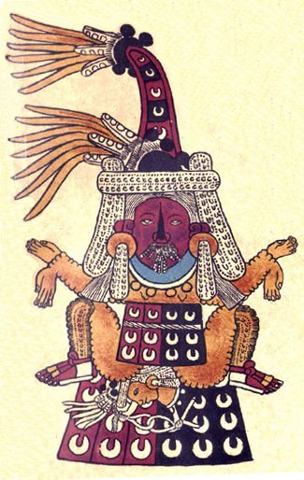
The Aztec goddess of lust and vice who is also the goddess of confession — the one being who can absorb a person's wrongdoing and leave them clean.
The goddess torn apart and buried to grow the first maguey plant — mother of pulque and of the four hundred rabbit gods of drunkenness.
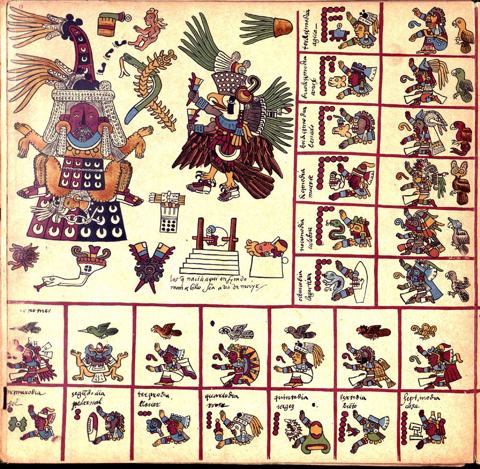
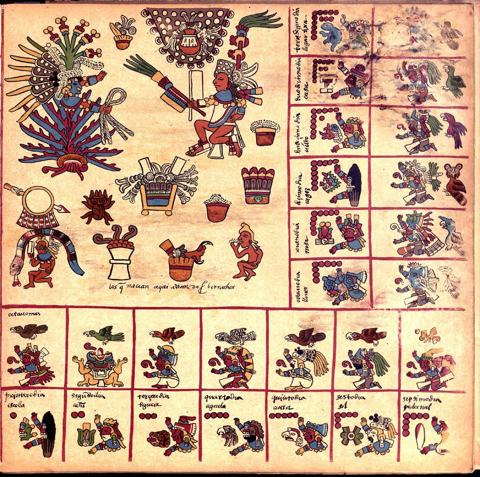
The 260-day sacred count that set every Aztec's birth-fate, built from 13 numbers and 20 day-signs, inherited from far older Mesoamerican tradition.
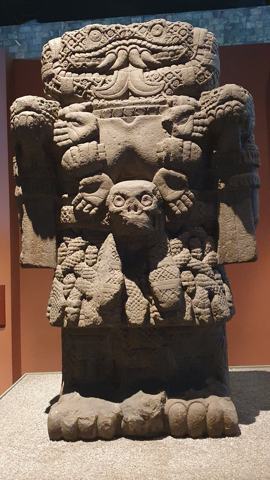
She of the Serpent Skirt — the Mexica earth mother who conceived Huitzilopochtli from a ball of feathers, and the colossal monolith that carries her name.
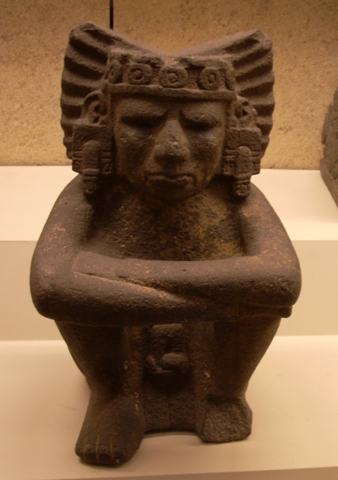
The Aztec fire god of the hearth and the ruling year, whose New Fire ceremony every 52 years kept the world from ending in darkness.
Sources & Further Reading
- 1.Bernardino de Sahagun, Florentine Codex — General History of the Things of New Spain (c. 1547-1579), Books 1 and 2.
- 2.Historia de los Mexicanos por sus pinturas (16th century).
- 3.Codex Borgia (pre-Columbian ritual manuscript).
- 4.Codex Fejervary-Mayer (pre-Columbian ritual manuscript).
- 5.Miller, Mary & Karl Taube. The Gods and Symbols of Ancient Mexico and the Maya. Thames & Hudson, 1993.
- 6.Read, Kay Almere & Jason J. Gonzalez. Handbook of Mesoamerican Mythology. ABC-CLIO, 2000.
- 7.Taube, Karl. Aztec and Maya Myths. British Museum Press / University of Texas Press, 1993.
Spot an error or have a source to suggest? Write to info@viseterna.com. We cite primary sources and modern scholarship, and we correct fast.