
The New Fire Ceremony
The Aztec rite that closed every 52-year cycle by dousing every fire in the realm and rekindling the world on a sacrificed captive's chest.
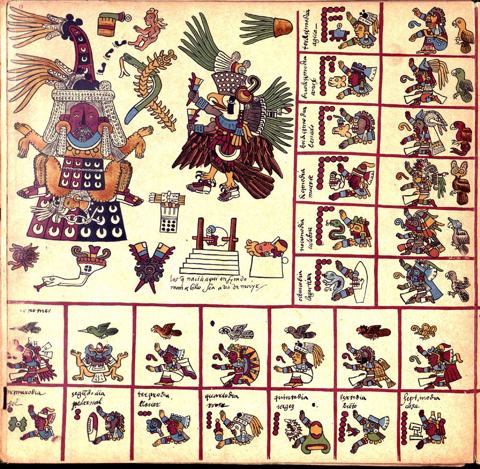
Codex Borbonicus, page 34, the binding of the years, Mexica, early 16th century (facsimile edition, 1899) · Public domain · source
Binding the Years
The New Fire Ceremony — Toxiuhmolpilia, "our years are bound," from xiuhmolpilli, "the binding of the years" — closed out the 52-year span in which the two Aztec calendars, the 260-day tonalpohualli and the 365-day solar count, ran their combined 18,980 days and returned to the same starting pair 1,6. Nahuatl speakers called that span a "century," and it was the largest unit of time the calendar recognized: no day-sign and year-bearer combination repeated within it, so its close was a genuine, once-in-a-lifetime reset rather than an ordinary new year 6. The physical emblem of the completed cycle was a xiuhmolpilli, a bundle of fifty-two reeds bound together, the same image the priests carry up the stairway in the Codex Borbonicus's rendering of the rite 3.
Putting Out Every Fire
Sahagun's account in Book 7 of the Florentine Codex describes a citywide shutdown in the days before the ceremony. Every hearth fire in the domain was extinguished, temple fires included, and households threw out their old cooking stones, worn mats, and broken household goods to begin the new cycle with nothing carried over from the old one 1. Pregnant women were considered especially exposed: fear held that if the world failed to be renewed, women who were pregnant at that moment would turn into monsters, and some were shut into granaries and masked with maguey leaves for the night. Children were kept awake and pinched periodically, since a child who slept through the crisis was thought to risk waking as a mouse 1. None of this reads as decorative pessimism — it is a population acting as though its world's continuation was genuinely, not ceremonially, in doubt.
The Watch on the Hill of the Star
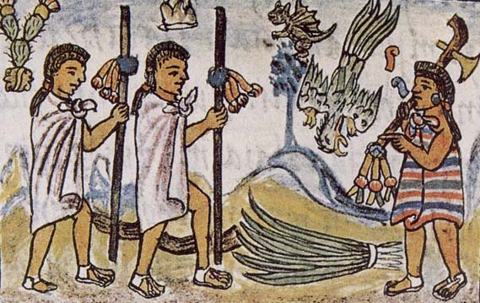
The fire itself was rekindled at Huixachtlan, the "Hill of the Star" (also called Citlaltepec), an extinct volcanic peak on the eastern shore of Lake Texcoco near Colhuacan, chosen because it stood visible across most of the Basin of Mexico so that its light could be seen and relayed outward the moment it caught 1,5. Priests in the regalia of various gods climbed at nightfall and waited on the star cluster the Nahuatl sources call Tianquiztli — the Pleiades — to cross the zenith at midnight; had it stopped or failed to reach that point, tradition held that the sky would fall and tzitzimime, star-demons, would descend to devour what remained of humanity 1,5. When the stars kept moving, a fire-drill was set turning on the chest of a war captive laid out for the purpose, and the new flame was struck at the instant his heart was cut out, fed first with wood and then, symbolically, with his own body 1,2. From that single blaze, runners carried torches back across the water and out along the causeways to relight the temple fires of Tenochtitlan and, in turn, every household hearth in the region, while people at home drew blood from their own ears and flicked it toward the fire's direction in thanks 1,2.
1507: The Last Binding
The final New Fire Ceremony performed under Mexica rule fell in the year 2-Reed, 1507, during the reign of Motecuhzoma Xocoyotzin (Moctezuma II) — the last such rite completed before the Spanish arrived in 1519 and before the empire that had organized it collapsed in 1521 1,2. The next binding was due in 1559, deep into the colonial period, and it never happened in the old form. Excavated caches of New Fire paraphernalia — bundles of reeds, incised sacrificial implements, and ritually smashed household ceramics matching Sahagun's account of discarded old goods — have been recovered at sites beyond Tenochtitlan itself, corroborating that the rite was performed at this kind of scale across Aztec-period central Mexico rather than being a purely Tenochca invention of the sources 4.
Reading the Fear Seriously
The New Fire Ceremony sits directly beside the myth Central Mexican priests told about their own age: this is the fifth sun, the Five Suns tradition holds, and it is fated to end, like the four before it, in catastrophe — in this case earthquake, since the age's calendar name is 4-Movement. The 52-year rite functioned as a periodic rehearsal of that ending, staged so that the world could be seen to survive it. Boone's study of the divinatory almanacs situates the New Fire within a broader Mexica preoccupation with reading and managing time as an active danger rather than a neutral backdrop, and Aveni's survey of Mesoamerican astronomy treats the precise stellar timing at Huixachtlan as evidence of real, sustained naked-eye observation built into state religion 6,7. There was also a political layer that the sources note without much comment: for one night, every fire in the domain depended on a blaze lit at a spot the Mexica state controlled, and every household that relit its hearth from a relayed torch had, in effect, renewed its place inside Tenochtitlan's order along with its year count 5.
After 1507
No further authentic pre-conquest binding took place, since the empire that organized it fell fourteen years after the 1507 rite 1,2. The ceremony survives today only through re-enactment: Mexica-identity dance and cultural groups in modern Mexico, and neo-Mexica revivalist movements more broadly, periodically stage a "Fuego Nuevo" as heritage performance and civic symbolism, work that is a modern reconstruction drawing on the colonial-era descriptions rather than an unbroken continuation of the rite Sahagun and Duran recorded 1,2.
Continue Exploring
The 260-day sacred count that set every Aztec's birth-fate, built from 13 numbers and 20 day-signs, inherited from far older Mesoamerican tradition.
The Aztec myth of four ruined world-ages before this one, each ended by its own catastrophe, in an order and cast of gods the sources don't agree on.
The Aztec fire god of the hearth and the ruling year, whose New Fire ceremony every 52 years kept the world from ending in darkness.
The 16th-century Nahuatl-Spanish encyclopedia of Aztec life and gods, compiled by a friar with Nahua scholars — the single richest source on Mexica myth.
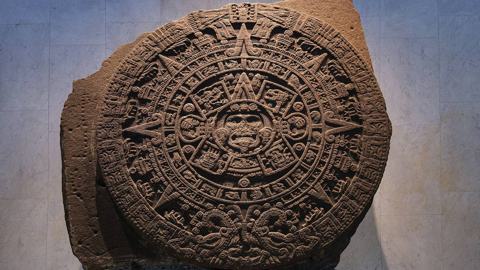
A 24-ton basalt disc unearthed in 1790 under Mexico City, long called the Aztec Calendar even though it was never used to track a single day.
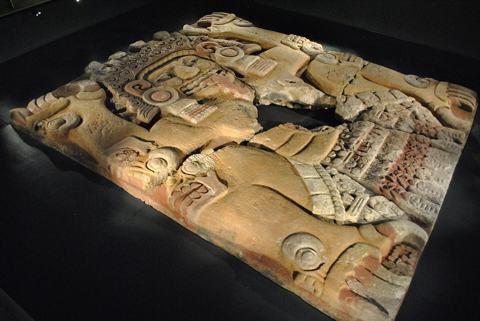
The crocodilian earth deity torn in two to make sky and ground — and the twelve-ton painted monolith of her unearthed at the Templo Mayor in 2006.
Sources & Further Reading
- 1.Bernardino de Sahagun, Florentine Codex — General History of the Things of New Spain (c. 1547-1579), Book 7.
- 2.Diego Duran, Book of the Gods and Rites and The Ancient Calendar (c. 1574-1579).
- 3.Codex Borbonicus. Pictorial manuscript, Mexica, early 16th century. Bibliotheque de l'Assemblee Nationale, Paris.
- 4.Elson, Christina M. & Michael E. Smith. "Archaeological Deposits from the Aztec New Fire Ceremony." Ancient Mesoamerica 12 (2001).
- 5.Miller, Mary & Karl Taube. The Gods and Symbols of Ancient Mexico and the Maya. Thames & Hudson, 1993.
- 6.Aveni, Anthony F. Skywatchers of Ancient Mexico. University of Texas Press, 1980.
- 7.Boone, Elizabeth Hill. Cycles of Time and Meaning in the Mexican Books of Fate. University of Texas Press, 2007.
Spot an error or have a source to suggest? Write to info@viseterna.com. We cite primary sources and modern scholarship, and we correct fast.