
The Aztec Sun Stone
A 24-ton basalt disc unearthed in 1790 under Mexico City, long called the Aztec Calendar even though it was never used to track a single day.
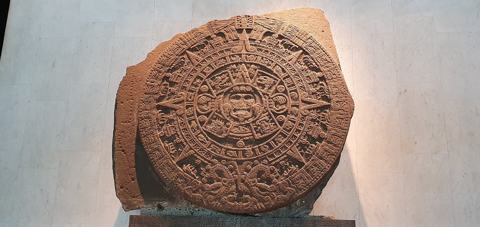
Aztec Sun Stone (Piedra del Sol), Mexica, late 15th to early 16th century, Museo Nacional de Antropologia, Mexico City; photograph by Sasha Isachenko, 2012 · CC BY-SA 3.0 · source
Found Under the Plaza
On 17 December 1790, workers leveling the main plaza of Mexico City for repaving struck a massive carved basalt disc, roughly 3.6 meters across and weighing an estimated 24 tons, buried a short distance from where the Coatlicue statue had turned up months earlier the same year 1,3. Both finds came from what had been the ceremonial heart of Tenochtitlan, and the disc, carved on one face only, with its back left rough, was almost certainly made to stand upright or be mounted rather than to lie flat as a tabletop 3,4. Most specialists date it to the reign of Axayacatl or Moctezuma II, in the final decades before the conquest 4.
Leon y Gama's Calendar
The stone owes its popular name to Antonio de Leon y Gama, a self-taught Mexican astronomer who published the first serious study of it in 1792 and argued it had functioned as a working solar instrument, a kind of monumental sundial the Mexica used to track solstices and mark the passage of days 1. His reading, and the name Piedra del Sol, "Sun Stone," stuck, and the disc has been reproduced on Mexican coins, textbooks, and tourist souvenirs ever since as a symbol of Aztec science 1,3. Modern specialists no longer accept the working-instrument reading. Richard Townsend's study of Mexica monumental art treats the stone instead as a cosmological monument meant to be looked at and read symbolically rather than consulted for a date, likely displayed upright in the Templo Mayor precinct as a freestanding statement of Mexica rule over time itself 2. No day on it could actually have been tracked against the real calendar in use, the interlocking Tonalpohualli and solar year, which the Mexica counted by entirely separate means 2,5.
What Is Carved On It
At the center is a face framed by the glyph 4 Movement, Nahui Ollin, the calendar name of the present cosmic age, flanked by clawed hands gripping human hearts 4,5. The next ring out carries the glyphs of the four prior suns whose destruction the present age followed, the same sequence told in this Codex's Five Suns entry 4,5. Beyond that runs a full ring of the twenty day-signs of the tonalpohualli in order, then bands of turquoise-style step frets and stars, and finally, forming the entire outer rim, the bodies of two fire serpents, xiuhcoatl, meeting tail to tail at the bottom where their gaping jaws disgorge two small figures usually read as deities associated with the stone's dedication 4,5. Every element on the disc, in other words, is a date, a cosmic era, or a ritual reference, arranged as a unified cosmogram rather than as a functioning instrument 2,4.
A Face Still in Dispute
Whose face occupies the center is not settled. The traditional identification, consistent with the popular name, is Tonatiuh, the sun deity of the present age 3,4. A substantial body of scholarship instead reads the face as Tlaltecuhtli, the earth-lord frequently shown with a wide, gaping mouth and, in some depictions, a stone sacrificial knife for a tongue, a detail some specialists see echoed here 4,5. Both readings fit the stone's evident purpose as a monument to sacrifice and cosmic renewal, and Mesoamerican specialists have not converged on one over the other; Matos Moctezuma and Solis's exhibition catalogue for the Royal Academy of Arts presents the identification as an open scholarly question rather than a settled fact 3.
From the Cathedral Wall to the Museum Floor
After its 1790 discovery, a short distance from the buried ruins of the Templo Mayor, the stone was displayed briefly, then set into the base of the west tower of the Metropolitan Cathedral, where it remained visible to the public, weathering in the open air, for most of the nineteenth century 1,3. It was later moved into the National Museum and today sits in the central hall of the Museo Nacional de Antropologia, opened in 1964, where it is one of the single most photographed objects in Mexican archaeology 3.
Instrument of National Identity
Pasztory's survey of Aztec art situates the stone's afterlife as being nearly as significant as its original meaning: adopted since the nineteenth century as shorthand for Mexican civilization itself, printed and sculpted so widely that many people encounter the Sun Stone's image years before they learn anything about the Mexica state that carved it, or the sacrificial cosmology it actually depicts 4. Nicholson's survey of the wider religious sources warns against reading the stone in isolation, since its imagery only fully makes sense set against the creation narratives recorded independently in Nahuatl texts, imagery the stone compresses into carved stone rather than narrates 6.
Continue Exploring
The Aztec myth of four ruined world-ages before this one, each ended by its own catastrophe, in an order and cast of gods the sources don't agree on.
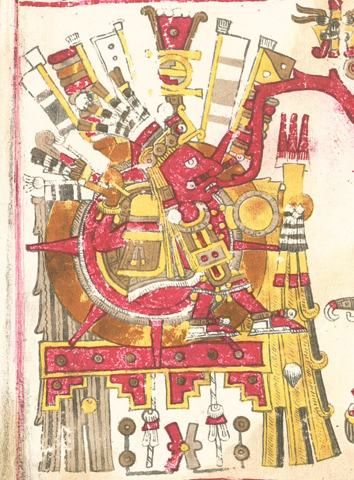
The Aztec sun of the present age, born from a beggar-god's leap into fire and kept moving only by the daily payment of human hearts and blood.
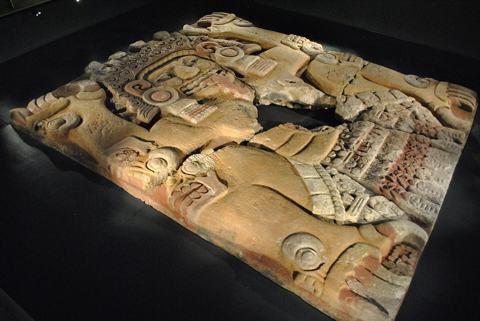
The crocodilian earth deity torn in two to make sky and ground — and the twelve-ton painted monolith of her unearthed at the Templo Mayor in 2006.
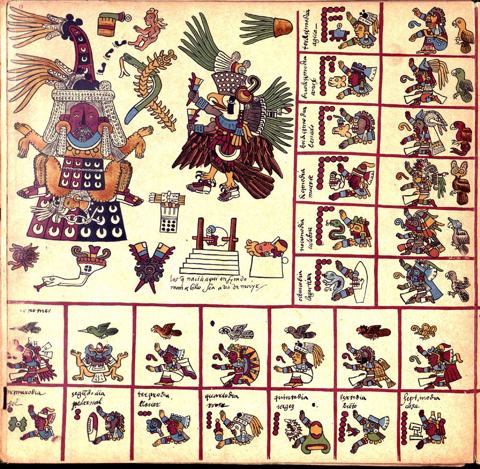
The 260-day sacred count that set every Aztec's birth-fate, built from 13 numbers and 20 day-signs, inherited from far older Mesoamerican tradition.
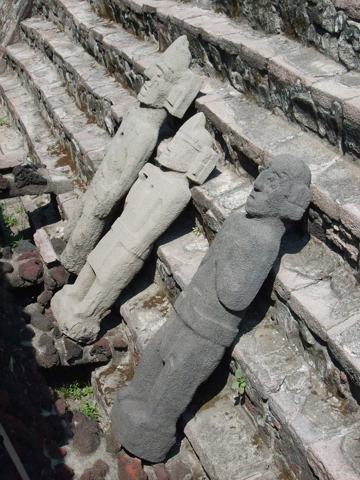
Tenochtitlan's twin pyramid to Huitzilopochtli and Tlaloc, demolished in 1521 and lost until 1978, when electrical workers struck the Coyolxauhqui stone.
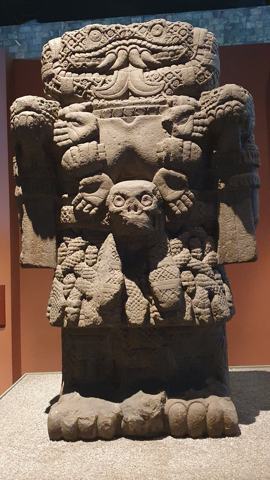
She of the Serpent Skirt — the Mexica earth mother who conceived Huitzilopochtli from a ball of feathers, and the colossal monolith that carries her name.
Sources & Further Reading
- 1.Leon y Gama, Antonio de. Descripcion historica y cronologica de las dos piedras que con ocasion del nuevo empedrado que se esta formando en la plaza principal de Mexico se hallaron en ella el ano de 1790. Mexico, 1792.
- 2.Townsend, Richard F. State and Cosmos in the Art of Tenochtitlan. Dumbarton Oaks, 1979.
- 3.Matos Moctezuma, Eduardo & Felipe Solis Olguin, eds. Aztecs. Royal Academy of Arts, London, 2002.
- 4.Pasztory, Esther. Aztec Art. Harry N. Abrams, 1983.
- 5.Miller, Mary & Karl Taube. The Gods and Symbols of Ancient Mexico and the Maya. Thames & Hudson, 1993.
- 6.Nicholson, H. B. 'Religion in Pre-Hispanic Central Mexico.' Handbook of Middle American Indians, vol. 10. University of Texas Press, 1971.
Spot an error or have a source to suggest? Write to info@viseterna.com. We cite primary sources and modern scholarship, and we correct fast.