
Xiuhtecuhtli (Aztec Fire Lord)
The Aztec fire god of the hearth and the ruling year, whose New Fire ceremony every 52 years kept the world from ending in darkness.
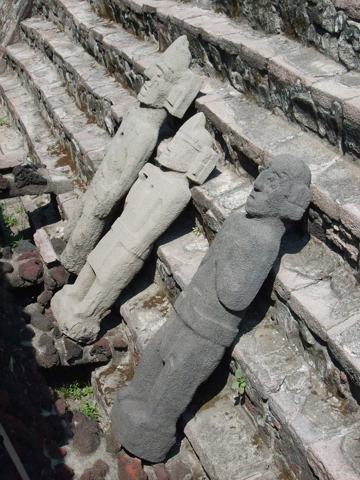
Seated figure of Xiuhtecuhtli, Mexica, 1325-1521 CE (British Museum) · CC BY-SA 3.0 · source
Turquoise Lord, Old God
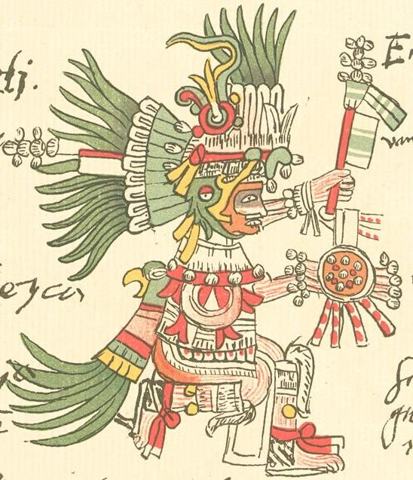
Xiuhtecuhtli joins the Nahuatl xihuitl — a word that means turquoise, year, and fire all at once — to tecuhtli, lord, and the deity is addressed under both readings depending on context: Turquoise Lord and Fire Lord together 4,5. Sahagun's informants record a cluster of further names for him: Ixcozauhqui, "yellow-faced," Cuezaltzin, "flame," and Totahtzin, "our father" 1,4.
Colonial sources frequently equate him with Huehueteotl, "the Old God," a fire deity attested archaeologically many centuries before the Mexica and usually sculpted as a bent, wrinkled ancient carrying a brazier on his head 4,5. Xiuhtecuhtli himself is not consistently shown old — Mexica art gives him the unlined face of a vigorous ruler as often as an elder's — and Nicholson treats the pairing as a fusion of an ancient, widespread Mesoamerican fire cult with a specifically Mexica court deity, rather than two names for one unchanging figure 5.
Fire at the Center of the House
Every household kept a hearth fire, and that fire was Xiuhtecuhtli's altar whether or not the family owned an image of him 1,6. Sahagun's informants describe a newborn's naming rites including a moment at the hearth, the infant briefly presented to the flame — a domestic counterpart, performed in every home, to the state cult conducted for the same god at the city's great temples 1,6.
That domestic role scaled up at the level of the palace. Xiuhtecuhtli was patron of the tlatoani himself, whose accession rites included offerings at his shrine, and the pochteca, the long-distance merchants whose expeditions depended on fire for cooking, light, and warmth on dangerous roads, kept him as a particular patron of their own 4,6.
The Binding of the Years
The triple sense of xihuitl was not an accident the Mexica ignored. Their word for the solar year, their word for turquoise, and their word for fire were deliberately the same sound, and Xiuhtecuhtli stood at the intersection of all three: lord of the year's turning, of the blue-green stone that marked rulership, and of the flame that measured time by consuming itself 4,5. The clearest expression of that role is the xiuhmolpilli, "binding of the years," a bundle of 52 reed stalks tied together to mark the close of a full calendar round, the point where the 260-day tonalpohualli and the 365-day solar year returned together to their shared starting point 4,6.
The New Fire Ceremony
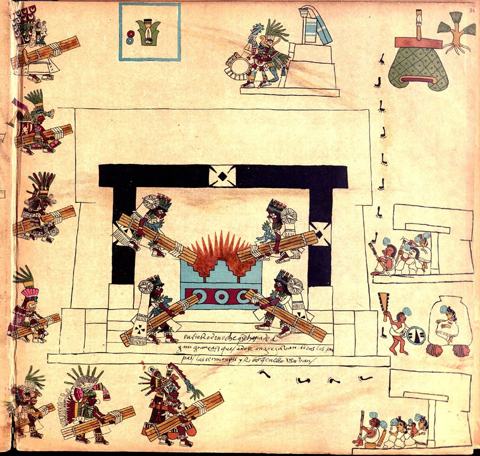
That 52-year turning was the most anxious moment on the Mexica calendar, and Xiuhtecuhtli stood at its center. On the final night of the New Fire Ceremony, priests extinguished every fire in the valley, smashed household goods, and climbed the Hill of the Star outside the city to watch a particular star group cross the night's meridian — proof, if it happened, that the world would continue rather than end in permanent darkness, a rite painted in full on a page of the Codex Borbonicus 1,3,7. At the moment of the crossing, priests kindled a new flame by friction on the open chest of a sacrificial victim, and runners carried it by torch to the Great Temple and outward to every hearth in the empire, relighting an entire civilization from a single source in Xiuhtecuhtli's name 1,7. Matos Moctezuma reads the rite as making explicit what the ordinary household hearth always implied: that time itself was a gift this god could, in principle, withhold 7.
Turquoise and Serpents
Xiuhtecuhtli's regalia in art is consistent and recognizable: a turquoise mosaic diadem called the xiuhuitzolli, a butterfly-shaped pectoral, fire-serpent ear ornaments, and the xiuhcoatl, the fire serpent, as his animal double and named weapon 2,4. That same fire serpent reappears as the weapon Huitzilopochtli seizes to strike down Coyolxauhqui at the instant of his birth, and Miller and Taube read the borrowing as pointed: the younger war god arms himself, for his first and defining act, with the fire lord's own signature weapon 4.
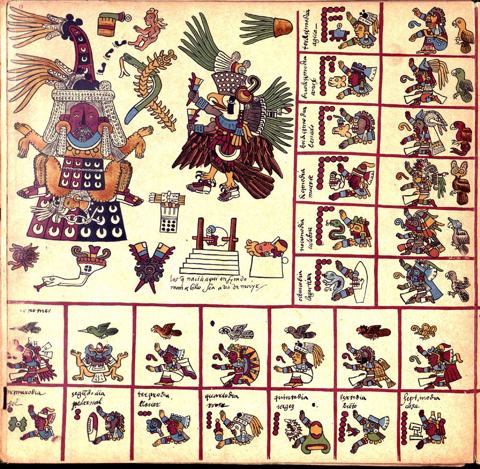
In the ritual manuscripts Xiuhtecuhtli also appears seated among the Nine Lords of the Night, a cycle of deities who governed the hours of darkness in rotation, an office that suits a fire god whose light mattered most exactly when the sun's had gone 2,3,4. The seated stone figure that survives today, worn but still bearing traces of his crown and a vessel-like hollow at his lap, is a rare case of that painted iconography carried into three-dimensional temple sculpture; the hollow is generally read as a brazier meant to hold a real offering of fire or copal incense 4.
Continue Exploring
Hummingbird of the Left — the Mexica sun-and-war god, born fully armed on Serpent Mountain and enthroned atop the Great Temple of Tenochtitlan.
The 260-day sacred count that set every Aztec's birth-fate, built from 13 numbers and 20 day-signs, inherited from far older Mesoamerican tradition.
Tenochtitlan's twin pyramid to Huitzilopochtli and Tlaloc, demolished in 1521 and lost until 1978, when electrical workers struck the Coyolxauhqui stone.
The Aztec rite that closed every 52-year cycle by dousing every fire in the realm and rekindling the world on a sacrificed captive's chest.
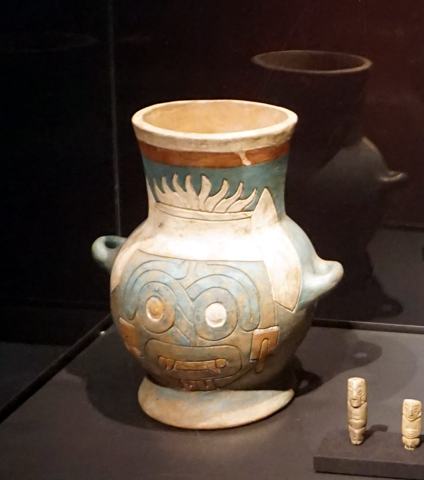
The goggle-eyed rain god who makes things sprout — giver of the storms that feed the maize, keeper of a green paradise, and taker of children.
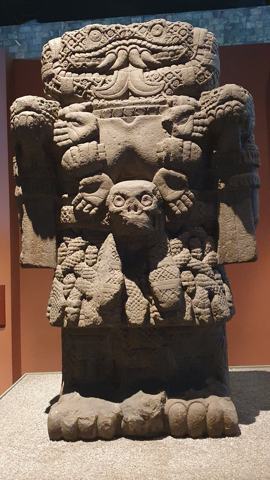
She of the Serpent Skirt — the Mexica earth mother who conceived Huitzilopochtli from a ball of feathers, and the colossal monolith that carries her name.
Sources & Further Reading
- 1.Bernardino de Sahagun, Florentine Codex — General History of the Things of New Spain (c. 1547-1579), Books 1 and 2.
- 2.Codex Borgia (pre-Columbian ritual manuscript).
- 3.Codex Borbonicus (pre-Columbian / early colonial ritual manuscript).
- 4.Miller, Mary & Karl Taube. The Gods and Symbols of Ancient Mexico and the Maya. Thames & Hudson, 1993.
- 5.Nicholson, H.B. 'Religion in Pre-Hispanic Central Mexico', Handbook of Middle American Indians vol. 10. University of Texas Press, 1971.
- 6.Read, Kay Almere & Jason J. Gonzalez. Handbook of Mesoamerican Mythology. ABC-CLIO, 2000.
- 7.Matos Moctezuma, Eduardo. The Great Temple of the Aztecs: Treasures of Tenochtitlan. Thames & Hudson, 1988.
Spot an error or have a source to suggest? Write to info@viseterna.com. We cite primary sources and modern scholarship, and we correct fast.