
Oni (Japanese Demons)
Horned, fanged ogres of Japanese folklore: hell's wardens, mountain bandits and village guardians, driven out with beans every February.
Imperial Bodyguard Fighting with a Demon (Watanabe no Tsuna and Ibaraki), Utagawa Kuniyoshi, 1825 · Public domain · source
The Word and What It Once Meant
The character used for oni, 鬼, is Chinese, where it means the spirit of a dead person — a ghost, not a monster. Japanese took the graph and attached to it a native word whose earliest recorded sense is something closer to "the unseen thing" 4,6. The tenth-century dictionary Wamyo ruijusho offers the derivation that has stuck: oni from on or onu, "to hide", because such beings do not wish to be seen 4. Whether the etymology is historically sound or a learned guess by a Heian lexicographer is not something the evidence can settle, but it is a useful description of the earliest oni, who are usually invisible and known only by what they leave behind 4,7.
In the Nihon Ryoiki, the Buddhist tale collection compiled around 822, oni are largely functionaries of death: they come from the king of the underworld with a summons, and they can occasionally be bribed 1,4. The Konjaku Monogatarishu of the early twelfth century has them eat people outright, sometimes leaving nothing but a hand or a strand of hair in a locked room 2,4. Only later does the oni acquire the body everyone now recognises.
Horns, Tigers and the Demon Gate
The standard oni of the medieval and early modern imagination is a huge red or blue humanoid with one or two horns, tusks, three fingers and three toes, a loincloth of tiger skin, and an iron studded club, the kanabo. The most frequently repeated explanation connects this to the compass. In the onmyodo system inherited from China, the northeast is the kimon, the "demon gate" through which malign influences enter, and by the twelve-animal scheme the northeast falls in the ushitora, the "ox-tiger" direction — hence the ox's horns and the tiger's pelt 4,6. Noriko Reider, whose Japanese Demon Lore is the standard English study, presents this as a plausible and long-standing rationalisation rather than a proven origin, and other scholars note that the iconography assembled gradually from Buddhist hell imagery as well 4,5.
That Buddhist stratum matters. Illustrated hell scrolls of the twelfth century onward populate the jigoku with wardens under Enma, king of the dead, among them the ox-headed gozu and horse-faced mezu who boil and dismember the damned 4,7. Japanese audiences met the fully formed monstrous body there long before folklore had settled on a single oni. The idiom oni ni kanabo, "an oni with an iron club" — meaning to make the already strong invincible — dates from the same world of imagery 4.
The Great Demon Stories
Two narratives carried the oni into popular culture and have never left it. The first is Shuten Doji, the demon of Mount Oe, who abducted the young women of the capital until Minamoto no Raiko and his four retainers came up the mountain disguised as mountain ascetics, fed him poisoned sake and beheaded him — the severed head still snapping at Raiko's helmet as it flew 3,4. The story survives in Muromachi otogizoshi and in some of the most spectacular picture scrolls of the period, and Reider reads it as a story about the Heian court's anxiety over the wild margins of its own territory: the oni is the outsider, the bandit, the unassimilated 3,4.
The second is Ibaraki-doji, one of Shuten Doji's followers, who ambushed the warrior Watanabe no Tsuna at a gate in the capital — the Rashomon in most versions, the Modoribashi bridge in others — and lost an arm to his sword. Days later an old woman claiming to be Tsuna's aunt talked her way into the house, seized the preserved arm and flew off with it, revealing herself as the demon 2,4. The scene is a staple of Noh, kabuki and ukiyo-e; the print above is Kuniyoshi's version of 1825.
Beans, Masks and Ambivalence
Every February, at setsubun, households and temples across Japan throw roasted soybeans while shouting oni wa soto, fuku wa uchi — "demons out, fortune in" — usually at someone wearing an oni mask 4,6. The rite descends from tsuina, a Chinese court exorcism adopted by the Heian palace to expel pestilence at the turn of the year, and its survival as a cheerful domestic custom is a good illustration of how the oni's terror has been domesticated without being discarded 4,6.
The ambivalence runs deeper than the festival. In many local traditions oni are not enemies at all. The namahage of the Oga peninsula in Akita — straw-caped, masked figures who tramp from house to house at New Year growling at children and lazy adults — are understood as visiting deities who bring blessing along with fright, and the practice is recognised by UNESCO as intangible cultural heritage 6,7. Some villages enshrine oni as protectors; some temples claim descent from a reformed demon; a few communities pointedly reverse the setsubun chant to oni wa uchi, welcoming the demons in 4,6. Komatsu Kazuhiko's influential analysis treats the oni as the category Japanese culture uses for whatever falls outside the settled community — which is exactly why the same figure can be a devil in one village and a guardian in the next 7.
Nor is the oni always born a monster. A recurring theme has human beings become oni through the intensity of their own emotion: the abandoned woman of the Noh play Kanawa and the jealous Lady Rokujo of The Tale of Genji stand behind the hannya mask, with its horns, gold eyes and expression that reads as rage and grief at once 4,5. The proverb oni mo juhachi, "even a demon is lovely at eighteen", belongs to the same instinct that the boundary is porous.
The Modern Oni
Reider's second major argument concerns what happened next. Over the twentieth century the oni was progressively softened — into a children's-book bogey, a mascot, a sports emblem, a romantic lead — until the frightening and diabolical figure of the medieval scrolls had acquired a parallel life as cute and even sexy 5. Contemporary manga, anime and games have accelerated the process without erasing the older layer; the demons of Onmyoji and Demon Slayer are recognisably descended from Shuten Doji 5,6.
The oni also remains a live metaphor in ordinary Japanese. A ferocious coach is an oni; a merciless section chief is an oni-bucho; oni-gokko is the children's game of tag. For a creature whose defining early trait was that it could not be seen, it has become remarkably hard to avoid 4,6. Compare the tengu, whose trajectory ran the other way — from Buddhist adversary to mountain guardian — and the kitsune, whose shapeshifting occupies the same folkloric border between the human world and everything outside it.
Continue Exploring
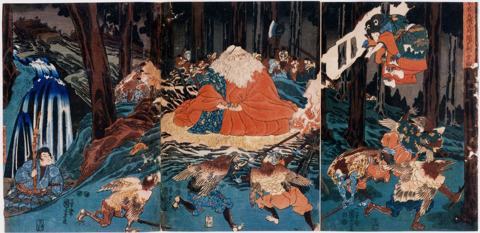
Winged mountain spirits of Japan: crow-beaked tricksters and long-nosed masters of the sword, once Buddhist demons, later guardians of the peaks.
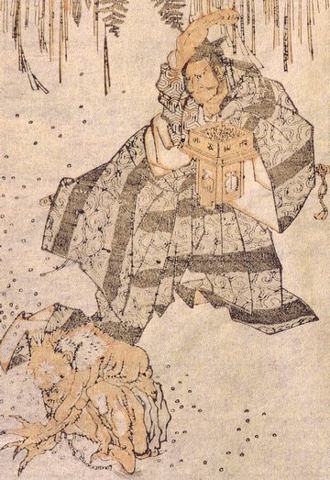
The eve of spring in the old calendar: roasted beans thrown at oni while households shout "demons out, fortune in," descended from a Heian court exorcism.
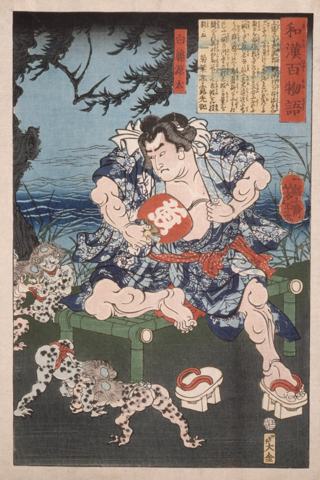
Japan's river-dwelling yokai — beaked and shell-backed, it drowns livestock and challenges travelers to sumo, yet is now a beloved mascot.
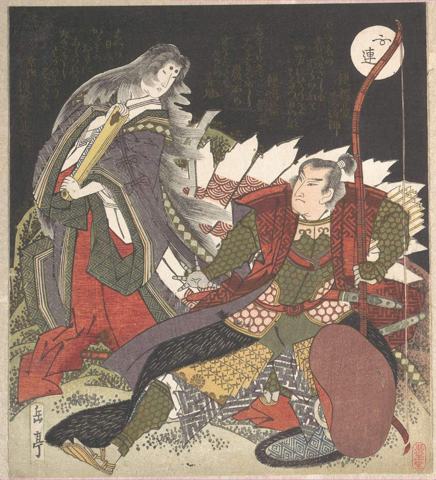
Japan's fox spirits — shapeshifters who gain tails and power with age, feared as deceivers and revered as the messengers of the rice kami Inari.
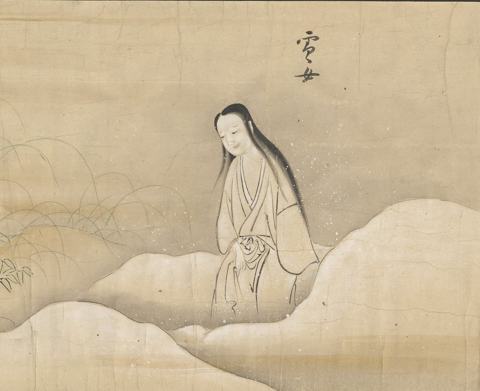
Japan's snow spirit, who freezes travelers on winter nights — known worldwide through Hearn's Kwaidan, though the folklore is far older and less romantic.
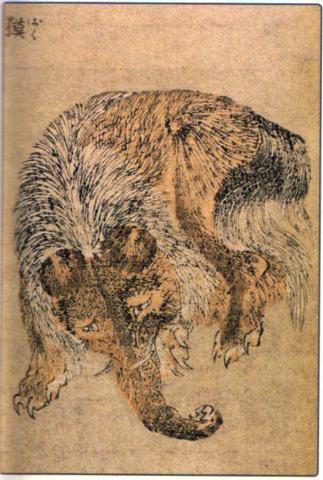
A Chinese-born chimera with an elephant's trunk and a tiger's claws, called on in Japan to eat bad dreams before they can do their damage.
Also mentioned inGashadokuroMomotaro (The Peach Boy)Nue (Japanese Chimera)Obon (Festival of the Dead)Shuten-doji (Oni King of Mount Oe)Tsukumogami (Haunted Objects)Yomi (Yomi-no-Kuni)
Sources & Further Reading
- 1.Nihon Ryoiki (Miraculous Stories from the Japanese Buddhist Tradition, c. 822), compiled by Kyokai.
- 2.Konjaku Monogatarishu (Tales of Times Now Past, c. 1120).
- 3.Shuten Doji — Muromachi-period otogizoshi and picture scrolls of the Oeyama demon.
- 4.Reider, Noriko T. Japanese Demon Lore — Oni from Ancient Times to the Present. Utah State University Press, 2010.
- 5.Reider, Noriko T. "Transformation of the Oni — From the Frightening and Diabolical to the Cute and Sexy." Asian Folklore Studies 62, no. 1 (2003), 133-157.
- 6.Foster, Michael Dylan. The Book of Yokai — Mysterious Creatures of Japanese Folklore. University of California Press, 2015.
- 7.Komatsu Kazuhiko. An Introduction to Yokai Culture. Japan Publishing Industry Foundation for Culture, 2017.
Spot an error or have a source to suggest? Write to info@viseterna.com. We cite primary sources and modern scholarship, and we correct fast.