
Obon (Festival of the Dead)
Japan's midsummer festival for the returning dead: welcoming fires, decorated graves, the bon-odori dance, and a Buddhist parable behind all of it.
Otsu-e-Style Bon Dance, Utagawa Hiroshige, 19th century · Public domain · source
A Festival for the Returning Dead
Obon, or Bon, is the annual midsummer observance in which the spirits of ancestors are believed to return to their family homes for a few days before departing again. Most of Japan keeps it around 13 to 16 August, though some regions, Tokyo among them, hold it a month earlier in mid-July, a split that traces back to the Meiji-era switch from the lunar to the Gregorian calendar and was never fully standardized 4,6. Together with the New Year, it is one of the two great points in the Japanese calendar when people travel home to their furusato, their family place of origin, making Obon week one of the country's heaviest travel periods as well as a religious one 4. Obon sits opposite Setsubun on the ritual year: where Setsubun drives unwanted spirits out of the house at the seasonal turn toward spring, Obon deliberately invites welcome ones in at the height of summer 6.
The Story Behind It: Mokuren and His Mother
Obon's origin story is a parable about a disciple named Mokuren, the Japanese rendering of Maudgalyayana, one of the Buddha's chief followers. Seeing with his spiritual power that his dead mother had been reborn among the hungry ghosts, Mokuren is instructed by the Buddha to make offerings to the assembled monastic community at the close of their summer retreat; the merit of that collective offering, rather than anything Mokuren could do alone, is what frees her 2. The story and the rite built around it, transmitted from India through China as the Ullambana sutra tradition, have been studied in exhaustive detail for their medieval Chinese form by Stephen Teiser, who treats the "ghost festival" less as a fixed doctrine than as a meeting point where Buddhist monastic economy, Confucian filial piety, and older ideas about hungry and dangerous dead all had to be reconciled 2. Japan inherited this textual and ritual complex, not a single unchanging ceremony, and adapted it to its own layer of ancestor belief, one that already included an indigenous land of the dead, Yomi, from the country's own creation myths 2,6.
First at Court, Then Everywhere
The Nihon Shoki records an urabon-e assembly held at the court during the seventh-century reign of Empress Saimei, one of the earliest datable notices of the rite in Japan, at a point when Buddhism itself was still a recent and largely aristocratic import 1. From that court ceremony the practice spread outward over the following centuries into temple life and then into ordinary households, merging along the way with pre-existing agrarian and ancestral customs that are difficult to separate cleanly from the Buddhist material once the fusion was complete 3,6. By the early modern period Obon was a household observance nationwide, resting on the temple-registration system that tied most families to a specific Buddhist temple responsible for their ancestral rites and memorial tablets 3.
Welcoming Fires, Graves, and the Bon Dance
The observance itself follows a homecoming logic. Families light mukae-bi, welcoming fires, to guide ancestral spirits back to the house, and set out small horse and ox figures made from cucumbers and eggplants on toothpick legs so the dead can travel home quickly and return to the afterlife at a more leisurely pace 3,6. Graves are cleaned and visited, the household Buddhist altar is decorated and provisioned with food, and at the close of the period many communities light okuri-bi, sending-off fires, or set paper lanterns adrift on rivers and the sea in the practice known as toro nagashi 3,6. The dance most associated with the season, bon-odori, descends from medieval nenbutsu odori, dancing performed while chanting the Buddha's name, a devotional style popularized by wandering preachers and later absorbed into local festival culture until nearly every region produced its own steps and its own tune, from the Awa Odori of Tokushima to the Gujo Odori of Gifu 6. Ukiyo-e artists found the bon dance a natural subject for parody prints, dressing its dancers as the stock comic figures of Otsu-e folk painting — a hawk-catcher, a wisteria-carrying beauty, and, incongruously, an oni — turning even a demon into a dance partner for one night of the year, at least on paper 6.
A Living Festival, Not a Reenactment
Obon is not a historical curiosity kept alive for tourists; it remains one of the two organizing poles, with the New Year, of the ordinary religious year for households across Japan, structuring the calendar of ancestor visits, temple donations, and family gatherings that Robert Smith's ethnography of mid-twentieth-century Japanese ancestor worship documented in close domestic detail 3,4. It has also traveled with the Japanese diaspora. Duncan Ryuken Williams's history of Japanese American Buddhism describes bon-odori dances held inside the wartime incarceration camps of the 1940s as an act of quiet religious continuity under confinement, and the same festival is now a major public event at Buddhist temples across Hawai'i and the American West Coast, drawn from the same practice and carrying a very different history alongside it 5. Whether in a Japanese village cemetery or a California temple parking lot, the underlying logic has not changed: for a few midsummer nights, the dead are expected, and the living prepare accordingly.
Continue Exploring
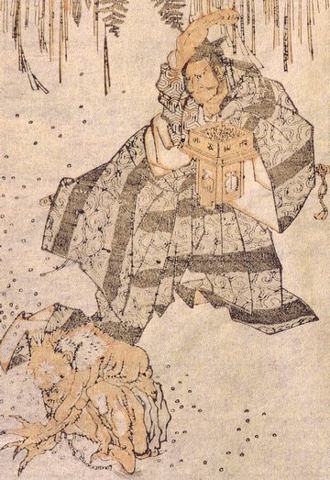
The eve of spring in the old calendar: roasted beans thrown at oni while households shout "demons out, fortune in," descended from a Heian court exorcism.
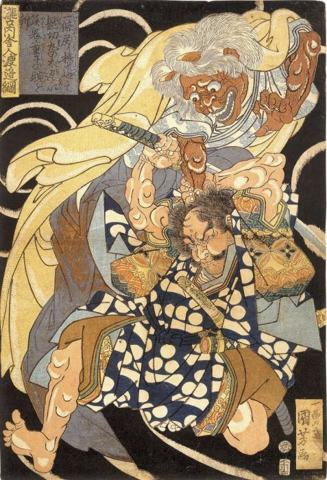
Horned, fanged ogres of Japanese folklore: hell's wardens, mountain bandits and village guardians, driven out with beans every February.
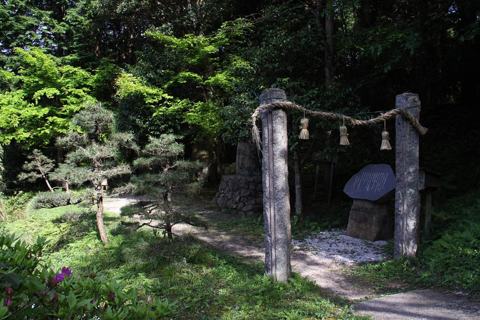
The land of the dead in Japan's oldest myths: a polluted country reached by a slope in Izumo, sealed with a boulder, with no judgment and no return.
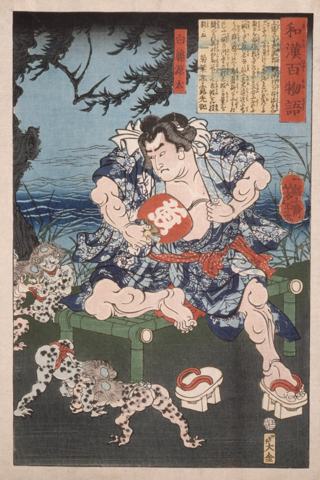
Japan's river-dwelling yokai — beaked and shell-backed, it drowns livestock and challenges travelers to sumo, yet is now a beloved mascot.
The creator pair of Japanese myth: they stirred the first island out of the sea, bore the land itself, and were parted forever by death.
Winged mountain spirits of Japan: crow-beaked tricksters and long-nosed masters of the sword, once Buddhist demons, later guardians of the peaks.
Sources & Further Reading
- 1.Nihon Shoki (Chronicles of Japan, 720), in W.G. Aston, trans., Nihongi. Kegan Paul, 1896.
- 2.Teiser, Stephen F. The Ghost Festival in Medieval China. Princeton University Press, 1988.
- 3.Smith, Robert J. Ancestor Worship in Contemporary Japan. Stanford University Press, 1974.
- 4.Reader, Ian. Religion in Contemporary Japan. University of Hawai'i Press, 1991.
- 5.Williams, Duncan Ryuken. American Sutra: A Story of Faith and Freedom in the Second World War. Harvard University Press, 2019.
- 6.Plutschow, Herbert E. Matsuri: The Festivals of Japan. Japan Library, 1996.
Spot an error or have a source to suggest? Write to info@viseterna.com. We cite primary sources and modern scholarship, and we correct fast.