
Momotaro (The Peach Boy)
Japan's best-known folk hero — born from a peach and famous for recruiting a dog, a monkey, and a pheasant to raid an island of oni.
Japanese Fairy Tale Series No. 1: Momotaro, published by T. Hasegawa, 1886 · Public domain · source
A Boy from a Peach
The story, in the form most Japanese children still hear it, starts with laundry. An old, childless woman is washing clothes at a river when an enormous peach comes floating down; she carries it home, and when she and her husband try to cut it open, a boy climbs out from inside 1,4. They name him Momotaro, "Peach Boy," and raise him as their own, and he grows at a startling rate into a strong, good-natured young man 1,4.
Nineteenth-century English readers first met the tale through Algernon Bertram Mitford's Tales of Old Japan, which renders it as "The Adventures of Little Peachling" and already shows the story in essentially its modern shape: peach, boy, and a household transformed overnight 1.
To the Island of Oni
Grown, Momotaro announces that he intends to sail to Onigashima, an island of oni, and put a stop to the raids they have been making on the mainland 1,4. His foster mother sends him off with a supply of kibi dango, millet dumplings, and on the road he meets, in turn, a dog, a monkey, and a pheasant, each of whom challenges or greets him and each of whom is won over with the offer of a dumpling in exchange for service 1,4. The three become his retainers for the crossing, an arrangement folklorists have long read as a miniature feudal contract dressed up as a children's story — loyalty purchased plainly, and paid for in food rather than land 4.
On Onigashima the four of them storm the oni stronghold, the pheasant scouting and pecking, the monkey scaling the walls, the dog biting at the defenders, and Momotaro leading the assault on the gate itself. The oni chief surrenders, hands over his hoard of treasure, and Momotaro sails home with his companions and his loot to a joyful welcome 1,4.
A Tale Without a Fixed Author
Momotaro has no single origin text the way the Kojiki's gods do; it is oral folklore that was written down, rewritten, and standardised over centuries, and the scholar who did the most to trace that process was Yanagita Kunio, the founder of modern Japanese folklore studies. His 1933 study Momotaro no Tanjo, "The Birth of Momotaro," gathered regional variants of the tale and argued that its recognisable modern shape only stabilised as late as the Muromachi period, built out of older, looser motifs about children born from fruit or gourds rather than descending from any single ancient source 2. Dorson's postwar survey of Japanese folk legend situates the tale within that same wider family of miraculously born culture-heroes, distinct from the aristocratic myths of the chronicles and rooted instead in village storytelling 4.
The printed record only really firms up in the Edo period, through cheap illustrated chapbooks, and again in the Meiji era, when the tale was adapted for the newly created national elementary curriculum and, through repeated printing in school readers, acquired the fixed cast and sequence — peach, dog, monkey, pheasant, dumplings, island — that is now treated as the "real" story 2,3.
Momotaro Goes to War
That schoolbook version made Momotaro useful to the state in ways the old village tale never was. Antoni's study of the fairy tale's role in early Showa-era nationalism traces how education, children's literature, and wartime propaganda recast Momotaro as an allegory of Japan itself — a righteous, purely Japanese hero setting out to punish foreign "demons" — with the oni of Onigashima standing in for whichever enemy the moment required 3. The clearest documented instance is cinematic: the Navy-sponsored animated films Momotaro's Sea Eagles (1943) and Momotaro: Sacred Sailors (1945, Japan's first feature-length animated film) cast Momotaro as a commander leading animal soldiers against caricatured Western enemies. Sea Eagles restages the attack on Pearl Harbor outright, footage and all; Sacred Sailors follows a paratroop landing modelled on Japan's invasion of the Netherlands East Indies 3. This is documented reception rather than anything latent in the folk tale itself, and Antoni is careful to treat it as a case study in how an existing, morally simple children's story can be redirected by the institutions that print and teach it 3.
Momotaro Today
Postwar Japan quietly dropped the wartime framing and kept the story; Momotaro remains a fixture of picture books, festivals, and regional tourism — Okayama in particular promotes itself as the tale's setting, tying its famous peaches and its own kibi dango confection to the legend 4. The oni he fights have had a long run as Japan's default folkloric villains, but Foster's survey of the yokai tradition is a useful reminder that oni are not uniformly evil across Japanese folklore, only in stories, like this one, built to need a clear enemy 5.
Continue Exploring
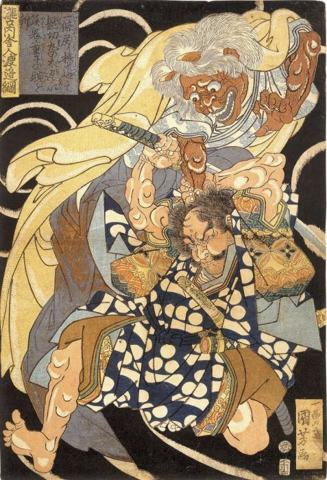
Horned, fanged ogres of Japanese folklore: hell's wardens, mountain bandits and village guardians, driven out with beans every February.
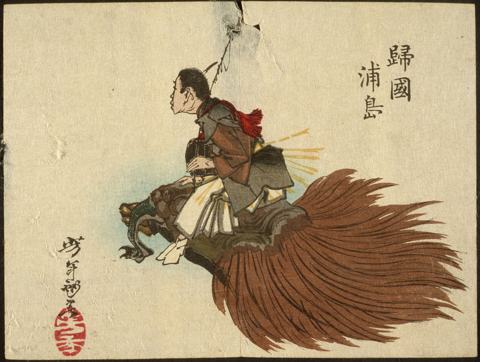
A fisherman rewarded with a journey to a timeless undersea land, who returns home to find centuries have passed and opens the one box he was told to leave shut.
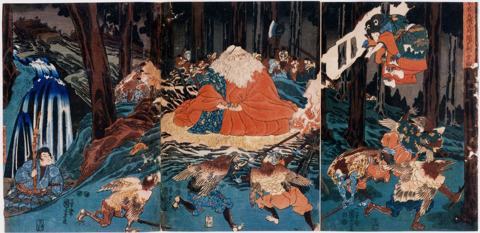
Winged mountain spirits of Japan: crow-beaked tricksters and long-nosed masters of the sword, once Buddhist demons, later guardians of the peaks.
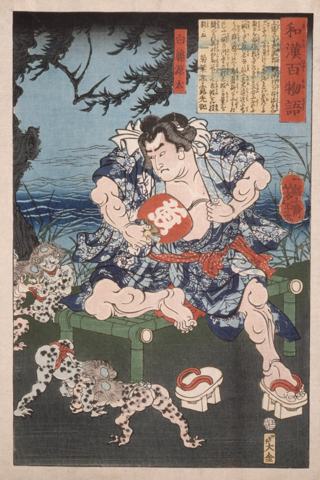
Japan's river-dwelling yokai — beaked and shell-backed, it drowns livestock and challenges travelers to sumo, yet is now a beloved mascot.
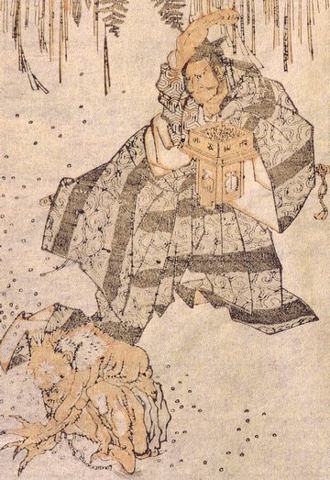
The eve of spring in the old calendar: roasted beans thrown at oni while households shout "demons out, fortune in," descended from a Heian court exorcism.
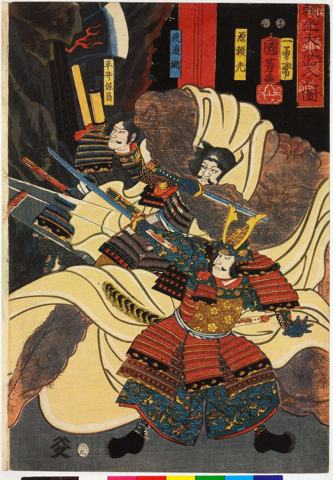
Japan's most famous oni — a demon king who ruled Mount Oe from a stolen palace, until Minamoto no Raiko brought him down with poisoned sake and a sword.
Sources & Further Reading
- 1.Mitford, A. B. Tales of Old Japan. Macmillan, 1871.
- 2.Yanagita, Kunio. Momotaro no Tanjo (The Birth of Momotaro). Sanseido, 1933.
- 3.Antoni, Klaus. "Momotaro (The Peach Boy) and the Spirit of Japan — Concerning the Function of a Fairy Tale in Japanese Nationalism of the Early Showa Age." Asian Folklore Studies 50, no. 1 (1991): 155-188.
- 4.Dorson, Richard M. Folk Legends of Japan. Charles E. Tuttle, 1962.
- 5.Foster, Michael Dylan. The Book of Yokai: Mysterious Creatures of Japanese Folklore. University of California Press, 2015.
Spot an error or have a source to suggest? Write to info@viseterna.com. We cite primary sources and modern scholarship, and we correct fast.