
Tsukumogami (Haunted Objects)
Tools that, discarded near their hundredth year, rise up as spirits in a Muromachi handscroll built to teach a Buddhist lesson about ordinary things.
Tsukumogami, from a copy of the Hyakki Yagyo Emaki traditionally attributed to Tosa Mitsunobu (Shinju-an collection), Muromachi period · Public domain · source
A Rule About Turning a Hundred
Tsukumogami (付喪神) is usually glossed as "tool kami," and the belief behind the name is specific rather than vague: an object that survives close to a hundred years of use can acquire a spirit of its own, with the will and the grievances that implies 1,4. The number is not arbitrary. It plays on a pun already present in a ninth-century poem in The Tales of Ise, where tsukumogami, "hair of ninety-nine years," describes an old woman's white hair; later writers heard kami, "hair," as a homophone for kami, "spirit," and built a folk doctrine out of the wordplay 2. Ninety-nine, one short of the round hundred, is the age at which an object is most likely to be thrown out — and, in the belief the pun encodes, most likely to object to it 2.
The Scroll That Explains Itself
The belief survives in unusually explicit form in the Tsukumogami Emaki (Tsukumogami ki), an illustrated Muromachi-period otogizoshi handscroll whose oldest surviving copy is held at the temple Sofuku-ji in Gifu, with further copies at the National Diet Library and Kyoto University Library 1. Its plot is a small morality tale. Every year, on the last day of the twelfth month, households across Kyoto perform susuharai, a ritual soot-sweeping that clears out worn tools along with the year's dust. One year the discarded objects — sandals, umbrellas, walking sticks, scraps of cloth — decide they have been treated as rubbish once too often, and on the advice of one of their own, transform into demons and take violent revenge on the households that threw them away, terrorizing the capital until an exorcism drives them out 1.
A Sermon Disguised as a Bestiary
Noriko Reider's study of the scroll argues that this is not neutral folklore collected for its own sake but doctrine dressed as entertainment. The Tsukumogami ki circulated in a milieu shaped by Shingon Buddhist teaching, and its second half undercuts its own monster story: rather than being destroyed outright, the defeated tool-spirits receive religious instruction, take up ascetic practice, and eventually attain enlightenment themselves 2. Reider reads this as a popular illustration of the doctrine, associated with esoteric Buddhist thought of the period, that even non-sentient matter possesses buddha-nature and can in principle reach awakening — a difficult theological point made vivid by giving a discarded umbrella a grudge, a face, and eventually a spiritual rebirth 2.
Named Kin: The Sandal, the Kettle, the Kasa
By the Edo period the general category had spun off individually named, individually drawn figures. Toriyama Sekien's compendia give distinct plates to the kasa-obake, a one-eyed, one-legged umbrella with a long tongue, and to other everyday objects reimagined as small, ill-tempered yokai — part of the same broader catalogue that also gave standard shape to the kappa and other Edo-print monsters 3. The boundary between an object gaining a spirit and an animal disguising itself as an object is not always tidy: the tanuki that becomes the bottomless teakettle of Morin-ji is, strictly, an animal shapeshifter rather than a tool given life after a century of use, but Edo audiences clearly enjoyed both ideas enough to blur them in art and story alike 3.
Cleaning House, Then and Now
Komatsu Kazuhiko places tsukumogami within a broader Japanese habit of treating the border between object and being as porous rather than fixed, one visible today in continuing rites like hari-kuyo, memorial services held for broken sewing needles, and similar ceremonies for old dolls and other well-used possessions 5. Modern popular culture has run with the idea in a lighter register — anime and games are full of living household objects — but the underlying instinct, that a thing used long and carefully enough deserves more than a trip to the rubbish heap, survives in exactly the kind of ritual the Tsukumogami Emaki was arguing for eight centuries ago 4,5.
Set beside the oni, whose menace was gradually softened into a mascot without ever losing its underlying moral charge, the tsukumogami runs the same arc in miniature: fear, then reconciliation, then a place back in the household rather than outside it 2,5. It also makes an instructive pair with yurei — both traditions hold that neglect and improper disposal, of a life or of a possession, is what produces the haunting in the first place.
Continue Exploring
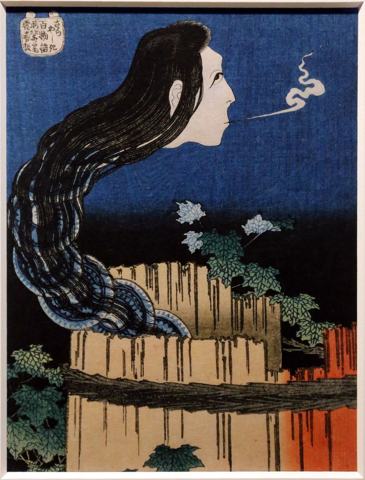
Japan's ghosts of specific dead people, bound by grievance to one place until it is resolved — white-robed, black-haired, and famous through Oiwa and Okiku.
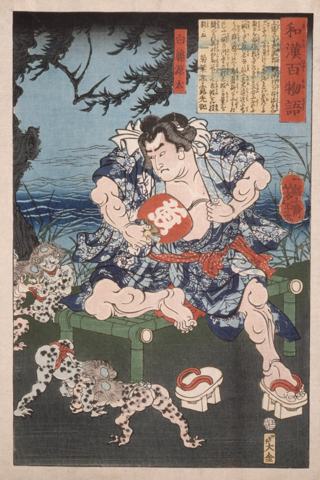
Japan's river-dwelling yokai — beaked and shell-backed, it drowns livestock and challenges travelers to sumo, yet is now a beloved mascot.
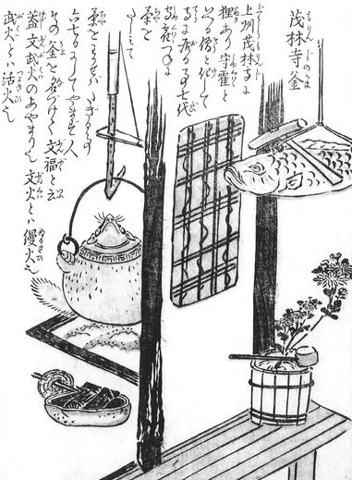
Japan's comic shapeshifter — a pot-bellied raccoon dog that drums on its belly, turns into teakettles, and plays the fool beside the more dangerous kitsune.
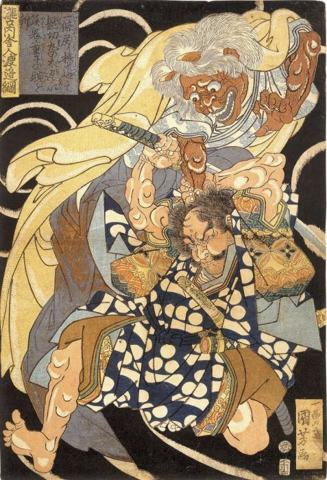
Horned, fanged ogres of Japanese folklore: hell's wardens, mountain bandits and village guardians, driven out with beans every February.
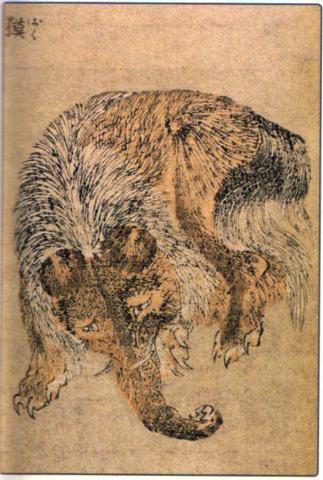
A Chinese-born chimera with an elephant's trunk and a tiger's claws, called on in Japan to eat bad dreams before they can do their damage.
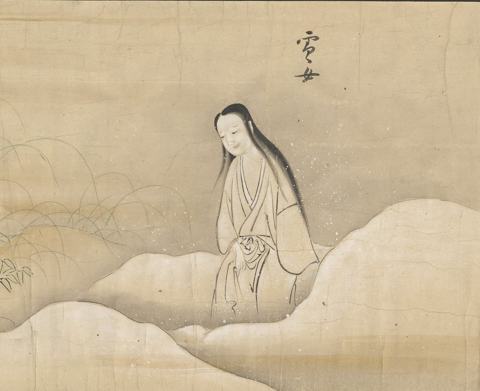
Japan's snow spirit, who freezes travelers on winter nights — known worldwide through Hearn's Kwaidan, though the folklore is far older and less romantic.
Sources & Further Reading
- 1.Tsukumogami Emaki (Tsukumogami ki), Muromachi-period otogizoshi handscroll; the oldest surviving copy is held at Sofuku-ji, Gifu, with further copies at the National Diet Library and Kyoto University Library.
- 2.Reider, Noriko T. "Animating Objects: Tsukumogami ki and the Medieval Illustration of Shingon Truth." Japanese Journal of Religious Studies 36, no. 2 (2009): 231-257.
- 3.Toriyama Sekien. Gazu Hyakki Yagyo (1776), in Sekien Toriyama's Japandemonium Illustrated — The Yokai Encyclopedias of Toriyama Sekien. Translated by Hiroko Yoda and Matt Alt. Dover Publications.
- 4.Foster, Michael Dylan. The Book of Yokai — Mysterious Creatures of Japanese Folklore. University of California Press, 2015.
- 5.Komatsu Kazuhiko. An Introduction to Yokai Culture. Japan Publishing Industry Foundation for Culture, 2017.
Spot an error or have a source to suggest? Write to info@viseterna.com. We cite primary sources and modern scholarship, and we correct fast.