
Baku (Dream Eater)
A Chinese-born chimera with an elephant's trunk and a tiger's claws, called on in Japan to eat bad dreams before they can do their damage.
Baku, Katsushika Hokusai, 19th century · Public domain · source
A Chinese Beast Takes a Japanese Job
The baku (獏/貘) arrived in Japan already assembled. Its name and its basic form come from the Chinese mo, a legendary composite animal described in Chinese encyclopedic and natural-history writing well before it shows up in Japanese sources, and Edo-period Japan absorbed the creature the way it absorbed a great deal of continental scholarship — through the encyclopedic compilations that organized inherited Chinese learning for a Japanese readership 1. The Wakan Sansai Zue, a sprawling illustrated encyclopedia of the natural and supernatural world compiled in the early eighteenth century, carries the baku in exactly this borrowed form, one entry among many creatures whose reputations crossed the sea in books rather than in person 1.
What It Is Made Of
Descriptions settle, by the time of Edo print culture, on a fixed and deliberately impossible combination: an elephant's trunk and tusks, a rhinoceros's eyes, an ox's tail, a tiger's paws, and a bear's heavy body, an animal built from spare parts precisely because no single real creature could be trusted to hold that much protective power 2. Toriyama Sekien gives the baku its place among the standard catalogue of Edo yokai in his Konjaku Hyakki Shui, alongside the other borrowed-and-localized figures that fill his four compendia 2. Earlier and cruder versions of the image are shaggier and less obviously elephantine, closer to a bear with claws than to the trunk-bearing chimera that later became standard 2.
Calling the Baku
The baku's job, in popular practice, was narrower than its intimidating anatomy suggests: it ate bad dreams, specifically, rather than functioning as a general guardian spirit. Lafcadio Hearn devoted an essay, "The Eater of Dreams," to the custom of invoking the creature after a nightmare — describing the belief that a sleeper who calls on the baku by name can have the dream taken away before it works any harm, and the related practice of keeping a written or embroidered image of the baku near a pillow as a standing ward against nightmares altogether 3. Children in particular were taught the invocation as a simple bedtime formula, a small piece of applied folklore rather than a story told for its own sake 3,4.
A Name Split in Two
The baku's afterlife took an odd turn once Western naturalists began cataloguing East and Southeast Asian wildlife. The real tapir, an unrelated animal with a genuinely elephant-like flexible snout, was given the Japanese name baku on the strength of that resemblance, so that the same word now names both the centuries-old dream-eating chimera and a living, distinctly unmythical mammal 4. It is a rare case of a folklore name colonizing zoology instead of the usual traffic running the other way, and it means that a modern Japanese speaker encountering the bare word baku has to rely on context to know whether the conversation concerns a nightmare or a zoo.
Guardian, Not Just Eater
Michael Dylan Foster situates the baku within a wider Japanese habit of using invented or imported composite animals as household and architectural protection — carved onto temple pillars and roof beams, printed on charms, treated as a ward against illness and misfortune more broadly rather than nightmares alone 4. That protective instinct outlived its Edo-period packaging. Foster's account of the postwar boom in illustrated yokai encyclopedias and character goods notes how easily older protective figures like the baku were folded into a modern commercial culture of charms, mascots, and printed ephemera without losing their basic function 5. The pillow charm is a smaller, quieter cousin of the practices covered at tengu, another imported Chinese figure reworked into a distinctly Japanese guardian, and of tsukumogami, where ordinary household objects carry their own kind of watchful, half-animate presence. Beside the flatly dangerous oni, the baku is a rarer thing in this company: a monster imported and kept specifically because it was useful.
Continue Exploring
Horned, fanged ogres of Japanese folklore: hell's wardens, mountain bandits and village guardians, driven out with beans every February.
Winged mountain spirits of Japan: crow-beaked tricksters and long-nosed masters of the sword, once Buddhist demons, later guardians of the peaks.
Tools that, discarded near their hundredth year, rise up as spirits in a Muromachi handscroll built to teach a Buddhist lesson about ordinary things.
Japan's river-dwelling yokai — beaked and shell-backed, it drowns livestock and challenges travelers to sumo, yet is now a beloved mascot.
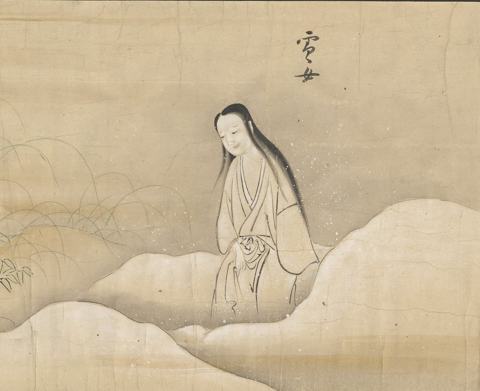
Japan's snow spirit, who freezes travelers on winter nights — known worldwide through Hearn's Kwaidan, though the folklore is far older and less romantic.
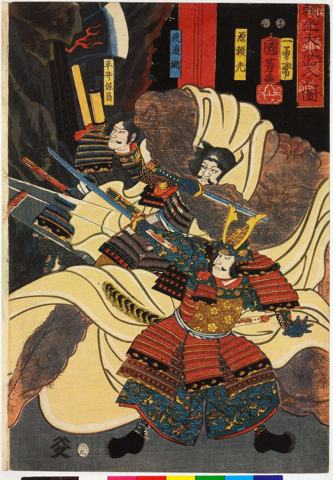
Japan's most famous oni — a demon king who ruled Mount Oe from a stolen palace, until Minamoto no Raiko brought him down with poisoned sake and a sword.
Sources & Further Reading
- 1.Wakan Sansai Zue (Japanese-Chinese Illustrated Encyclopedia of the Three Realms), compiled by Terajima Ryoan, circa 1712.
- 2.Toriyama Sekien. Konjaku Hyakki Shui (1781), in Sekien Toriyama's Japandemonium Illustrated — The Yokai Encyclopedias of Toriyama Sekien. Translated by Hiroko Yoda and Matt Alt. Dover Publications.
- 3.Hearn, Lafcadio. "The Eater of Dreams," in Kotto — Being Japanese Curios, with Sundry Cobwebs. The Macmillan Company, 1903.
- 4.Foster, Michael Dylan. The Book of Yokai — Mysterious Creatures of Japanese Folklore. University of California Press, 2015.
- 5.Foster, Michael Dylan. Pandemonium and Parade — Japanese Monsters and the Culture of Yokai. University of California Press, 2009.
Spot an error or have a source to suggest? Write to info@viseterna.com. We cite primary sources and modern scholarship, and we correct fast.