
Gashadokuro
A building-sized skeleton yokai widely presented as ancient folklore, though the figure itself was invented in illustrated books of the 1960s and 70s.
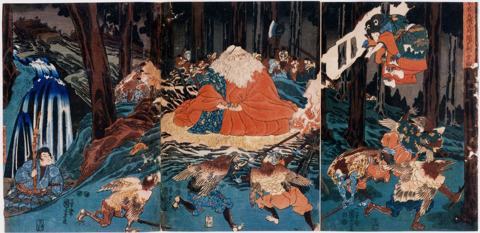
Soma no Furudairi (Takiyasha the Witch and the Skeleton Spectre), Utagawa Kuniyoshi, circa 1844 · Public domain · source
A Skeleton With a Thousand-Year Resume
Popular yokai guides describe the gashadokuro with real confidence: a skeleton dozens of feet tall, built from the unburied bones of soldiers and famine victims whose collective resentment has fused them into one starving, rattling body, its approach announced by a ringing in a victim's ears just before it grabs and beheads them 1,2. Many retellings attach an origin story to it — that the first gashadokuro was raised by Princess Takiyasha, daughter of the defeated tenth-century rebel Taira no Masakado, as an act of revenge against the capital that killed her father 3. This article's honest position is that almost none of that description is old. It is a genuine piece of modern Japanese pop folklore, and it deserves to be treated as one rather than dressed up as something out of a medieval scroll.
What the Historical Record Actually Says
The one real, well-documented thread in the story is Masakado himself. His rebellion against the Heian court in the 930s, his brief self-declared status as a "new emperor" in the eastern provinces, and his death in battle in 940 are among the best-attested events of the period, covered in detail by modern military historians of early Japan 4. What is not attested anywhere near that period is a vengeful daughter conjuring an army of the dead into a single giant skeleton. Takiyasha as a named, magic-using daughter of Masakado is a literary elaboration that surfaces centuries later, in Edo-period fiction and theatre built loosely around the Masakado legend rather than in any tenth-century source 4.
Kuniyoshi's Print Is Not the Source
That later fiction produced the single image most responsible for gashadokuro's borrowed sense of age: Utagawa Kuniyoshi's 1844 triptych Soma no Furudairi, usually known in English as Takiyasha the Witch and the Skeleton Spectre. It shows Takiyasha conjuring one enormous skeleton to terrify the warrior Oya no Taro Mitsukuni at the ruined Soma palace 3. It is a spectacular, genuinely Edo-period, genuinely public-domain print — and it is not a picture of a gashadokuro in the sense the word is used today. Kuniyoshi's skeleton is a single dramatic apparition summoned for one scene in one story; it carries none of the now-standard gashadokuro lore, the ear-ringing warning, the mass of nameless war dead, the roaming building-sized menace with its own name and habits. The print and the modern yokai are related only in that the second borrowed the first's imagery after the fact 3.
Where the Bones Actually Came From
The gashadokuro as a defined, named yokai with its own fixed traits enters print in the 1960s and 70s. Early illustrated features aimed at children introduced a giant, vengeful skeleton figure in that period, and the modern template was fixed soon after by Sato Arifumi's widely read Nihon Yokai Zukan, published by Rippu Shobo in 1972 1. Mizuki Shigeru, by far the most influential figure in postwar yokai publishing, carried the figure into his own long-running yokai encyclopedias, later collected and revised as Nihon Yokai Taizen 2. Between them, a magazine feature and two illustrated reference books gave a brand-new monster the same authoritative, encyclopedic presentation as creatures with genuine centuries of textual history behind them — and, from the outside, very little to tell the two apart.
Why the Mistake Sticks
Michael Dylan Foster's study of the postwar "yokai boom" describes exactly this mechanism at work across the genre: illustrated zukan aimed at children, especially the ones associated with Mizuki Shigeru, presented old and new figures side by side in the same authoritative format, with little in the presentation itself to mark which creatures had centuries of folklore behind them and which had been assembled for that week's issue 5. Gashadokuro is one of the clearer cases where that mechanism worked exactly as well as it could: a striking modern monster, a genuinely old and genuinely famous woodblock print willing to serve as its illustration, and sixty years of retelling have been enough to make "ancient Japanese legend" the default assumption rather than the exception.
Compare nue for a near-inversion of this problem: a monster whose story really is medieval, presented by its own oldest source as something nobody could quite name. Gashadokuro is closer to the opposite case, a very recent invention wearing the confidence of a thousand-year pedigree it does not have 1,2,5. Its appetite for the improperly dead also sits oddly close to yurei, where individual grievance rather than mass anonymity drives the haunting, and its scale invites comparison with the more thoroughly attested menace of the oni.
Continue Exploring
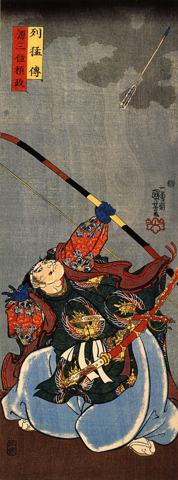
A chimera of monkey, tiger, snake and tanuki that darkened Emperor Konoe's nights in the Tale of the Heike, until archer Minamoto no Yorimasa brought it down.
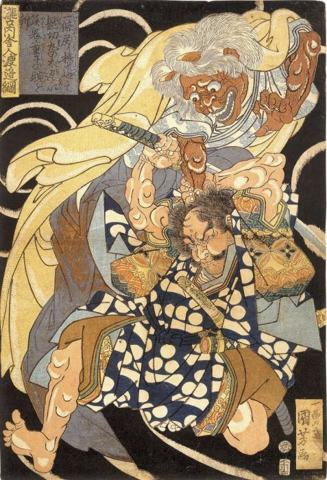
Horned, fanged ogres of Japanese folklore: hell's wardens, mountain bandits and village guardians, driven out with beans every February.
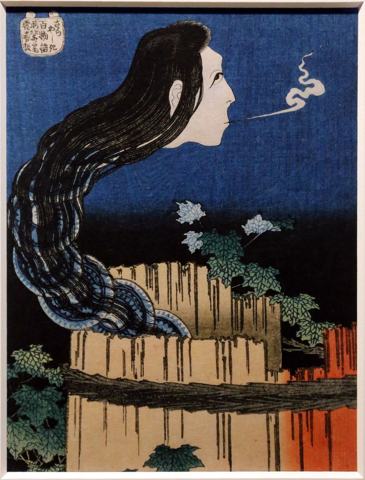
Japan's ghosts of specific dead people, bound by grievance to one place until it is resolved — white-robed, black-haired, and famous through Oiwa and Okiku.
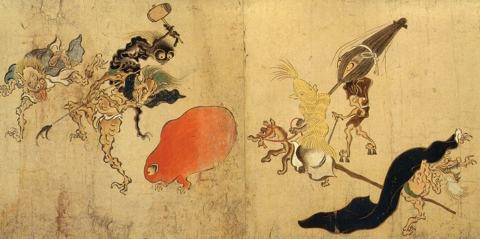
Tools that, discarded near their hundredth year, rise up as spirits in a Muromachi handscroll built to teach a Buddhist lesson about ordinary things.
Winged mountain spirits of Japan: crow-beaked tricksters and long-nosed masters of the sword, once Buddhist demons, later guardians of the peaks.
Japan's river-dwelling yokai — beaked and shell-backed, it drowns livestock and challenges travelers to sumo, yet is now a beloved mascot.
Sources & Further Reading
- 1.Sato Arifumi. Nihon Yokai Zukan (Japanese Yokai Encyclopedia). Rippu Shobo, 1972.
- 2.Mizuki Shigeru. Kaitei-ban Nihon Yokai Taizen (Revised Encyclopedia of Japanese Yokai). Kodansha, 2014.
- 3.Utagawa Kuniyoshi. Soma no Furudairi (The Old Palace at Soma), also known as Takiyasha the Witch and the Skeleton Spectre, colour woodblock triptych, circa 1844.
- 4.Friday, Karl F. The First Samurai — The Life and Legend of the Warrior Rebel Taira Masakado. John Wiley & Sons, 2008.
- 5.Foster, Michael Dylan. Pandemonium and Parade — Japanese Monsters and the Culture of Yokai. University of California Press, 2009.
Spot an error or have a source to suggest? Write to info@viseterna.com. We cite primary sources and modern scholarship, and we correct fast.