
Nue (Japanese Chimera)
A chimera of monkey, tiger, snake and tanuki that darkened Emperor Konoe's nights in the Tale of the Heike, until archer Minamoto no Yorimasa brought it down.
Minamoto no Yorimasa Shooting the Nue, from the series Retsu Mo Den (Biographies of Fierce Men), Utagawa Kuniyoshi, 19th century · Public domain · source
A Cry Before It Had a Face
The word nue named a bird before it named a monster. In the eighth-century poetry anthology Man'yoshu, nue is an old name for what is now usually called the White's thrush, a bird whose long, quavering night call was already a fixed image of loneliness and grief centuries before anyone attached the word to anything with claws 3. That cry is the only thing connecting the bird to the creature the Tale of the Heike would later make famous — a monster identified not by what it looked like, at first, but by the sound it made in the dark 1,3.
The Cloud Over the Palace
Book four of the Heike Monogatari sets the story in the reign of Emperor Konoe. Each night a patch of black cloud settled over the roof of the imperial residence, and each night the emperor was seized with terror and fell ill, until his ministers concluded that whatever was inside the cloud needed to be answered with force rather than prayer 1. The ministers had precedent in mind: a generation earlier, a mysterious nightly cry at the palace was said to have been silenced by an arrow from Minamoto no Yoshiie, and it was that earlier success, invoked by name, that led the court to summon another archer of the same line rather than turn to prayer alone — a small but telling sign of how far the bow and arrow had displaced court exorcism as the palace's preferred remedy for the uncanny by the twelfth century 1,4.
An Arrow Into the Dark
The archer summoned for Konoe's cloud was Minamoto no Yorimasa, and the Heike gives his shot the weight of a set-piece: he prays to the war god Hachiman, nocks an arrow fletched with a mountain bird's feathers, and looses it into the blackness on sound and instinct alone. Something falls. His retainer I no Hayata finishes it on the ground with several strokes of a dagger, and torches are brought so the court can see what it has actually killed 1. The emperor's health returns at once, and Yorimasa is rewarded with a sword the text treats as being nearly as significant as the kill itself — a Minamoto retainer walking out of the palace with an imperial blade in hand was itself a small marker of where power was starting to shift 1,4.
A Body With No Name
What the torches showed, in the version of the text most often quoted, was something with the head of a monkey, the torso of a tanuki, the limbs of a tiger, and a snake for a tail 1. What the Heike does not do is give this thing a settled species name of its own. It is called nue only because its dying cry resembled the bird's, and the chronicle says plainly that "its true nature was unknown" — the label is a borrowed one, reached for because the court had no other word ready 1,3. The body was set adrift downriver in a hollowed log; more than one town along the coast has, at different times, claimed to be where it eventually washed ashore, and more than one still keeps a nuezuka, a "nue mound," marking the spot 5.
The Ghost Yorimasa Left Behind
The killing was well known enough to be staged. The Noh play Nue, traditionally credited to Zeami Motokiyo, takes the Heike episode and turns it inside out: a travelling priest meets a boatman on a lonely stretch of water who is revealed, by the second half of the play, to be the nue's own restless spirit, still unable to move on because it never received proper rites after Yorimasa's arrow found it 2. Set beside the chronicle, the play is a small but pointed correction. It spends its time on the suffering of the thing that was killed rather than the glory of the man who killed it, and it ends, in the standard Noh pattern for these ghost plays, with the priest's prayer offering the spirit the release the Heike never bothered to grant it 2.
An Omen, and Then a Word
David Bialock reads the nue as part of a much older habit in Japanese court writing, in which political trouble announces itself through bodies that refuse to sort into one category — the cloud, the mixed anatomy, the cry with no name attached, are all of a piece with a genre where disorder in the realm shows up first as disorder in nature 4. Whatever the twelfth-century court made of it, the word outlived the monster: modern Japanese still uses nue as an adjective for a person, a policy, or a political deal that refuses to be pinned to one identity — evasive, composite, impossible to categorize cleanly, which is a fair description of the thing Yorimasa is supposed to have shot out of the sky 5.
Compare gashadokuro, a monster whose reputation for antiquity turns out to be almost entirely modern, a near-inversion of the nue's real but unstable pedigree 5. The court's other favored answer to a monstrous night, a demon fought rather than shot, is covered at oni, and Yorimasa's fellow monster-hunter from the same warrior culture, the slayer of the demon of Mount Oe, keeps his own entry at Shuten Doji.
Continue Exploring
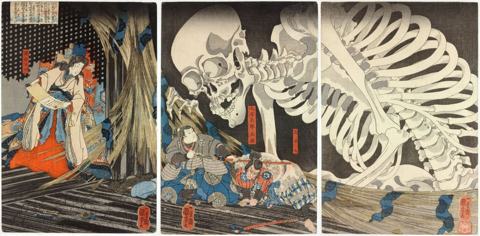
A building-sized skeleton yokai widely presented as ancient folklore, though the figure itself was invented in illustrated books of the 1960s and 70s.
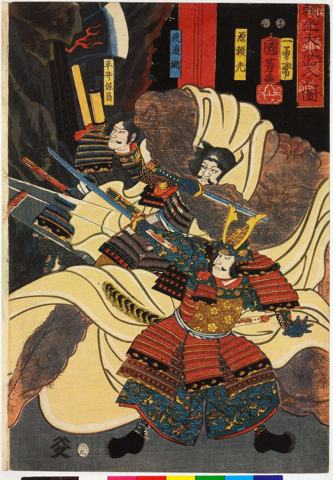
Japan's most famous oni — a demon king who ruled Mount Oe from a stolen palace, until Minamoto no Raiko brought him down with poisoned sake and a sword.
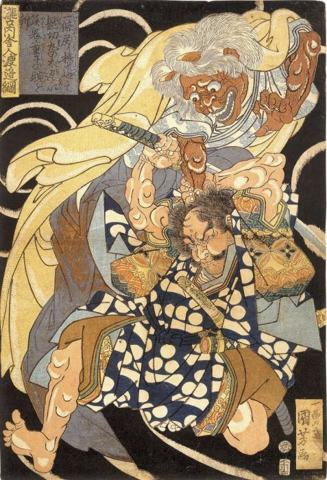
Horned, fanged ogres of Japanese folklore: hell's wardens, mountain bandits and village guardians, driven out with beans every February.
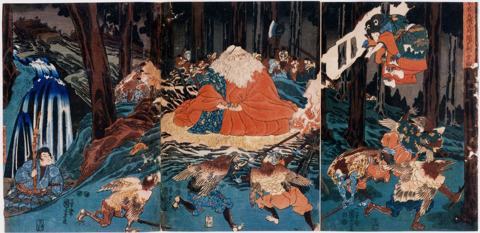
Winged mountain spirits of Japan: crow-beaked tricksters and long-nosed masters of the sword, once Buddhist demons, later guardians of the peaks.
Japan's river-dwelling yokai — beaked and shell-backed, it drowns livestock and challenges travelers to sumo, yet is now a beloved mascot.
The eve of spring in the old calendar: roasted beans thrown at oni while households shout "demons out, fortune in," descended from a Heian court exorcism.
Sources & Further Reading
- 1.Heike Monogatari (The Tale of the Heike), Book 4 — the nue episode. Translated by Helen Craig McCullough. Stanford University Press, 1988.
- 2.Nue, Noh play traditionally attributed to Zeami Motokiyo (14th-15th century).
- 3.Man'yoshu (8th century) — an early use of nue as the name of a bird whose cry signals grief.
- 4.Bialock, David T. Eccentric Spaces, Hidden Histories: Narrative, Ritual, and Royal Authority from The Chronicles of Japan to The Tale of the Heike. Stanford University Press, 2007.
- 5.Foster, Michael Dylan. The Book of Yokai: Mysterious Creatures of Japanese Folklore. University of California Press, 2015.
Spot an error or have a source to suggest? Write to info@viseterna.com. We cite primary sources and modern scholarship, and we correct fast.