
Kitsune
Japan's fox spirits — shapeshifters who gain tails and power with age, feared as deceivers and revered as the messengers of the rice kami Inari.
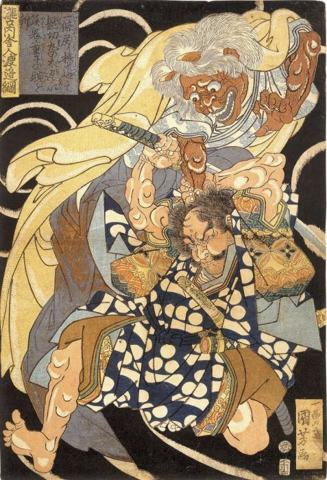
The Warrior Miura-no-suke Confronting Tamamo-no-Mae as She Turns into a Nine-Tailed Fox, Japanese woodblock print, 19th century (Metropolitan Museum of Art) · CC0 · source
What a Kitsune Is
Kitsune (狐) is simply the Japanese word for fox — and also the name of one of the country's most persistent supernatural figures 4. In folk belief a fox that lives long enough acquires power: the ability to change shape, to produce illusions, to make fire, and to enter and possess a human being 3,4. Tails are the standard index of age and strength, with the greatest foxes bearing nine and turning white or gold; a thousand years is the figure most often quoted for reaching that state, though the number varies by region and by era 3,4.
Folk classification usually splits them in two. Zenko, "good foxes," are benevolent and associated with the kami Inari; nogitsune or yako, "field foxes," are the tricksters and the possessors 3,4. Foster warns against treating this as a fixed taxonomy — Japanese folk categories are local, unstable, and frequently contradictory, and a fox that helps one household may ruin the next 4.
Messengers of Inari
The single most important thing to get right about kitsune is their relationship to Inari Okami, the kami of rice, agriculture, industry, and prosperity, whose head shrine is Fushimi Inari Taisha in Kyoto and whose branch shrines number in the tens of thousands across Japan 3,5. The paired stone foxes at every Inari shrine gate, holding a key, a jewel, a scroll, or a sheaf of rice in their mouths, are Inari's messengers — not Inari 3.
Smyers's ethnography of contemporary Inari worship found this distinction stated firmly by priests and just as firmly blurred by many worshippers, some of whom address the fox directly, and she treats the ambiguity as a real feature of the tradition rather than as an error to be corrected 3. The jewel the foxes carry, the hoshi no tama, is likewise read variously as Inari's spirit, as the fox's own soul, and as a Buddhist wish-fulfilling gem, depending on who is asked 3.
Inari is also, historically, a deity with a foot in both Buddhism and shrine religion; Toyokawa Inari is a Soto Zen temple, and the Meiji separation of kami and buddhas cut across a cult that had never been organised along those lines 3,6.
Shapeshifters and Fox-Wives
The oldest surviving Japanese fox story is a marriage. In the Nihon ryoiki, compiled around 822, a man takes a wife who bears him a son and is then revealed to be a fox by the household dog; she flees in her animal form, but he calls her back to sleep beside him each night — and the text offers a folk etymology of kitsune from a phrase meaning "come and sleep" 1. The pattern set there runs through the whole tradition: the fox-wife is loving, the marriage is real, and the discovery ends it 1,4.
Medieval collections such as the Konjaku Monogatarishu are full of foxes transforming into women, monks, and travellers, sometimes to seduce, sometimes to repay a kindness, often simply to make a fool of someone on a dark road 2,4. The most famous elaboration is Kuzunoha, the fox-wife who in legend bore the Heian court diviner Abe no Seimei and departed in tears when her son saw her tail — a story that reached its familiar form on the puppet and kabuki stages of the eighteenth century rather than in ancient text 4.
The Nine-Tailed Fox
The dangerous end of the tradition is Tamamo-no-Mae, a nine-tailed fox who takes the form of a beautiful, brilliant court lady, wins an emperor's devotion, and sickens him — until a diviner exposes her 4. She flees to the moor at Nasu, is hunted down, and becomes the Sessho-seki, the "killing stone," whose fumes were said to kill anything that approached; the stone at Nasu is a real and much-visited site, and its splitting in 2022 made national news 4.
The medieval versions of the tale give her a career before Japan, identifying her with a fox demon who had already destroyed rulers in India and China — a transmission story that says a good deal about how Japanese writers of the period imagined their place in a Buddhist world, and that links her to the Chinese huli jing fox-spirit tradition 4.
Foxfire, Possession, and the Village Fox
Everyday fox belief attached itself to observed things. Kitsunebi, foxfire, names the drifting lights sometimes seen at night; a line of them was called a fox wedding procession, as was a sunshower — rain falling while the sun shines 4. Households or whole families could be reputed to "keep" foxes, an accusation with real social consequences for marriage and standing in some rural districts 3,4.
Kitsunetsuki, fox possession, was a recognised affliction with a recognised cure: the possessed person spoke in another voice, craved fried tofu, and was treated by exorcism, often at an Inari shrine or temple 3,4. It should be handled with care rather than as a curiosity — it was a serious illness category within a coherent local medicine, and Smyers records shamanic Inari practitioners still working in this idiom in the late twentieth century 3.
Foxes Today
Inari worship is thoroughly alive. Fushimi Inari's tunnels of vermilion torii, each donated by a business or family, are among the most visited religious sites in Japan, and offerings of aburaage — fried tofu, the fox's supposed favourite — are left at shrines and have given their name to inarizushi and kitsune udon 3,5.
Modern anime, games, and fiction have made the nine-tailed fox a global fixture, usually collapsing the good fox, the trickster, and the demon into one character 4. The older tradition kept them apart, and kept the fox where it actually lived: at the edge of the rice field, useful, uncanny, and not to be insulted 3,4.
Continue Exploring
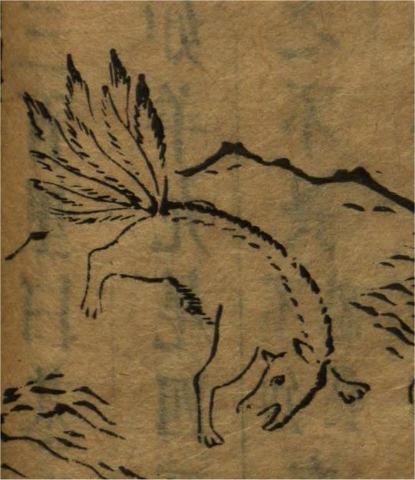
China's shapeshifting fox spirits, who gain power and human form through age — feared as seducers and omens of ruin, and the root of Japan's kitsune.
Horned, fanged ogres of Japanese folklore: hell's wardens, mountain bandits and village guardians, driven out with beans every February.
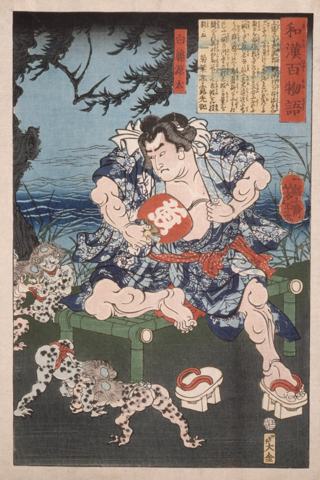
Japan's river-dwelling yokai — beaked and shell-backed, it drowns livestock and challenges travelers to sumo, yet is now a beloved mascot.
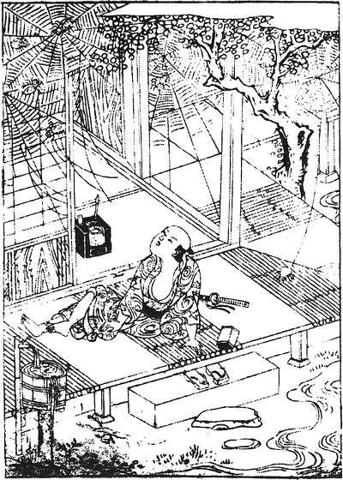
A giant spider of Japanese folklore that takes the shape of a beautiful woman to lure victims into her web, haunting Edo ghost stories and mountain waterfalls.
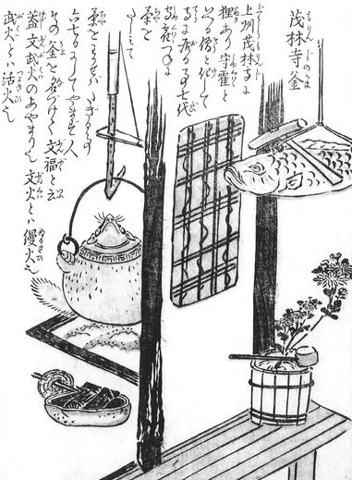
Japan's comic shapeshifter — a pot-bellied raccoon dog that drums on its belly, turns into teakettles, and plays the fool beside the more dangerous kitsune.
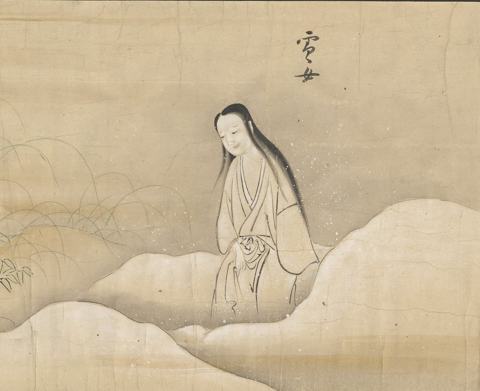
Japan's snow spirit, who freezes travelers on winter nights — known worldwide through Hearn's Kwaidan, though the folklore is far older and less romantic.
Also mentioned inInari (Inari Okami)
Sources & Further Reading
- 1.Nakamura, Kyoko Motomochi, trans. Miraculous Stories from the Japanese Buddhist Tradition: The Nihon ryoiki of the Monk Kyokai. Harvard University Press, 1973.
- 2.Konjaku Monogatarishu — Anthology of Tales from the Past (c. 1120).
- 3.Smyers, Karen A. The Fox and the Jewel: Shared and Private Meanings in Contemporary Japanese Inari Worship. University of Hawai'i Press, 1999.
- 4.Foster, Michael Dylan. The Book of Yokai: Mysterious Creatures of Japanese Folklore. University of California Press, 2015.
- 5.Hardacre, Helen. Shinto: A History. Oxford University Press, 2017.
- 6.Breen, John & Mark Teeuwen. A New History of Shinto. Wiley-Blackwell, 2010.
Spot an error or have a source to suggest? Write to info@viseterna.com. We cite primary sources and modern scholarship, and we correct fast.