
Kappa (Japanese Water Yokai)
Japan's river-dwelling yokai — beaked and shell-backed, it drowns livestock and challenges travelers to sumo, yet is now a beloved mascot.
Shirafuji Genta Watching Kappa Wrestle, Tsukioka Yoshitoshi, 1865 (Wakan Hyakumonogatari) · Public domain · source
A Creature of a Hundred Local Names
Kappa (河童), "river child," is the standard modern name for Japan's most famous water yokai, but it is really a national label pasted over hundreds of local beings: kawaro and kawataro in the west, enko in Shikoku, gawappa in Kyushu, hyousube in Saga 4. Michael Dylan Foster treats this variety as the point rather than a problem to be tidied away — a kappa is less a fixed species than a regional slot for "the dangerous thing in the river," filled differently from valley to valley 4.
The body that eventually became standard is nonetheless distinctive: child-sized, greenish or sallow-skinned, with webbed hands and feet, a tortoise-like shell, a beaked face, and — the detail every version agrees on — a shallow water-filled dish, the sara, set into the top of its skull. The dish is the kappa's battery. Spill it and the creature weakens or dies; keep it full and it is fast, strong, and dangerous in the water 1,4.
Suijin's Dangerous Cousin
Folklorists generally place the kappa within the broader worship of suijin, water kami who could bring irrigation and fish or take a life in the current, and the kappa reads as the trickster, everyday end of that same belief — less a god to be enshrined than a hazard to be managed 4,6. The commonest kappa story is a drowning averted: the creature seizes a horse or ox by the leg to drag it under, misjudges its strength, and is instead hauled onto dry land, where it is caught, made to swear never to harm the village's people or animals again, and released 3,4. Foster's Pandemonium and Parade takes this horse-pulling tale as a central case study precisely because it recurs, with local variation, across the whole of Japan, and because it stages the kappa's basic ambivalence: genuinely lethal, yet ultimately talked down 3.
Sumo, Cucumbers, and How to Survive One
Kappa are compulsive sumo wrestlers, prone to challenging travelers at the water's edge, and this habit doubles as their weakness: a kappa's sense of etiquette is strong enough that if a human bows to it, the kappa will bow back — spilling the water from its head-dish and losing its strength in the act 1,4. Cucumbers are its other obsession. Villagers who wanted safe passage across kappa-haunted water would write a family member's name on a cucumber and float it downstream, a folk bargain that later ages have read backward into the name of the cucumber sushi roll, kappa-maki, though that is a modern popular etymology rather than an attested Edo-period one 4.
The Kappa of Tono
Kunio Yanagita's 1910 Tono Monogatari, the founding text of Japanese folklore studies, records kappa as living, local fact in the Tono valley of Iwate rather than as literary ornament. Its kappa are reddish rather than green, said to leave the water to mate with horses and produce monstrous foals, and to haunt specific named pools — the tradition survives today at the Kappa Fuchi pool by Jokenji temple, still marketed as kappa habitat and fished, half-jokingly, with cucumber bait 2. Yanagita's informants treated encounters with the same matter-of-fact tone used for weather or crop failure, which is exactly what gives the collection its evidentiary weight for later folklorists 2,4.
From Edo Bestiary to Modern Mascot
Toriyama Sekien's illustrated yokai encyclopedias of the 1770s and 1780s gave the kappa the fixed visual template — shell, beak, dish — that popular art has repeated ever since, feeding a wider Edo-period appetite for cataloguing and half-jokingly "explaining" such beings that natural history writers of the day sometimes tried to rationalize as sightings of giant salamanders or drowned children 1,4. Gerald Figal's study of Meiji-era modernization describes the opposite pressure a century later: a new school system and medical establishment that treated kappa belief as backward superstition to be corrected, even while folklorists such as Yanagita were racing to record the same beliefs before they vanished 5. Both pressures failed to kill the kappa. Foster's Pandemonium and Parade follows it into the twentieth century as it resurfaces as a comic mascot, a sake and cucumber-snack brand character, and a stock figure of children's manga — the same creature that once drowned livestock now grins from vending machines 3,6.
Kappa Among Japan's Other Yokai
The kappa's mix of real menace and manageable comedy is very much a family trait. It sits alongside the tengu, a mountain danger later rehabilitated into a guardian, and the oni, whose terror has likewise been softened into a setsubun mascot without ever quite disappearing 4,6. Unlike the kitsune, whose power depends on age and cunning, the kappa's strength is a physical, almost mechanical property — the water in its dish — which is part of why its folklore is so full of practical countermeasures rather than exorcisms: bow to it, feed it a cucumber, or simply outrun it to the riverbank 4.
Continue Exploring
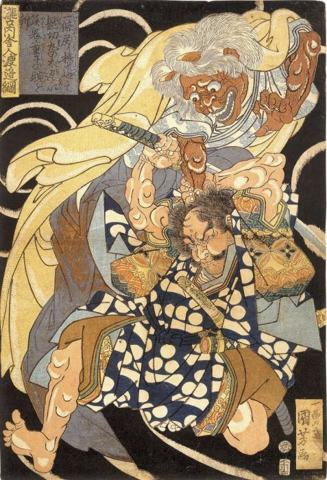
Horned, fanged ogres of Japanese folklore: hell's wardens, mountain bandits and village guardians, driven out with beans every February.
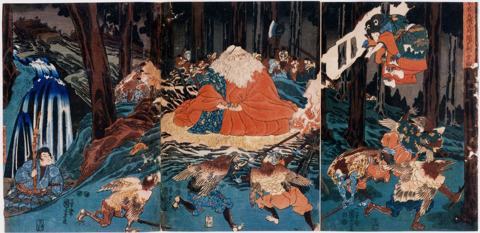
Winged mountain spirits of Japan: crow-beaked tricksters and long-nosed masters of the sword, once Buddhist demons, later guardians of the peaks.
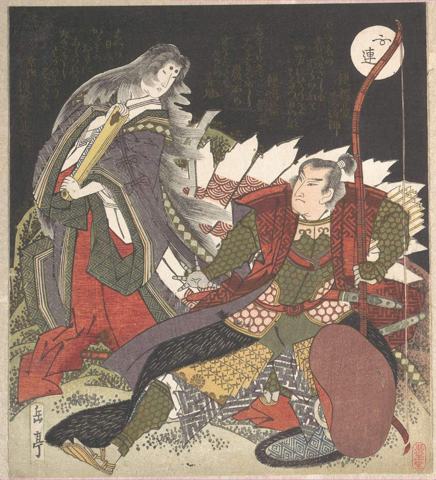
Japan's fox spirits — shapeshifters who gain tails and power with age, feared as deceivers and revered as the messengers of the rice kami Inari.
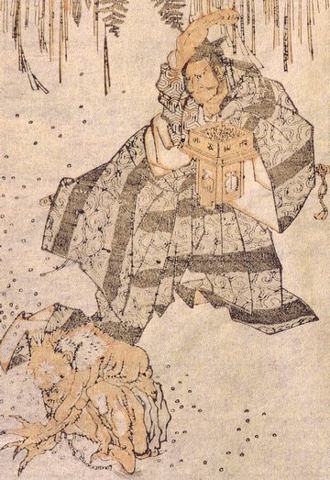
The eve of spring in the old calendar: roasted beans thrown at oni while households shout "demons out, fortune in," descended from a Heian court exorcism.
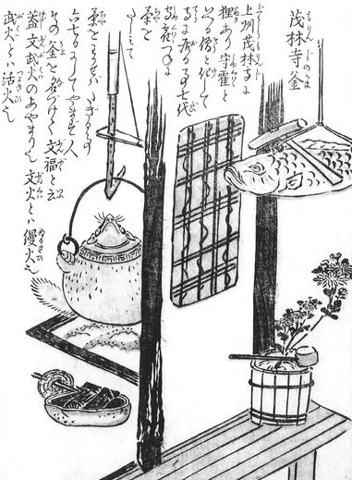
Japan's comic shapeshifter — a pot-bellied raccoon dog that drums on its belly, turns into teakettles, and plays the fool beside the more dangerous kitsune.
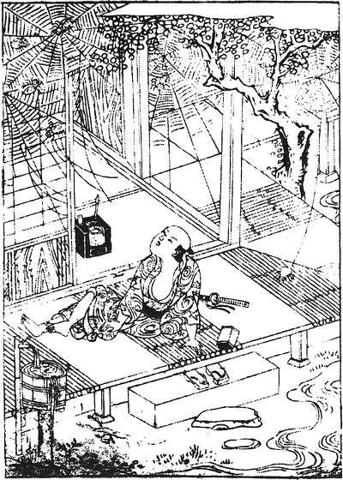
A giant spider of Japanese folklore that takes the shape of a beautiful woman to lure victims into her web, haunting Edo ghost stories and mountain waterfalls.
Also mentioned inTsukumogami (Haunted Objects)Yurei (Japanese Ghosts)
Sources & Further Reading
- 1.Toriyama Sekien. Gazu Hyakki Yagyo (1776) and Konjaku Hyakki Shui (1781), in Sekien Toriyama's Japandemonium Illustrated — The Yokai Encyclopedias of Toriyama Sekien. Translated by Hiroko Yoda and Matt Alt. Dover Publications, 2016.
- 2.Yanagita, Kunio. The Legends of Tono. Translated by Ronald A. Morse. 100th anniversary ed. Lexington Books, 2008.
- 3.Foster, Michael Dylan. Pandemonium and Parade — Japanese Monsters and the Culture of Yokai. University of California Press, 2009.
- 4.Foster, Michael Dylan. The Book of Yokai — Mysterious Creatures of Japanese Folklore. University of California Press, 2015.
- 5.Figal, Gerald. Civilization and Monsters — Spirits of Modernity in Meiji Japan. Duke University Press, 1999.
- 6.Komatsu Kazuhiko. An Introduction to Yokai Culture. Japan Publishing Industry Foundation for Culture, 2017.
Spot an error or have a source to suggest? Write to info@viseterna.com. We cite primary sources and modern scholarship, and we correct fast.