
Setsubun
The eve of spring in the old calendar: roasted beans thrown at oni while households shout "demons out, fortune in," descended from a Heian court exorcism.
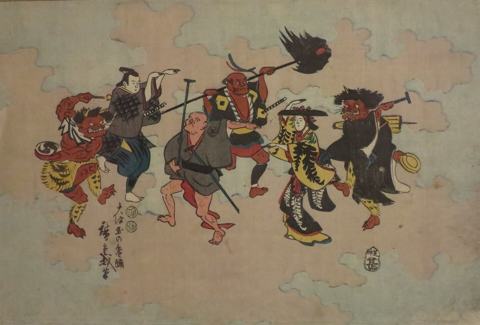
Setsubun no Oni, Katsushika Hokusai, early 19th century · Public domain · source
The Eve Between Winter and Spring
Setsubun, "seasonal division," once marked the eve of any of the four points the old lunisolar calendar used to divide the year — the start of spring, summer, autumn, and winter. By the Edo period the term had narrowed to just one of these, the night before risshun, the beginning of spring, usually 3 or 4 February, because that turn was treated as the effective new year of the older ritual calendar even after the civil new year had moved elsewhere 4,6. What survives today as a single, well-defined household custom is the residue of that older, larger system: the one seasonal boundary important enough to keep its rites after the other three were forgotten 4,6.
Tsuina: The Court Exorcism Behind It
Setsubun's mechanics come from tsuina, also called oni-yarai, a demon-expelling ceremony imported from the Chinese court and performed at the Heian palace on the last night of the year. The Engishiki, the tenth-century compendium of court procedure, sets out the ritual calendar this ceremony belonged to, with an official in a four-eyed mask and bearskin driving out the unseen spirits of pestilence while courtiers shot reed arrows from peach-wood bows at targets nobody could see 1,2. Reider traces how those invisible plague-spirits gradually acquired the visible, horned body of the oni familiar from later art, and how the aristocratic bow-and-arrow rite was gradually supplemented, then largely replaced, by the much simpler act of throwing roasted beans, a change usually placed in the medieval period as the ceremony moved out of the court and into temples and ordinary homes 2.
Beans Out, Fortune In
The modern core of the festival is mamemaki, bean-scattering. Roasted soybeans, fuku mame ("fortune beans"), are thrown from the doorway or at a household member — often the head of the family, or whoever was born in the year's zodiac animal — wearing an oni mask, while everyone shouts oni wa soto, fuku wa uchi: "demons out, fortune in" 2,3. Afterward it is customary to eat one bean for each year of one's age, plus one more for the year ahead, a small act of sympathetic magic meant to secure health through the coming twelve months 3,5. The chant itself varies by region and even by household: a few families and temples associated with names containing "oni," or claiming a benevolent demon ancestor, reverse it to welcome demons in rather than driving them out, which Reider and Komatsu both treat as evidence of how unstable the oni's moral status has always been in local practice 2,4.
The Mask at the Door
Putting an actual demon in the room, however briefly, is the custom's most theatrical touch, and it depends on the same oni imagery — horns, tusks, a tiger-skin loincloth — that developed out of Buddhist hell iconography and Heian directional taboo over the medieval centuries 2. Hokusai's small ink drawing above shows the joke in miniature: an elegantly dressed figure holds up a box of beans while a shrunken, cowering oni crouches at the bottom of the scene, already losing 2. The household oni is rarely frightening for long; within the scene it is a role to be played and then defeated, not a genuine threat to be survived, which is part of why the same figure can appear as comic relief at Setsubun and as a genuine man-eating menace in stories like that of Shuten Doji 2.
Sardine Heads and Other Household Defenses
Bean-throwing is not the season's only defense. In much of western Japan, households pierce a roasted sardine head onto a holly branch, hiiragi iwashi, and hang it at the entrance: the smell is said to repel oni, and the holly's spiked leaves to injure them if the smell alone does not work 3,5. Larger temples and shrines hold public mamemaki with much bigger crowds, sometimes with sumo wrestlers or other local celebrities throwing beans and wrapped sweets from a stage. A newer and more commercial addition, eating an uncut sushi roll called eho-maki in silence while facing the year's lucky compass direction, began as a regional Osaka-area practice and spread nationwide mainly through convenience-store and supermarket marketing from the 1990s onward — a reminder that Setsubun, like most living festivals, keeps acquiring new layers rather than staying fixed in an imagined original form 5.
A Festival Still Practiced, Still Changing
Setsubun today sits opposite Obon on the ritual calendar: one drives unwelcome spirits out at winter's end, the other welcomes ancestral ones in at the height of summer, and between them they frame a year that is still, underneath the modern conveniences, organized around who is allowed to cross the threshold and when 5,6. It is practiced in homes, schools, and major temples across the country every February, changing in small ways each generation while keeping the same basic shape it inherited from a Heian court ceremony aimed at spirits nobody could see 1,2,6.
Continue Exploring
Japan's midsummer festival for the returning dead: welcoming fires, decorated graves, the bon-odori dance, and a Buddhist parable behind all of it.
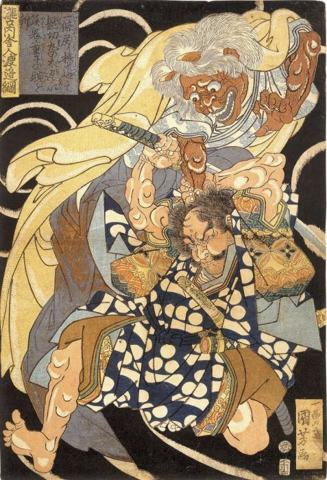
Horned, fanged ogres of Japanese folklore: hell's wardens, mountain bandits and village guardians, driven out with beans every February.
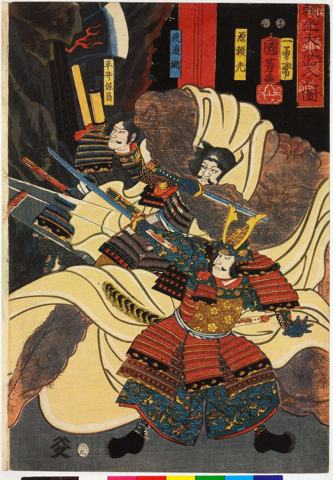
Japan's most famous oni — a demon king who ruled Mount Oe from a stolen palace, until Minamoto no Raiko brought him down with poisoned sake and a sword.
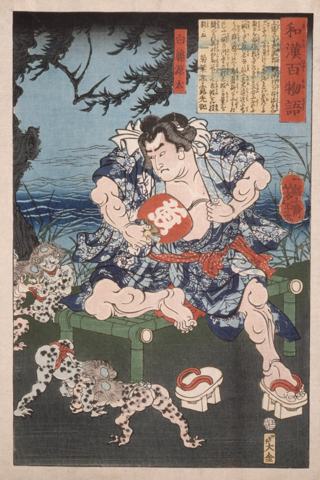
Japan's river-dwelling yokai — beaked and shell-backed, it drowns livestock and challenges travelers to sumo, yet is now a beloved mascot.
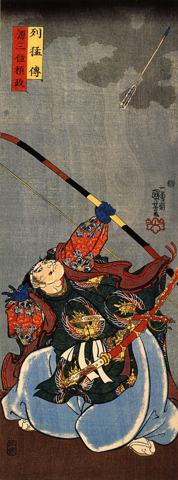
A chimera of monkey, tiger, snake and tanuki that darkened Emperor Konoe's nights in the Tale of the Heike, until archer Minamoto no Yorimasa brought it down.
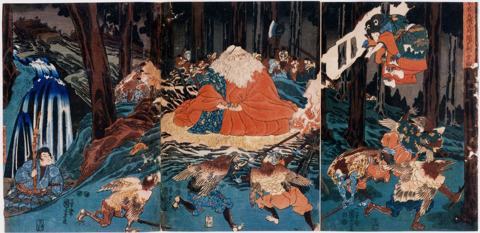
Winged mountain spirits of Japan: crow-beaked tricksters and long-nosed masters of the sword, once Buddhist demons, later guardians of the peaks.
Sources & Further Reading
- 1.Engishiki (Procedures of the Engi Era, 927).
- 2.Reider, Noriko T. Japanese Demon Lore — Oni from Ancient Times to the Present. Utah State University Press, 2010.
- 3.Foster, Michael Dylan. The Book of Yokai — Mysterious Creatures of Japanese Folklore. University of California Press, 2015.
- 4.Komatsu Kazuhiko. An Introduction to Yokai Culture. Japan Publishing Industry Foundation for Culture, 2017.
- 5.Plutschow, Herbert E. Matsuri: The Festivals of Japan. Japan Library, 1996.
- 6.Hardacre, Helen. Shinto: A History. Oxford University Press, 2017.
Spot an error or have a source to suggest? Write to info@viseterna.com. We cite primary sources and modern scholarship, and we correct fast.