
Persephone
The girl carried off in a chariot and the dread queen of the dead. Persephone divides her year between the grain above and the throne below.
Proserpine, Dante Gabriel Rossetti, 1874 (Tate, London) · Public domain · source
Two Names, Two Lives
Persephone is the daughter of Zeus and Demeter, and she has two names because she has two existences 1,3. Above ground and before her marriage she is Kore, simply "the girl" or "the maiden"; below, she is Persephone — a name that appears in a striking range of variants across Greek dialects (Persephoneia, Persephassa, Pherrephatta), which usually signals a word that is not originally Greek. Its meaning is unknown, and the ancient guesses connecting it to "bringer of destruction" are folk etymology 7,8.
Cult kept the two aspects distinct. As Kore she stands beside her mother in the grain rites; as Persephone she is addressed with real fear, and Greek writers often avoid naming her at all, calling her "the maiden" or simply "the goddess" 6,8.
The Abduction
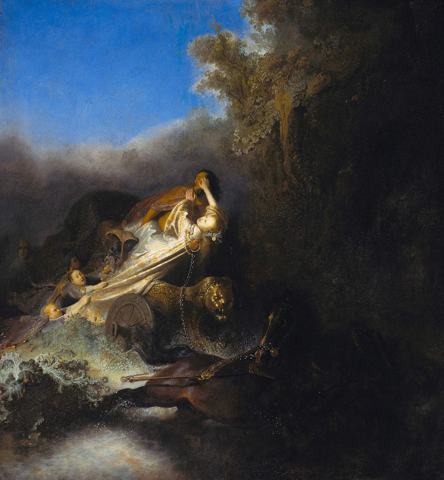
The Homeric Hymn to Demeter tells the story in its fullest early form. Kore is gathering flowers — roses, crocus, violets, iris, hyacinth — with the daughters of Ocean, when Gaia sends up a narcissus of impossible beauty as a snare. She reaches for it, the ground splits, and Hades comes up with his immortal horses and takes her down screaming to her father, who is sitting apart and hears nothing 1.
The hymn is explicit that this is an arranged marriage, not an outrage against the family: Zeus has given his daughter to his own brother without telling her mother 1,7. Later Roman versions, especially Ovid's, shift the emphasis toward romance and toward Sicily, placing the meadow at Enna and adding the nymph Cyane, who dissolves into her own spring in grief 5. Local claims to the site were numerous, and Greek cities from Eleusis to Lerna to Sicily each asserted that the earth had opened in their territory 6.
The Pomegranate
Demeter's strike — the withheld harvest that starves the earth — forces Zeus to send Hermes down to fetch her back. Hades submits with unexpected courtesy, telling his wife that she will rule over everything that lives and hold the greatest honours among the immortals, and then quietly gives her something to eat 1.
In the hymn it is a single pomegranate seed, and Persephone says she was made to swallow it against her will 1. Apollodorus also gives one; Ovid says seven grains, and other traditions give three or four 4,5. The variation is real, and it matters, because in some versions the number of seeds fixes the number of months she must spend below. The hymn's settlement gives her a third of the year in the dark and two thirds with her mother; the familiar half-and-half division is a later simplification 1,5,7.
Whether the story is primarily seasonal is debated. As an agricultural allegory it fits the Mediterranean year awkwardly, and many scholars read it instead — or additionally — as a myth about the violence of marriage, the separation of daughters from mothers, and the initiate's passage through symbolic death 7,8.
The Dread Queen
Once below, Persephone is not a victim but a sovereign, and Homer, who never tells the abduction at all, knows only this side of her. In the Odyssey she is "dread Persephone", the power who sends up the ghosts of women for Odysseus to see and can scatter them at will; Circe's instructions treat her, not Hades, as the one whose consent governs the encounter 2.
She is the goddess who grants or refuses passage out of death. She yields to Orpheus' music and lets Eurydice go, on the condition he breaks 4,5. She is deceived by Sisyphus, who talks his way back to the upper world on a pretext and does not return 4. She keeps Theseus and Pirithous fixed to their seats when they come to carry her off, and only Theseus is ever released 4,6. When Aphrodite hides the infant Adonis with her in a chest, she opens it, keeps him, and forces Zeus to divide his year — the same bargain she herself lives under 4.
Heracles' descent for Cerberus is permitted, in Apollodorus' telling, by the rulers below on the condition that he take the hound without weapons 4.
Cult and the Mysteries
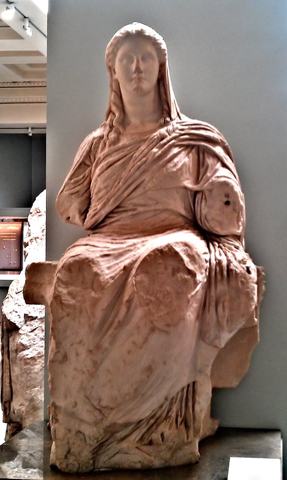
At Eleusis, Persephone's return is the pivot of the Mysteries, the moment the initiates' hope of a better lot after death attaches to 1,7. At Locri Epizephyrii in southern Italy, thousands of terracotta plaques show her enthroned beside Hades, receiving offerings from women, in a cult that treated her as the patron of marriage rather than an object of pity 6,8.
The gold leaves buried with initiates of Orphic and Bacchic groups, found from Thessaly to Crete to Italy, are addressed to her: the dead declare their purity, claim kinship with the divine, and ask to be sent to the seats of the blessed — see Elysium 7,8. Late Orphic tradition also makes her the mother, by Zeus, of the first Dionysus, though the antiquity of that story is contested 8.
To the Romans she was Proserpina, and it is under that name and through Ovid that she reached Dante, Milton, Bernini and the Pre-Raphaelites — Rossetti's painting above shows her with the fatal pomegranate already bitten 5,7.
Continue Exploring
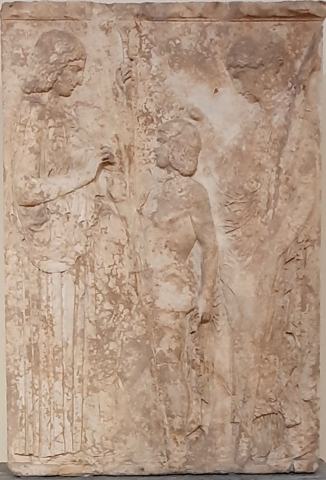
The secret initiation rite of Demeter and Persephone at Eleusis, the most prestigious mystery cult in the Greek world for nearly two thousand years.
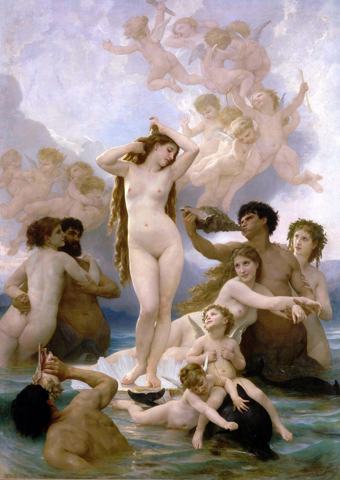
Born from sea foam or fathered by Zeus — the goddess of desire, whose power over gods and mortals starts wars as easily as marriages.
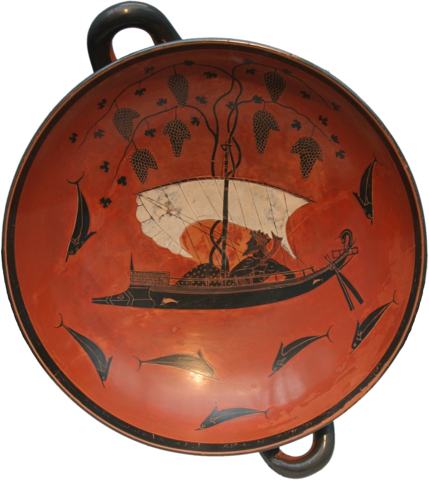
Twice-born god of wine, madness and the mask. He dissolves the boundary between god and beast, and destroys the cities that refuse him.
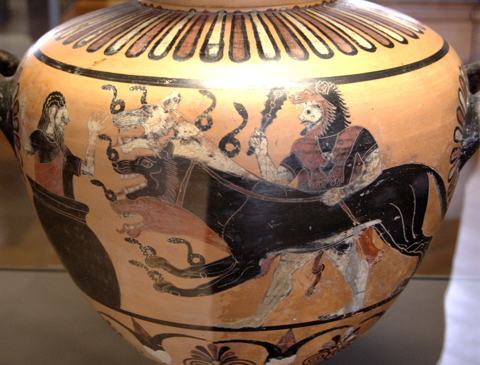
The many-headed hound who guards the gates of the underworld. He fawns on everyone who enters and devours anyone who tries to leave.
Lord of the underworld and of the wealth beneath the earth. Not a devil — a grim, lawful king whose only rule is that no one leaves.
Goddess of grain and the mother who stopped the world's harvest to get her daughter back. Founder of the Eleusinian Mysteries.
Also mentioned inTheseus
Sources & Further Reading
- 1.Homeric Hymn 2, To Demeter (c. 650-550 BC).
- 2.Homer, Odyssey — Books 10 and 11, the Nekyia (c. 8th-7th century BC).
- 3.Hesiod, Theogony (c. 700 BC).
- 4.Apollodorus, Bibliotheca (Library), 1st-2nd century AD.
- 5.Ovid, Metamorphoses Book 5 and Fasti Book 4 (c. AD 8 and AD 8-17).
- 6.Pausanias, Description of Greece — Books 1, 8 and 9 (c. AD 160-180).
- 7.Foley, Helene P. (ed.). The Homeric Hymn to Demeter — Translation, Commentary, and Interpretive Essays. Princeton University Press, 1994.
- 8.Burkert, Walter. Greek Religion. Trans. John Raffan. Harvard University Press, 1985.
Spot an error or have a source to suggest? Write to info@viseterna.com. We cite primary sources and modern scholarship, and we correct fast.