
Lia Fail (the Stone of Destiny)
A standing stone on the Hill of Tara said to roar beneath Ireland's rightful king; the rival Scottish claim on it is a much later legend, not medieval fact.
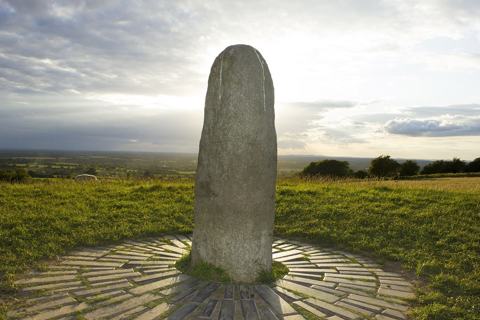
The Lia Fail on the Hill of Tara, photograph by John J. Duncan, 2012 · CC BY-SA 4.0 · source
A Stone on a Royal Hill
The Lia Fail, "the Stone of Fal," is a rough, unworked pillar stone standing on the Hill of Tara in County Meath, the ceremonial and legendary seat of the High Kings of Ireland 4,5. It is one of many monuments on a hill occupied and reused across thousands of years, including the Neolithic passage tomb known as Duma na nGiall, the Mound of the Hostages, and medieval texts place the stone near that mound, associating it directly with royal inauguration on the site 4,5. As a physical object it is simply a granite pillar, roughly a metre and a half tall; it carries no inscription, and nothing about its shape independently dates it or proves its use in any particular period, so everything that makes it more than a large rock comes from the texts written about it centuries after any inauguration it may have witnessed 5,6.
The Stone That Screamed
In Lebor Gabala Erenn, the Lia Fail is one of the Four Treasures the Tuatha De Danann bring to Ireland from their city of Falias, and its defining power is stated flatly: it cries out beneath the man with a rightful claim to the kingship 2. The fullest narrative use of that power comes in Baile in Scail, "The Phantom's Frenzy," where Conn of the Hundred Battles treads on the stone by chance while walking the ramparts of Tara, and it roars under him; a phantom in an otherworldly house then reveals, through a druid's interpretation, how many kings of Conn's line will rule after him, one roar for each 1. The Dindshenchas tradition adds a darker note to the same stone's history, recording that it had earlier fallen silent for an unworthy claimant and, in one strand of legend, that Cu Chulainn split it with his sword when it refused to cry out for a king he favoured, so that its later roar for Conn was itself remarkable 3. None of this should be read as a record of an actual inauguration ritual; it is origin-legend and dynastic propaganda, composed to root a ruling line's authority in an object nobody could argue with 4,6.
Moved for the Dead
The stone's current position, standing on top of the mound called An Forradh near the summit of Tara, is not its medieval one. It was erected there in the nineteenth century, and local tradition holds that the move was made to mark the mass grave of United Irish rebels killed at the nearby Battle of Tara on 26 May 1798, turning a monument built around royal legitimacy into a memorial for men who died fighting royal authority 5. The battle and its dead are historical fact; the specific claim that the stone was repositioned for this reason is repeated widely but is itself a report of local and antiquarian tradition rather than a documented decision, so it belongs with the stone's other layers of legend rather than beside it as settled archaeology 5.
A Later Legend from Scotland
From the fourteenth century on, Scottish chroniclers including John of Fordun claimed that the Lia Fail and the Stone of Scone, used for centuries to inaugurate the kings of Scotland, were one and the same object, supposedly lent to the legendary king Fergus around 500 CE and never returned 7. The story is medieval political theology rather than archaeology: geological examination of the stone that sat at Scone and later at Westminster identifies it as a local sandstone quarried in the vicinity of Scone itself, not a stone that ever travelled from Ireland, and modern scholarship treats the Fergus story as a later legend built to give Scottish kingship an ancient, borrowed legitimacy rather than as a record of an actual journey 7. The genuine relationship between the two traditions is that both draw on the same widespread motif of a stone that authenticates a king, not that they share one physical rock 6,7.
What Is Left When the Legend Is Set Aside
Archaeologically, Tara is real and extraordinarily rich, surveyed in detail by Conor Newman's Discovery Programme project and by the essay collection Edel Bhreathnach edited on the site's kingship and landscape, and the hill demonstrably functioned as a focus of ritual and political power for millennia 5,6. The Lia Fail itself sits inside that landscape without independent proof of its own antiquity or original function; its authority comes entirely from the stories layered onto it, Lebor Gabala's treasure list, Baile in Scail's prophecy, the Dindshenchas's memory of an earlier silence, and, much later, an invented Scottish pedigree, and separating those layers is the only honest way to describe what is standing on Tara today 4,5,6.
Continue Exploring
Four wonder-objects the Tuatha De Danann brought to Ireland: a screaming stone, an unstoppable spear, an inescapable sword, and a cauldron that never runs dry.
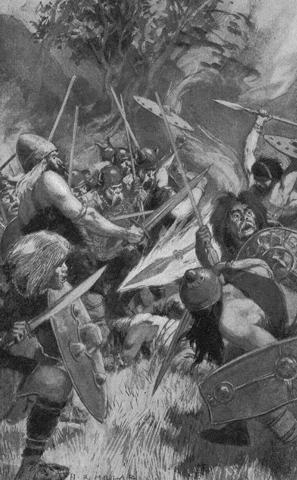
Ireland's race of gods — arriving with four treasures from four lost cities, winning Ireland twice, then losing it once and withdrawing into the mounds.
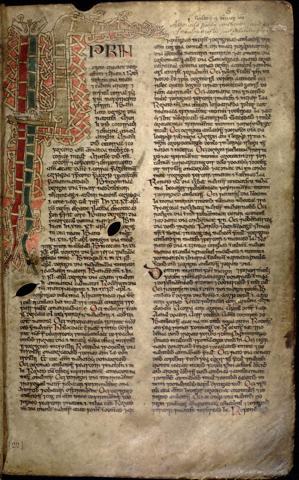
A medieval synthetic history of Ireland: six waves of settlers, the Tuatha De Danann, and the Gaelic Milesians, engineered to answer to the Bible.
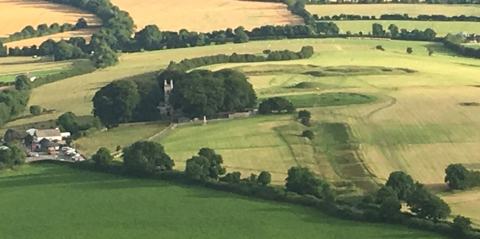
A low Meath hilltop layered with 5,000 years of earthworks, remembered as the seat of Ireland's High Kings — a title the archaeology alone cannot confirm.
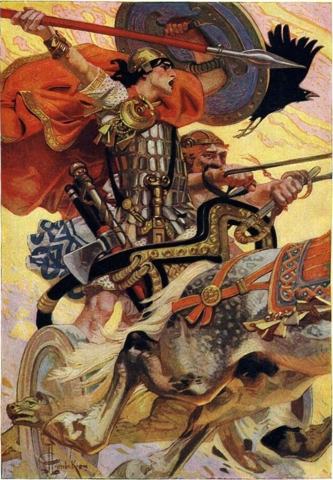
The Hound of Ulster — a boy-hero who holds an entire army at a ford, warps into a monster when he fights, and dies standing up, tied to a stone.
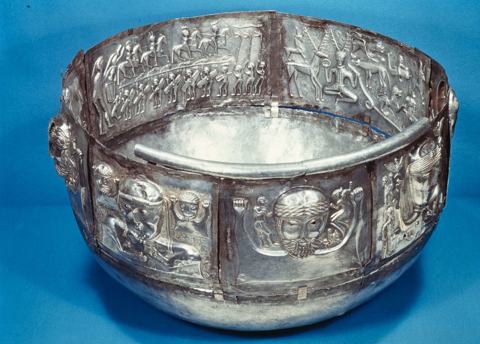
A lavishly decorated silver cauldron pulled from a Danish bog in 1891, made by Thracian silversmiths for Celtic patrons and covered in gods no text explains.
Sources & Further Reading
- 1.Baile in Scail (The Phantom's Frenzy), ed. and trans. Kevin Murray. Irish Texts Society 58, 2004.
- 2.Macalister, R. A. Stewart (ed. and trans.). Lebor Gabala Erenn, The Book of the Taking of Ireland, Parts I-V. Irish Texts Society, 1938-1956.
- 3.Gwynn, Edward (ed. and trans.). The Metrical Dindshenchas. Royal Irish Academy, Todd Lecture Series, 1903-1935.
- 4.Petrie, George. "On the History and Antiquities of Tara Hill." Transactions of the Royal Irish Academy 18 (1839).
- 5.Newman, Conor. Tara, An Archaeological Survey. Royal Irish Academy / Discovery Programme, 1997.
- 6.Bhreathnach, Edel (ed.). The Kingship and Landscape of Tara. Four Courts Press, 2005.
- 7.MacKillop, James. Dictionary of Celtic Mythology. Oxford University Press, 1998.
Spot an error or have a source to suggest? Write to info@viseterna.com. We cite primary sources and modern scholarship, and we correct fast.