
Mount Kunlun
China's cosmic mountain in the far west — the Yellow Emperor's earthly capital, the Queen Mother's paradise, and, confusingly, a real Asian mountain range too.
Celebration in Jade Pool (Gathering of Immortals at the Lake of Gems), Zhang Wo, 1341, Yuan dynasty (National Palace Museum, Taipei) · Public domain · source
A Mountain in Two Registers
Kunlun names two different things that Chinese tradition has never fully separated. One is mythic: a cosmic peak in the far west, an axis between earth and heaven, home in different eras to the Yellow Emperor's earthly court and to Xiwangmu's paradise of immortals 1,6. The other is real: one of Asia's longest mountain chains, more than three thousand kilometres along the northern rim of the Tibetan Plateau, given the name Kunlun by Han-dynasty explorers who believed, wrongly as it turned out, that they had located the mythic mountain's earthly counterpart 4. The two Kunluns share a name, a rough direction, and almost nothing else, and the confusion between them is old enough to be part of the mountain's own history rather than a modern mistake 4,6.
The Yellow Emperor's Earthly Capital
The Shanhaijing is where the mythic geography first appears in detail, and its Kunlun is not, at first, Xiwangmu's at all. The "Classic of Regions Within the Seas" describes Kunlun Xu, the "Mound of Kunlun," as a walled, nine-gated terrace pierced by nine wells and guarded by Kaiming, a nine-headed beast with a tiger's body facing east 1. This is named plainly as the lower, earthly capital of the high god, in most readings the Yellow Emperor, with its own treasuries, gardens, and staff of minor guardian spirits 1. Xiwangmu, in the Shanhaijing's older layer, keeps a separate address entirely: Mount Yu, in the western mountains chapter, well apart from Kunlun Xu 1.
The Nine Levels of the Huainanzi
A different, more systematic cosmology appears a century or two later in the Huainanzi, compiled under the patronage of Liu An, Prince of Huainan. Its "Treatise on Terrestrial Forms" stacks Kunlun into tiers: the lowest slopes are called Liangfeng, the "Cool Wind" terrace, and climbing it grants immortality; above that stands Xuanpu, the "Hanging Garden," which grants magical potency; and above that again the mountain simply becomes Heaven itself, residence of the high god 3. This is architecture rather than travelogue, a graduated ladder of attainment mapped onto a single peak, and it is the version later Daoist religious geography draws on most directly when it comes to describe the mountain as the seat of an entire bureaucracy of transcendents rather than a single palace 3,5.
King Mu's Visit, and the Merger With Xiwangmu
The Mu tianzi zhuan supplies the story that eventually welds the mountain to the goddess. King Mu of Zhou, driving his eight famous horses west, is said to climb Kunlun to inspect the treasuries and gardens of the Yellow Emperor's old capital, and separately, in the same itinerary, to banquet with Xiwangmu at the Turquoise Pond, exchanging sung verses with her before turning for home 2. The text does not yet fully identify the pond with Kunlun itself, but later writers closed that gap; by the time of the Six Dynasties Han Wudi neizhuan, Xiwangmu's palace and Kunlun's peak have become the same address, and Cahill's study of her medieval cult treats the merger as a real, traceable development rather than a simple later confusion of two older stories 5.
The Real Mountains, Misnamed on Purpose
The historical identification came from an actual expedition. The Shiji's account of the Han court's dealings with Central Asia records that Emperor Wu sent officers to trace the Yellow River to its source; when they returned with a location, the emperor consulted the old classics and formally declared the mountain there to be Kunlun, regardless of whether the identification held up under scrutiny 4. It did not, by later and modern geographic knowledge, the Yellow River does not in fact rise in the range now called Kunlun, but the name stuck, and the real Kunlun Mountains, running through Xinjiang, Qinghai, and Tibet, have carried it ever since, entirely disconnected from the mythic mountain's nine gates and hanging gardens 4,6.
Kunlun After the Myth Settled
By the Tang dynasty, Daoist writers had finished the job the Mu tianzi zhuan only began, making Kunlun Xiwangmu's uncontested seat and the registry-office of the transcendent bureaucracy she was believed to administer 5. Later vernacular fiction kept the address without much of the theology behind it: Journey to the West sends its immortals to Kunlun-adjacent paradises as a matter of course, and the peaches of immortality that Sun Wukong steals grow specifically in Xiwangmu's orchard there 1. A mountain that started as two separate addresses in the oldest sources, one bureaucratic and one plague-ridden and monstrous, ended up as Chinese literature's single most reliable answer to the question of where the immortals live 1,5,6.
Continue Exploring
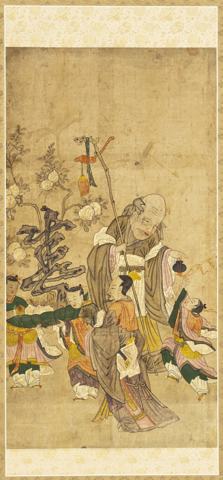
The fruit that ripens once every three thousand years in the Queen Mother's orchard — eaten by the wrong guest, it triggered heaven's most famous brawl.
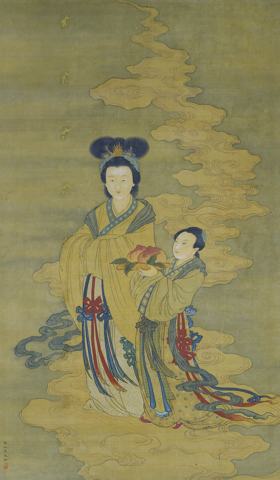
A tiger-toothed mountain spirit who became China's greatest goddess of immortality, keeper of the peaches that ripen once in three thousand years.
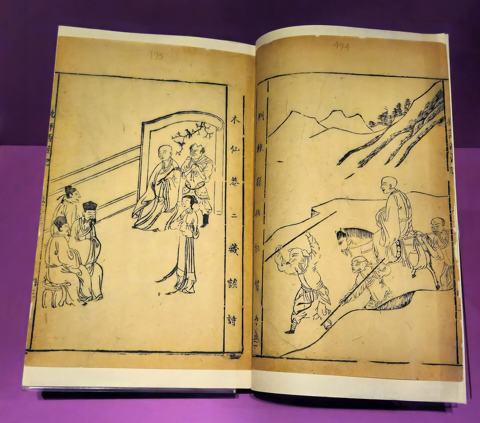
The Ming novel that sent a monk and three monster disciples across demon country for Buddhist scripture — and gave Sun Wukong to the world.
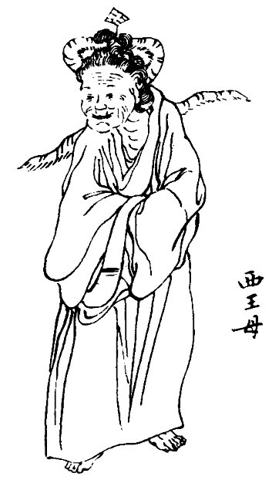
China's oldest surviving catalogue of mountains, monsters, and gods — a text nobody can name an author for, and half this Codex's bestiary depends on.
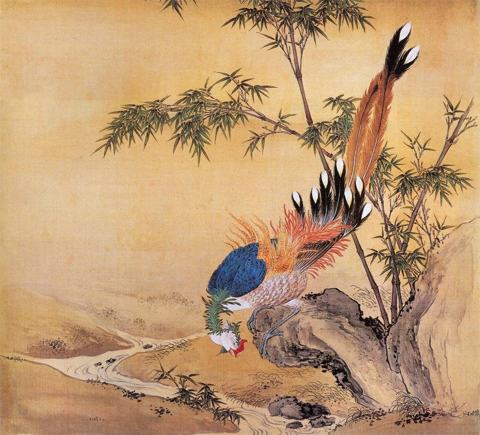
The radiant bird of Chinese myth — ruler of all birds, marked with the five virtues, whose rare appearance announces a just reign and an age of peace.
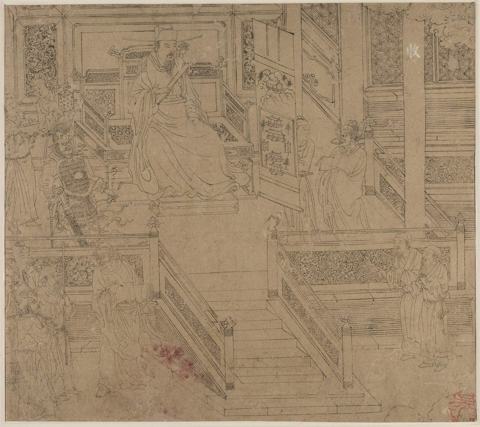
The Chinese underworld — a bureaucracy of ten courts where the dead are tried, serve sentences for what they did, and are then sent back into rebirth.
Sources & Further Reading
- 1.Shanhaijing — The Classic of Mountains and Seas (compiled c. 4th century BCE - 2nd century CE); trans. Anne Birrell. Penguin Classics, 1999.
- 2.Mu tianzi zhuan — The Account of Mu, Son of Heaven (recovered from a tomb in 279 CE; text probably 4th-3rd century BCE).
- 3.Huainanzi — 'Dixing xun' (Treatise on Terrestrial Forms), compiled under Liu An, King of Huainan, c. 139 BCE.
- 4.Sima Qian, Shiji — 'Dayuan liezhuan' (Account of Dayuan), c. 94 BCE.
- 5.Cahill, Suzanne E. Transcendence and Divine Passion: The Queen Mother of the West in Medieval China. Stanford University Press, 1993.
- 6.Yang, Lihui & Deming An. Handbook of Chinese Mythology. ABC-CLIO, 2005.
Spot an error or have a source to suggest? Write to info@viseterna.com. We cite primary sources and modern scholarship, and we correct fast.