
Shanhaijing (Classic of Mountains and Seas)
China's oldest surviving catalogue of mountains, monsters, and gods — a text nobody can name an author for, and half this Codex's bestiary depends on.
Xiwangmu, illustration from a printed edition of the Shanhaijing · Public domain · source
A Book With No Author
The Shanhaijing — "Guideways Through Mountains and Seas," usually rendered Classic of Mountains and Seas — is the foundational catalogue of Chinese myth, and almost nothing about its origin is settled 1,3. Traditional scholarship credited it to the flood-taming hero Yu the Great and his minister Boyi, sage authors placed at the dawn of the Xia dynasty; the Han-dynasty bibliographer Liu Xin, who produced the first formal edition, endorsed the attribution, and the fourth-century commentator Guo Pu, whose notes still accompany the text today, accepted it too 1. Modern scholarship treats this as pious fiction. The material was compiled in layers, probably between the fourth century BCE and the early Han, out of separate regional sources only later stitched into one book — the Qing-dynasty scholar Bi Yuan was already arguing this on textual grounds two centuries ago, and Birrell's and Strassberg's modern translations both treat the text as a composite rather than a single author's work 1,2,3.
Eighteen Guideways
The book's structure is a catalogue disguised as an itinerary. Its core "Mountain" chapters move from range to range in fixed compass order, giving for each peak its distance from the last, the rivers that rise there, the minerals and plants found on it, and the spirits that must be sacrificed to — a ritual gazetteer as much as a work of geography 1,3. Surrounding this core are later sections, "Regions Beyond the Seas," "Regions Within the Seas," and the "Great Wilderness" chapters, which abandon the itinerary format for looser accounts of foreign peoples, culture heroes, and the deeds of gods 1. Eighteen sections in total describe several hundred mountains and watercourses, and scholars still argue over whether any of it maps onto real geography, or whether the compass directions and distances are a cosmological scheme dressed as a travelogue 2,3.
A Catalogue of Monsters
What makes the book famous today is not its geography but its bestiary. Nearly every entry pairs a place with a creature: a composite animal built from parts of familiar ones, given a name, a description, and usually a prediction of what its appearance means for the human world 2. Fenghuang appears here with its markings read as the five Confucian virtues, the Chinese dragon tradition draws on the book's Zhulong and Yinglong, and the moon-goddess Chang'e has a possible antecedent in the text's twelve-moon-bathing Chang Xi 1. Strassberg's translation catalogues the recurring grammar behind these hybrids, human face on beast body, extra eyes, extra tails, and reads it as a deliberate rhetoric of the monstrous rather than random invention 2.
Xiwangmu and Kunlun
The book's oldest and strangest portrait is of a goddess later civilised almost beyond recognition. In the "Classic of the Western Mountains," Xiwangmu lives on Mount Yu with a human face, a leopard's tail, and tiger's teeth, and is named ruler over the sky's calamities and the five punishments — a plague deity, not yet a queen 1. Elsewhere the text separately describes Kunlun Xu, the "Mound of Kunlun," as the terrestrial capital of the high god, walled and nine-gated, a distinct strand of cosmic geography that Mount Kunlun tradition would only later fuse with Xiwangmu's own mountain 1,4. The Shanhaijing keeps the two more or less apart; the merger is an achievement of later Han and Six Dynasties writers working from this raw material 1,4.
Read as Fantasy, Not as Fact
Not everyone in antiquity took the book seriously as geography. Sima Qian, compiling the Shiji not long after the text reached something like its present form, declined to use it as a historical source, saying he dared not speak of the strange beings it recorded 3. That scepticism has had a long afterlife: Yang and An's survey of the field notes that the book's status has swung between "corrupted geography," "shamanic ritual manual," and "proto-encyclopedia of natural history" across a century of scholarship, without settling on one 4. Sterckx's broader study of animals in early Chinese thought argues that the uncertainty is itself instructive — early Chinese writing did not draw the firm line between the natural and the monstrous that later, more zoological texts would try to draw, and the Shanhaijing is the fullest surviving record of that older, more porous view of the animal world 5.
Afterlife of a Strange Book
The Shanhaijing never stopped being read. The poet Tao Yuanming wrote a cycle of poems "on reading the Shanhaijing" in the fifth century, treating it as a private pleasure rather than a reference work 3. Its bestiary fed directly into later fiction: Journey to the West's monster-haunted geography draws constantly on its vocabulary of hybrid beings, and its account of Xiwangmu underlies her role in that novel's Peach Banquet 1. Illustrated editions multiplied from the Ming dynasty onward, giving faces to creatures the text only describes in words, and modern translations by Birrell and Strassberg have carried the book to English readers for the first time in anything like a complete form — proof that a text nobody can name an author for has outlasted almost everyone who tried to explain it 2,3.
Continue Exploring
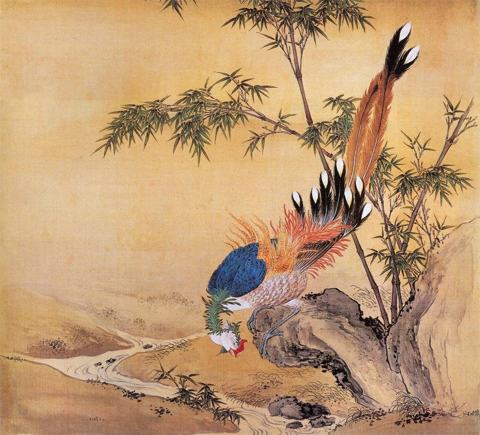
The radiant bird of Chinese myth — ruler of all birds, marked with the five virtues, whose rare appearance announces a just reign and an age of peace.
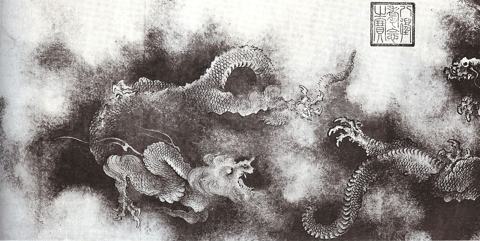
China's dragon — a benevolent, scaled power of rain, river, and sea, emblem of imperial authority and the only mythical beast in the zodiac.
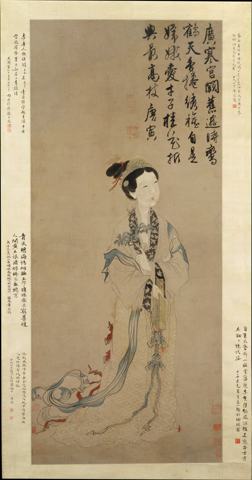
The moon goddess who swallowed the elixir of immortality and rose beyond reach — honoured each Mid-Autumn Festival with mooncakes and lanterns.
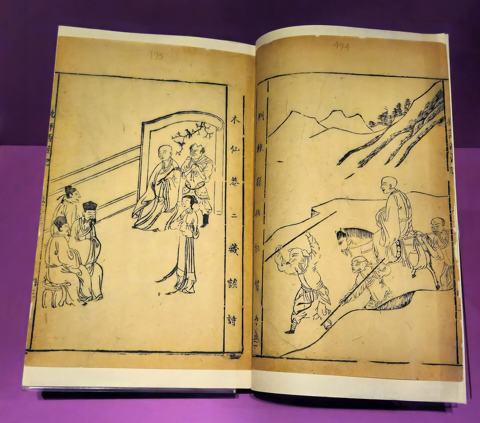
The Ming novel that sent a monk and three monster disciples across demon country for Buddhist scripture — and gave Sun Wukong to the world.
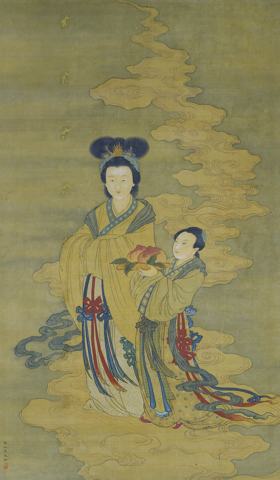
A tiger-toothed mountain spirit who became China's greatest goddess of immortality, keeper of the peaches that ripen once in three thousand years.
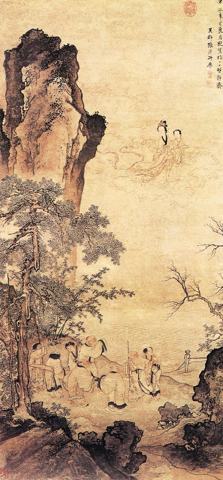
China's cosmic mountain in the far west — the Yellow Emperor's earthly capital, the Queen Mother's paradise, and, confusingly, a real Asian mountain range too.
Sources & Further Reading
- 1.Shanhaijing — The Classic of Mountains and Seas (compiled c. 4th century BCE - 2nd century CE); trans. Anne Birrell. Penguin Classics, 1999.
- 2.Strassberg, Richard E. (trans.). A Chinese Bestiary: Strange Creatures from the Guideways through Mountains and Seas. University of California Press, 2002.
- 3.Birrell, Anne. Chinese Mythology: An Introduction. Johns Hopkins University Press, 1993.
- 4.Yang, Lihui & Deming An. Handbook of Chinese Mythology. ABC-CLIO, 2005.
- 5.Sterckx, Roel. The Animal and the Daemon in Early China. State University of New York Press, 2002.
Spot an error or have a source to suggest? Write to info@viseterna.com. We cite primary sources and modern scholarship, and we correct fast.