
The Flower Wars (Xochiyaoyotl)
Ritualized battles between the Aztec Triple Alliance and its nearest unconquered neighbors, fought to take captives — and whose real purpose is still disputed.
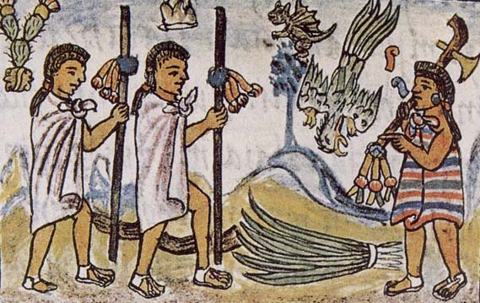
The defeat at Atlixco against the Huejotzinca, Historia de las Indias de Nueva Espana (Diego Duran manuscript), folio 168v, c. 1581 · Public domain · source
Battles With a Fixed Address
The xochiyaoyotl, "flower war" — from xochitl, flower, and yaoyotl, war — named a category of combat the Triple Alliance fought against a short list of nearby, never-conquered states: chiefly Tlaxcala and its neighbors Huejotzinco and Cholula in the Puebla-Tlaxcala valley, sometimes joined by Tliliuhquitepec 1,3. Unlike a campaign of conquest, a flower war is described in the colonial sources as fought by prior arrangement, at agreed times and places, between forces that were kept roughly equal, with close-range weapons such as the obsidian-edged macuahuitl favored over projectile arms, and its stated goal was not territory but living captives 1,4.
Tlacaelel's Bargain
Duran preserves the fullest founding story. After a series of Basin of Mexico famines in the 1450s, so severe that people reportedly sold themselves into slavery for maize, the Mexica statesman Tlacaelel is credited with proposing a standing arrangement with Tlaxcala, Huejotzinco, and Cholula: since the empire had outgrown its ability to make ordinary war on its remaining close neighbors without destabilizing the whole region, the four powers would instead meet periodically on a kind of open, understood battlefield, less to conquer each other than to keep both sides supplied with prisoners for sacrifice 1. Whether this is real fifteenth-century policy or a tidy origin story assembled for a Spanish friar decades later, it is the account nearly every later summary of the flower wars still relies on 1,6.
Captives for the Sun
The rationale the sources give is theological: the sun's motion had to be paid for in chalchihuatl, "precious water," the blood of sacrifice, and ordinary conquest warfare could not supply captives fast enough or reliably enough once the empire's borders had pushed its most convenient enemies out of easy reach 1,6. That is the same logic recorded around Huitzilopochtli's cult at Templo Mayor, where war captives were the expected offering at the war god's principal festivals — the flower war, on this reading, simply kept that supply running against opponents too strong, too useful as a buffer, or too far from home to be worth annexing outright 1,6.
When the Rules Broke: Atlixco
The historical record does not stay tidy. One of the best-documented flower-war engagements, a battle fought at Atlixco against Huejotzinco, ended in a rout of the Mexica force, illustrated in Duran's manuscript with warriors down and dying beside their shattered shields — a reminder that "ritual" combat still killed real soldiers and could be genuinely lost 1. Elsewhere the Tlaxcalan chronicler Munoz Camargo, writing from the losing empire's perspective after the conquest, describes Mexica pressure on Tlaxcala that looks far more like a real siege economy than a scheduled contest: blockades that cut off salt and cotton, and sustained attempts to starve the republic into submission rather than simply harvest its warriors on an appointed day 2.
The Debate: Ritual, Training, or Strategy
Modern historians read this contradiction differently. Some scholars, taking Moctezuma II's own later explanation at face value, treat captive-taking for sacrifice and warrior training as the flower wars' real and sufficient purpose 1,6. Frederic Hicks argued that this framing obscures a harder political reality: Munoz Camargo's account of embargoes and attempted starvation suggests conquest, or at least coerced submission, was very much on the table, and that "flowery war" may be as much a later gloss smoothing over ordinary imperial pressure as it is a distinct institution 2,5. Ross Hassig's synthesis of Aztec military practice takes a middle position, proposing that the flower wars served several purposes at once — steady attrition of Tlaxcala's manpower and food supply, a live demonstration of Triple Alliance strength to everyone watching, and continued propaganda value in keeping a permanent, visible threat in place without the cost and risk of full annexation 4. None of these readings has become consensus, and the honest state of the field is that scholars agree the flower wars existed and disagree, sometimes sharply, on what they were actually for 4,5.
Still Fighting in 1519
The arrangement was still active when Cortes landed. Tlaxcala's decades of flower-war pressure from the Mexica, whatever its original purpose, is part of why Tlaxcalan leaders chose to ally with the Spanish rather than face Tenochtitlan alone — an old, unresolved war of uncertain purpose helping to decide, in the end, a war of conquest that was not ritual at all 2,4.
Continue Exploring
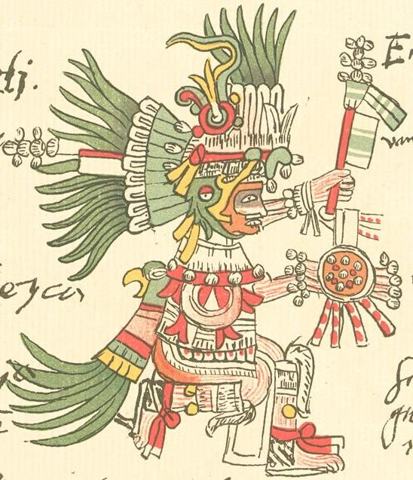
Hummingbird of the Left — the Mexica sun-and-war god, born fully armed on Serpent Mountain and enthroned atop the Great Temple of Tenochtitlan.
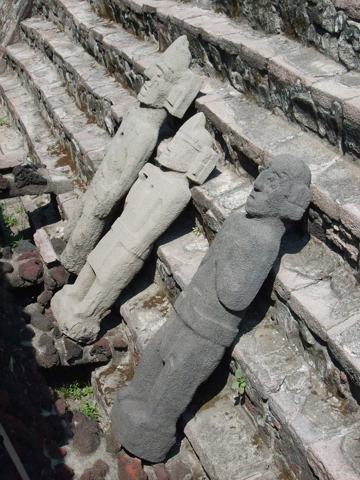
Tenochtitlan's twin pyramid to Huitzilopochtli and Tlaloc, demolished in 1521 and lost until 1978, when electrical workers struck the Coyolxauhqui stone.
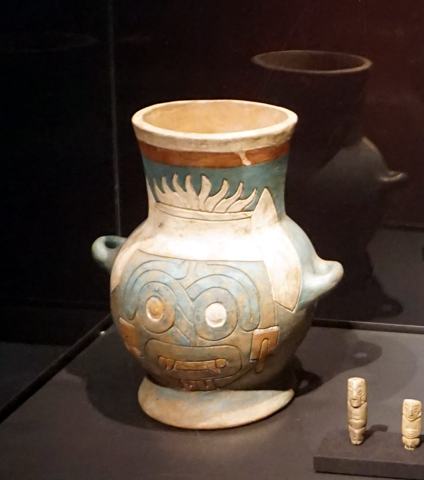
The goggle-eyed rain god who makes things sprout — giver of the storms that feed the maize, keeper of a green paradise, and taker of children.
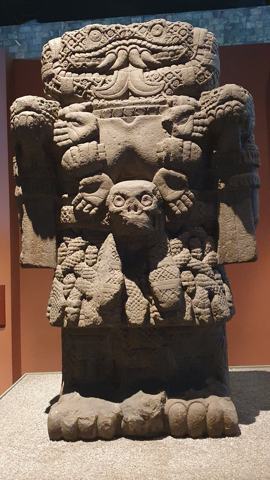
She of the Serpent Skirt — the Mexica earth mother who conceived Huitzilopochtli from a ball of feathers, and the colossal monolith that carries her name.
The 16th-century Nahuatl-Spanish encyclopedia of Aztec life and gods, compiled by a friar with Nahua scholars — the single richest source on Mexica myth.
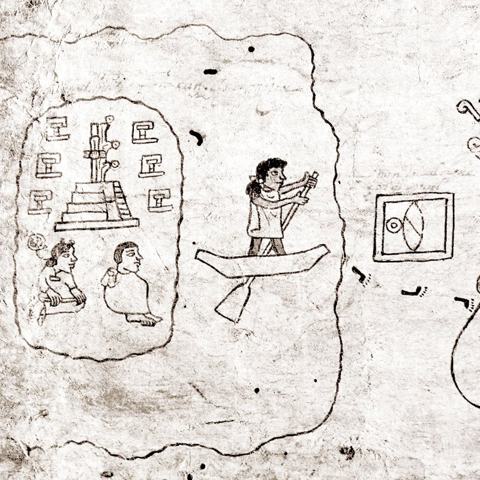
The island homeland the Mexica claimed to have left behind — a founding-migration legend whose real location no one has ever settled.
Sources & Further Reading
- 1.Diego Duran, Historia de las Indias de Nueva Espana e Islas de Tierra Firme (c. 1581).
- 2.Munoz Camargo, Diego. Historia de Tlaxcala (16th century).
- 3.Historia de los Mexicanos por sus pinturas (16th century).
- 4.Hassig, Ross. Aztec Warfare: Imperial Expansion and Political Control. University of Oklahoma Press, 1988.
- 5.Hicks, Frederic. "'Flowery War' in Aztec History." American Ethnologist, 1979.
- 6.Miller, Mary & Karl Taube. The Gods and Symbols of Ancient Mexico and the Maya. Thames & Hudson, 1993.
Spot an error or have a source to suggest? Write to info@viseterna.com. We cite primary sources and modern scholarship, and we correct fast.