
Aztlan
The island homeland the Mexica claimed to have left behind — a founding-migration legend whose real location no one has ever settled.
Codex Boturini (Tira de la Peregrinacion), page 1, Mexica, 16th century · Public domain · source
An Island Behind Them
Aztlan is the legendary point of departure for the Mexica, the people who would go on to found Tenochtitlan: the word gives the Mexica their older name, Azteca, "people from Aztlan" 3,6. Colonial-era pictorial and alphabetic sources describe it as an island in a lake, reached and left by canoe, marked by a temple and by Colhuacan, "the curved hill," which some accounts treat as part of the same place and others as a separate stop nearby 1,3. Two common glosses of the name compete without resolution: "place of herons" and "place of whiteness," and neither has displaced the other in the scholarship 6.
Seven Caves, Seven Peoples
Aztlan is closely bound to Chicomoztoc, the "Place of Seven Caves," from which tradition holds that not just the Mexica but seven related Nahua-speaking peoples emerged together — among them the Xochimilca, the Chalca, the Tepaneca, and the Tlaxcalteca — before going their separate ways to found their own cities 1,2. Whether Aztlan and Chicomoztoc were originally the same place, two stages of one migration, or distinct traditions merged by later scribes varies from source to source, and Boone's survey of the pictorial history manuscripts treats that instability as characteristic of the genre rather than a problem to be solved: each altepetl, each city-state, kept its own version of the shared migration, tailored to its own claims of seniority and right 5.
The Walk to the Eagle and the Cactus
The Mexica departure from Aztlan is framed, across the sources, as an act of will by their patron god: Huitzilopochtli speaks to the priests carrying his bundle and leads the people out on a long walk through the Basin of Mexico and beyond, marked in the Codex Boturini by a chain of footprints and dated place-signs, generation after generation, until the promised sign — an eagle on a cactus — points them to the island where they found Tenochtitlan, crowned in time by the Templo Mayor 1. The Codex Aubin gives the departure a harder edge, describing the Mexica as fleeing tyrannical rule in Aztlan rather than simply setting out, and the Cronica Mexicayotl, compiled from Nahua sources in the early seventeenth century, adds still more names and incidents to the road 2,4. None of these accounts was recorded before the sixteenth century, generations after Tenochtitlan's founding, and all of them serve a political purpose: a migration story that ends in eagle-and-cactus prophecy fulfilled is also a founding charter, told by an empire to explain why it, rather than any of its six sibling peoples, was owed the center 3,5.
Where Was It, If Anywhere
Whether Aztlan corresponds to a real, locatable place has been argued for well over a century without settling. The most persistent candidate is Mexcaltitan de Uribe, a small island town in the coastal state of Nayarit whose causeway-ringed, canal-cut layout has struck generations of visitors as suggestively similar to descriptions of Aztlan and to Tenochtitlan itself; the nineteenth-century historian Alfredo Chavero first proposed the identification, and twentieth-century scholars including Wigberto Jimenez Moreno gave it serious consideration, though it has never become consensus 6. Other researchers have argued for locations much further north, and a substantial body of opinion treats the search itself as misconceived — Aztlan functioning in the sources less as a coordinate to be found than as an origin-myth's homeland, real to the people who told the story and not necessarily real on a map 3,6.
A Name Claimed Again
Aztlan's afterlife runs well past Nahua tradition. In 1969, Chicano activists meeting in Denver adopted Aztlan as the name for a reclaimed ancestral homeland spanning the American Southwest — the territory Mexico ceded to the United States in 1848 — publishing El Plan Espiritual de Aztlan and turning a sixteenth-century migration legend into a live political and cultural symbol still invoked in Chicano and Mexican-American organizing and literature 7. That modern Aztlan is deliberately not a claim about the Mexica's actual sixteenth-century geography; it is a conscious act of reclaiming a name whose original referent was already, for the Mexica themselves, half memory and half myth 7.
Continue Exploring
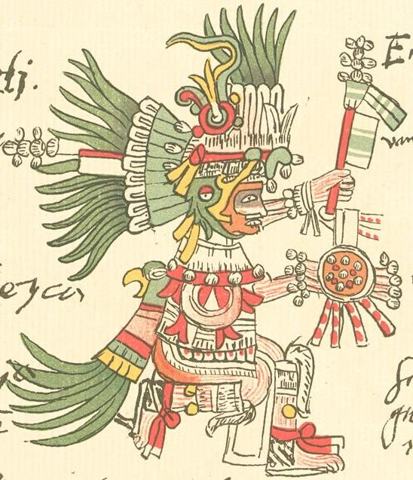
Hummingbird of the Left — the Mexica sun-and-war god, born fully armed on Serpent Mountain and enthroned atop the Great Temple of Tenochtitlan.
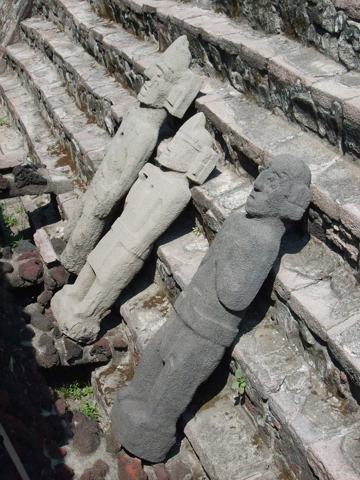
Tenochtitlan's twin pyramid to Huitzilopochtli and Tlaloc, demolished in 1521 and lost until 1978, when electrical workers struck the Coyolxauhqui stone.
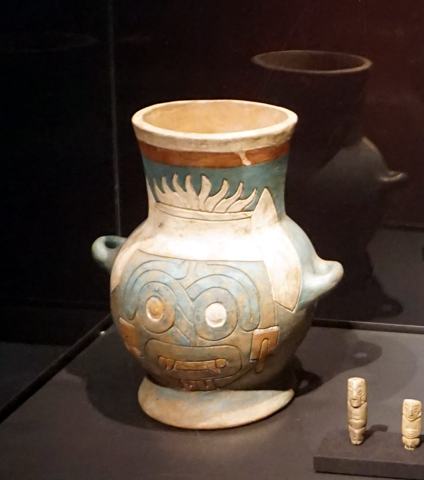
The goggle-eyed rain god who makes things sprout — giver of the storms that feed the maize, keeper of a green paradise, and taker of children.
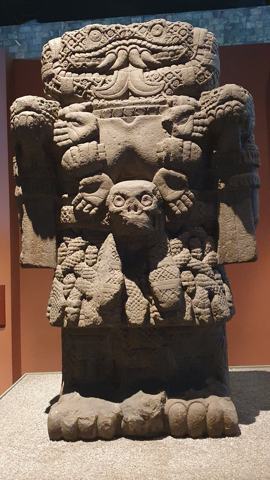
She of the Serpent Skirt — the Mexica earth mother who conceived Huitzilopochtli from a ball of feathers, and the colossal monolith that carries her name.
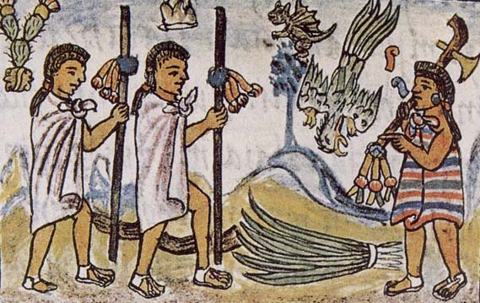
The 16th-century Nahuatl-Spanish encyclopedia of Aztec life and gods, compiled by a friar with Nahua scholars — the single richest source on Mexica myth.
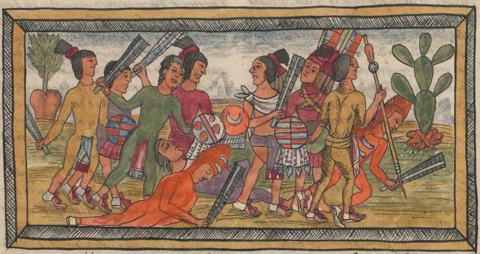
Ritualized battles between the Aztec Triple Alliance and its nearest unconquered neighbors, fought to take captives — and whose real purpose is still disputed.
Sources & Further Reading
- 1.Codex Boturini (Tira de la Peregrinacion). Pictorial manuscript, Mexica, 16th century.
- 2.Hernando de Alvarado Tezozomoc, Cronica Mexicayotl (early 17th century).
- 3.Diego Duran, Historia de las Indias de Nueva Espana e Islas de Tierra Firme (c. 1581).
- 4.Codex Aubin (16th-17th century Nahuatl annals).
- 5.Boone, Elizabeth Hill. Stories in Red and Black: Pictorial Histories of the Aztecs and Mixtecs. University of Texas Press, 2000.
- 6.Miller, Mary & Karl Taube. The Gods and Symbols of Ancient Mexico and the Maya. Thames & Hudson, 1993.
- 7.Anaya, Rudolfo & Francisco Lomeli, eds. Aztlan: Essays on the Chicano Homeland. University of New Mexico Press, 1989.
Spot an error or have a source to suggest? Write to info@viseterna.com. We cite primary sources and modern scholarship, and we correct fast.