
Coyolxauhqui
The dismembered sister of Huitzilopochtli, often read as the moon — and the carved disc whose discovery in 1978 uncovered the Templo Mayor itself.
Coyolxauhqui Stone, Mexica, c. 1473 (Museo del Templo Mayor, Mexico City); photograph by Thelmadatter, 2008 · Public domain · source
Bells on Her Cheeks
Coyolxauhqui is built from Nahuatl coyolli, a small bell of the kind cast in copper or gold, and a verb of painting or adorning: "she who is painted with bells", or "she of the golden bells" 4,6. The name describes her image directly. In every surviving depiction she wears a round bell on each cheek, and those two discs are the surest way to identify her in stone 3,4.
She is a daughter of Coatlicue and the elder sister of Huitzilopochtli, and she leads the Centzon Huitznahua, the "four hundred southerners" who are her brothers — four hundred in Nahuatl meaning, in practice, an uncountable number 1,4. Outside the one story she is part of, she has almost no independent cult: no festival of her own is recorded, and she appears in the sources principally as the thing Huitzilopochtli defeats 1,4.
Coatepec
The story is told in Book 3 of the Florentine Codex 1. Coatlicue, sweeping on Coatepec, becomes pregnant from a ball of feathers. Coyolxauhqui reads the pregnancy as a dishonour and persuades the four hundred brothers to arm themselves and climb the mountain to kill their mother 1.
One of them, Quauitlicac, warns the unborn child at each stage of the ascent. At the moment the attackers reach the summit, Huitzilopochtli is born fully grown and armed. He takes the fire serpent Xiuhcoatl and strikes his sister with it; her body is cut apart and falls down the slope, arriving at the foot of the mountain in pieces, and he pursues the four hundred around the mountain and destroys them 1. Duran preserves a broadly similar account 2.
The usual modern gloss makes this astronomy: the newborn sun rising in the east cuts down the moon and scatters the stars, night after night 4,6. The reading is old, it is compelling, and it is an inference — the sixteenth-century texts do not say it, and specialists differ on how much lunar identity Coyolxauhqui actually carried before ethnographers went looking for it 4,5. Cecelia Klein and others have argued that the Mexica sources treat her more consistently as a defeated enemy warrior and a dismembered sacrificial victim than as the moon as such 5.
The Stone
On 21 February 1978, electric company workers digging behind the cathedral in the centre of Mexico City struck carved stone. What they had found was a monolithic andesite disc more than three metres across, showing a woman cut into pieces: head thrown back, limbs severed at the joints and arranged around the body, bells on her cheeks, a two-headed serpent knotted at her waist, skull-and-bone tied at her elbows and knees 3.
The find triggered the Templo Mayor Project under Eduardo Matos Moctezuma, which cleared a city block and exposed the successive building stages of the pyramid together with thousands of buried offerings from across the empire 3. In other words, the greatest single excavation in the archaeology of the Aztec capital began because someone found Coyolxauhqui 3.
Its position is what makes it eloquent. The disc lay at the foot of the stairway on the Huitzilopochtli side of the twin pyramid, directly below the shrine at the summit; it is associated with the building stage usually dated to around 1473 3. The pyramid was therefore built as Coatepec. A victim killed at the top and sent down the steps came to rest exactly where the dismembered sister lay, so that the myth was re-enacted on the structure that told it 3,4.
A colossal greenstone head of the goddess, found in the same precinct in the nineteenth century, and a second dismemberment relief recovered later, confirm that the image was repeated rather than unique 3,4.
What the Image Was For
Read as state theology, the Coyolxauhqui stone is an argument. It says that the god of the Mexica was born in an ambush and won, that the enemies of his people are dismembered by definition, and that the temple at the middle of the city is the mountain where it happened 3,4. Sacrificial victims were frequently captives from tributary or rival states; making them fall onto the image of the defeated sister told the political meaning and the cosmological one in a single motion 3,6.
There is also a gendered reading, now common in the scholarship: the one figure in the founding myth who challenges the birth of the war god is a woman, and she is punished by being taken apart in public and permanently displayed in that condition 5.
Reassembly
Modern Chicana writing has taken that last point and inverted it. Gloria Anzaldua developed what she called the Coyolxauhqui imperative: the drive to gather the scattered pieces of a self, a history or a community back into a whole, with the fragmentation on the stone read not as a verdict but as the starting condition of any real repair 7. The framing has since spread well beyond literary criticism, into education, therapy and activist writing.
It is not what the Mexica sculptors meant, and it is worth keeping the two apart 5,7. But the disc has now spent longer above ground as a symbol of putting things back together than it spent below ground as a record of taking them apart.
Continue Exploring
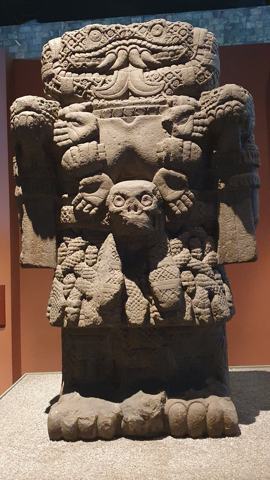
She of the Serpent Skirt — the Mexica earth mother who conceived Huitzilopochtli from a ball of feathers, and the colossal monolith that carries her name.
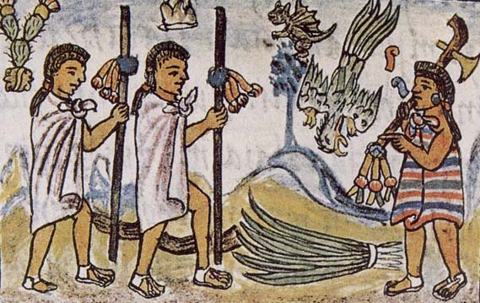
The 16th-century Nahuatl-Spanish encyclopedia of Aztec life and gods, compiled by a friar with Nahua scholars — the single richest source on Mexica myth.
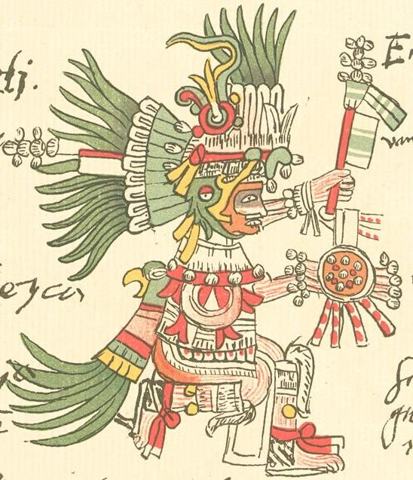
Hummingbird of the Left — the Mexica sun-and-war god, born fully armed on Serpent Mountain and enthroned atop the Great Temple of Tenochtitlan.
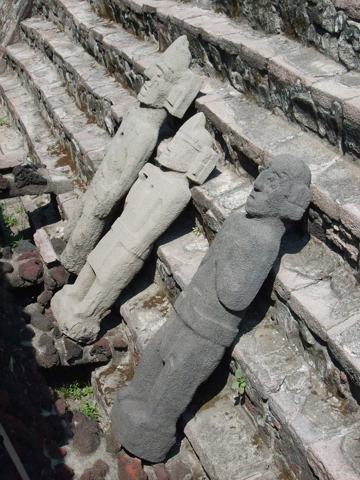
Tenochtitlan's twin pyramid to Huitzilopochtli and Tlaloc, demolished in 1521 and lost until 1978, when electrical workers struck the Coyolxauhqui stone.
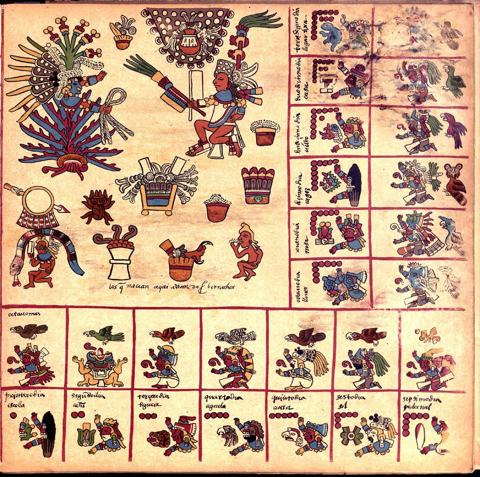
The goddess torn apart and buried to grow the first maguey plant — mother of pulque and of the four hundred rabbit gods of drunkenness.
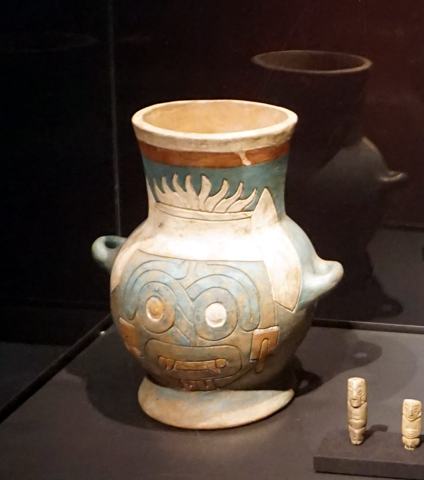
The goggle-eyed rain god who makes things sprout — giver of the storms that feed the maize, keeper of a green paradise, and taker of children.
Sources & Further Reading
- 1.Bernardino de Sahagun, Florentine Codex — General History of the Things of New Spain (c. 1547–1579), Book 3.
- 2.Diego Duran, Historia de las Indias de Nueva Espana e Islas de Tierra Firme (c. 1581).
- 3.Matos Moctezuma, Eduardo. The Great Temple of the Aztecs: Treasures of Tenochtitlan. Thames & Hudson, 1988.
- 4.Miller, Mary & Karl Taube. The Gods and Symbols of Ancient Mexico and the Maya. Thames & Hudson, 1993.
- 5.Klein, Cecelia F. 'A New Interpretation of the Aztec Statue Called Coatlicue, Earth Mother', Ancient Mesoamerica 19 (2008).
- 6.Taube, Karl. Aztec and Maya Myths. British Museum Press / University of Texas Press, 1993.
- 7.Anzaldua, Gloria. Light in the Dark / Luz en lo Oscuro. Duke University Press, 2015.
Spot an error or have a source to suggest? Write to info@viseterna.com. We cite primary sources and modern scholarship, and we correct fast.