
Coatlicue
She of the Serpent Skirt — the Mexica earth mother who conceived Huitzilopochtli from a ball of feathers, and the colossal monolith that carries her name.
Coatlicue monolith, Mexica, late 15th century (Museo Nacional de Antropologia, Mexico City); photograph by Jose Luiz, 2024 · CC BY-SA 4.0 · source
She of the Serpent Skirt
Coatlicue is Nahuatl coatl, serpent, and cueitl, skirt: "she of the serpent skirt" 4. She belongs to a cluster of Mexica earth and mother goddesses whose names and attributes overlap so thoroughly that colonial writers used them almost interchangeably — Cihuacoatl ("serpent woman"), Toci ("our grandmother"), Tonantzin ("our revered mother"), Tlazolteotl, Coatlicue herself 1,4. Modern scholarship generally treats these less as separate persons than as names for aspects of a single earth complex, invoked differently by different communities and in different rites 4,5.
The earth in that complex is not gentle. She gives birth and she eats the dead, and the Mexica showed her with the equipment of both: skirts of woven snakes, necklaces of hearts and severed hands, claws where the feet should be 4. Sahagun's informants describe her festivals as occasions of both midwifery and terror, and the goddesses of this group are the patrons of women who died in childbirth, who were honoured exactly as fallen warriors were 1.
The Birth on Coatepec
Her one famous narrative is told in Book 3 of the Florentine Codex 1. Coatlicue is sweeping the temple on Coatepec, Serpent Mountain, when a ball of down drifts out of the sky. She tucks it into her waistband, and when she looks for it again it is gone; she is pregnant 1.
Her daughter Coyolxauhqui takes the pregnancy as an outrage against the family and rouses her four hundred brothers, the Centzon Huitznahua, to climb the mountain and kill their mother 1. Coatlicue is terrified, but the child in her womb speaks to her and tells her not to be afraid. At the moment the attackers reach the summit, Huitzilopochtli is born fully grown and armed; he takes up the fire serpent Xiuhcoatl, strikes Coyolxauhqui down, and scatters the four hundred 1.
The episode is commonly read as a solar allegory — dawn destroying moon and stars — but the sixteenth-century sources do not state that, and the reading is a modern inference that some specialists accept and others treat as an over-tidy imposition 4,5. What the text does state plainly is dynastic: the story explains why the Mexica god required war, and it was built into stone at the Templo Mayor, whose Huitzilopochtli side was made to be Coatepec 6.
The Monolith
Most people who know the name know it from a single object: a 2.5-metre andesite colossus in the Museo Nacional de Antropologia in Mexico City, unearthed on 13 August 1790 when the viceregal government was repaving the main plaza — months before the same works produced the Sun Stone 3,4.
The figure is decapitated, and from the stump rise two facing rattlesnake heads whose profiles read together as a single frontal face. Her hands are snakes; she wears a necklace of severed hands and human hearts with a skull pendant, and a skirt of interlaced serpents 3,4. Antonio de Leon y Gama published the first study in 1792 and identified it, wrongly, as Teoyaomiqui, a figure connected with the souls of dead warriors 3. The statue was reburied more than once in the following decades, on the reasoning that its exhibition might revive indigenous devotion, before it was permanently displayed 3,4.
Who Is She, Actually
The identification of that monolith as Coatlicue is a nineteenth-century convention rather than a documented fact, and it has been contested. Fragments of at least three closely similar colossi are known, which argues against a unique portrait of one named goddess 5. Cecelia Klein has argued at length that the statue is better understood as a tzitzimitl — one of the fanged star demons who threaten to descend and devour humanity when the sun fails — and that the serpent-skirted earth mother of the Coatepec story and this particular sculpture may simply be two different things wearing similar regalia 5.
That debate has not been settled, and the museum label has not changed. It is a useful reminder of how much of what is confidently said about Mexica religion rests on colonial texts and modern museum practice rather than on anything the sculptors wrote down 4,5.
Afterlives
Coatlicue has had an unusually active life since the conquest. Sahagun recorded with alarm that indigenous pilgrims to the new Marian shrine at Tepeyac called the Virgin Tonantzin, "our revered mother", the name of an earth goddess whose temple had stood there; the continuity between the pre-conquest mother goddesses and the Virgin of Guadalupe has been argued ever since, and is still argued, without agreement 1,4.
In the twentieth century she became an emblem. Mexican muralists and the indigenista movement took the monolith as a national image of an origin the conquest had tried to bury, and in 1987 Gloria Anzaldua made a "Coatlicue state" the central metaphor of Borderlands / La Frontera: the paralysing, generative descent through which a person is broken open and remade 7. Whether or not the statue ever depicted the mother of Huitzilopochtli, it now carries the meaning that reception has given it.
Continue Exploring
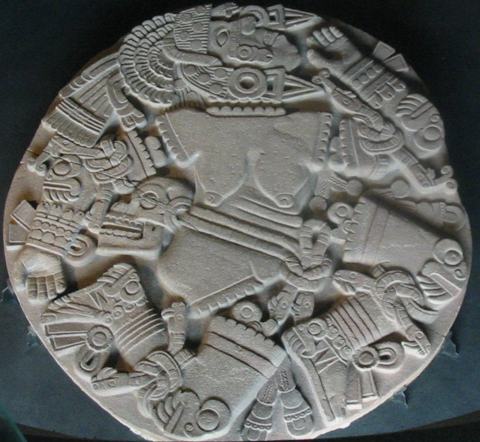
The dismembered sister of Huitzilopochtli, often read as the moon — and the carved disc whose discovery in 1978 uncovered the Templo Mayor itself.
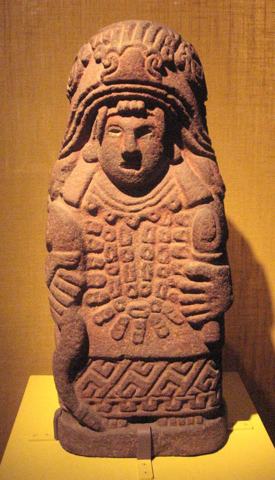
The Aztec goddess of childbirth and earth who helped shape humanity, lent her name to Tenochtitlan's second-in-command, and wept an omen before the conquest.
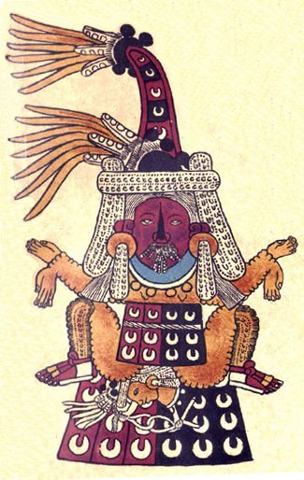
The Aztec goddess of lust and vice who is also the goddess of confession — the one being who can absorb a person's wrongdoing and leave them clean.
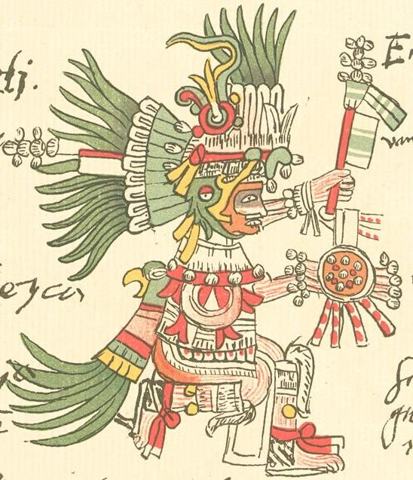
Hummingbird of the Left — the Mexica sun-and-war god, born fully armed on Serpent Mountain and enthroned atop the Great Temple of Tenochtitlan.
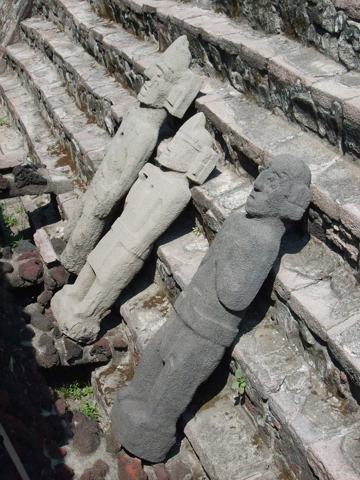
Tenochtitlan's twin pyramid to Huitzilopochtli and Tlaloc, demolished in 1521 and lost until 1978, when electrical workers struck the Coyolxauhqui stone.
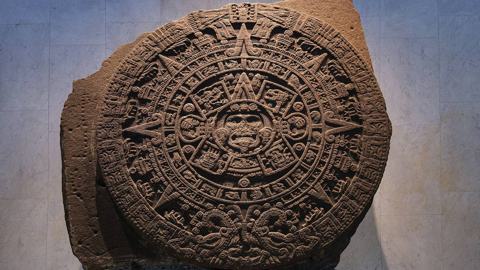
A 24-ton basalt disc unearthed in 1790 under Mexico City, long called the Aztec Calendar even though it was never used to track a single day.
Also mentioned inChalchiuhtlicue (Aztec Water Goddess)
Sources & Further Reading
- 1.Bernardino de Sahagun, Florentine Codex — General History of the Things of New Spain (c. 1547–1579), Books 1, 3 and 6.
- 2.Diego Duran, Historia de las Indias de Nueva Espana e Islas de Tierra Firme (c. 1581) and Book of the Gods and Rites.
- 3.Antonio de Leon y Gama, Descripcion historica y cronologica de las dos piedras (Mexico, 1792).
- 4.Miller, Mary & Karl Taube. The Gods and Symbols of Ancient Mexico and the Maya. Thames & Hudson, 1993.
- 5.Klein, Cecelia F. 'A New Interpretation of the Aztec Statue Called Coatlicue, Earth Mother', Ancient Mesoamerica 19 (2008).
- 6.Matos Moctezuma, Eduardo. The Great Temple of the Aztecs: Treasures of Tenochtitlan. Thames & Hudson, 1988.
- 7.Anzaldua, Gloria. Borderlands / La Frontera: The New Mestiza. Aunt Lute Books, 1987.
Spot an error or have a source to suggest? Write to info@viseterna.com. We cite primary sources and modern scholarship, and we correct fast.