
The Epic of Gilgamesh
The world's oldest surviving epic — five Sumerian poems welded into an Akkadian masterpiece, lost for two thousand years until an 1872 tablet made headlines.
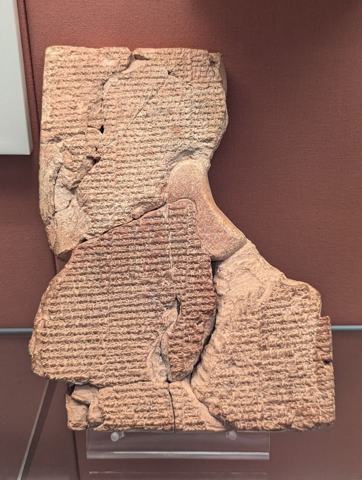
Tablet V of the Epic of Gilgamesh, Old Babylonian, c. 2003-1595 BCE (Sulaymaniyah Museum, Iraqi Kurdistan) · CC BY-SA 4.0 · source
An Epic, Not a Biography
This article is about the text, not the king. What follows is the story of how five separate Sumerian poems about a legendary ruler of Uruk were welded into a single Akkadian epic, how that epic was copied, buried, and lost for two thousand years, and how it came back. For the hero's own life and deeds, see Gilgamesh 3,4.
Five Poems in a Sumerian Schoolroom
Before there was an epic, there were scribal exercises. Sumerian schools of the early second millennium BCE copied five independent poems about a king of Uruk called Bilgames: his expedition against the monster Huwawa in the Cedar Mountain, his fight with the Bull of Heaven, the netherworld journey of his servant Enkidu, an account of his own death, and his defense of Uruk against Aga of Kish 1. They were not composed as chapters of one continuous story and do not agree closely on detail, but between them they supplied nearly every episode later poets would draw on 1,6.
An Akkadian Poet Takes Over
Sometime in the Old Babylonian period, around 1800 BCE, an Akkadian-language poet drew on this Sumerian material to compose a continuous narrative, opening with the line shutur eli sharri, "surpassing all other kings" 2,6. The best-preserved witnesses to this earlier version are two tablets named for the museum collections that hold them, the Pennsylvania tablet and the Yale tablet, both acquired for American university collections in the early twentieth century 2,4. Comparing this version against the later Standard recension is how Assyriologists trace the poem's growth stage by stage, and Tigay's study remains the standard account of that process 6.
Sin-leqi-unninni's Standard Version
The text most people read today is the Standard Babylonian recension, a twelve-tablet version compiled sometime in the last centuries of the second millennium BCE and opening with a different line, sha naqba imuru, "he who saw the deep" 3,4. Ancient Mesopotamian catalogues of literature name its compiler as a scholar called Sin-leqi-unninni, which makes this one of the few ancient Near Eastern texts with anything resembling a credited author, though how much of the wording is truly his own composition rather than careful editorial welding of older material cannot now be recovered 3,4. Tablet XII, a fairly literal rendering of half of the old Sumerian netherworld poem, sits awkwardly after the story has already ended and is generally read as a later appendix rather than part of the original plan 3,4.
Buried at Nineveh, Read in London
Nearly every copy of the Standard version comes from one place: the library the Assyrian king Ashurbanipal assembled at Nineveh in the seventh century BCE, excavated in fragments by Austen Henry Layard and Hormuzd Rassam in the 1840s and 1850s and shipped to the British Museum 3,4. The tablets sat there largely unread until George Smith, a self-taught cuneiformist working in the Museum's collections, identified and translated the flood narrative on Tablet XI and announced it to the Society of Biblical Archaeology in December 1872, a discovery that made front-page news for its resemblance to the biblical flood and that scholars now trace to an older Babylonian source, the epic of Atrahasis, rather than to any wholly independent invention 4. Smith's find triggered decades of further excavation and fragment-matching, and the text George published in 2003 is still not complete: whole passages remain reconstructed from parallel lines or left as gaps 4.
A Tablet from a Smuggler's Bag
The epic is still growing. In 2011 the Sulaymaniyah Museum in Iraqi Kurdistan, which buys looted antiquities on the open market specifically to keep them from disappearing into private hands, acquired a clay tablet from a smuggler without at first knowing what it was. The Assyriologist Farouk Al-Rawi recognized it as a missing section of Tablet V, and he and Andrew George published it jointly in 2014 7. The new lines describe the Cedar Forest before Gilgamesh and Enkidu destroy it, full of birdsong and chattering monkeys, a tended park rather than a howling wilderness, and give Gilgamesh a line of open regret over killing its guardian Humbaba, details the older, more damaged manuscripts had simply lacked 7.
Reading It Now
No single ancient manuscript preserves the whole poem, so every modern edition is necessarily a mosaic of many partial witnesses, cross-checked and filled in against one another 4. George's 2003 critical edition set the current standard text; his Penguin translation and Foster's Norton Critical Edition are the versions most widely used outside specialist Assyriology 4,5,8. It remains, on current evidence, the oldest extended work of narrative literature to survive from anywhere in the world, and the discovery of Tablet V's missing lines in a market stall in 2011 is a reminder that the manuscript record is not yet closed 3,6,7.
Continue Exploring
The Old Babylonian flood epic — the fullest account of why the gods nearly drowned humanity, and the source behind Gilgamesh's own flood story.
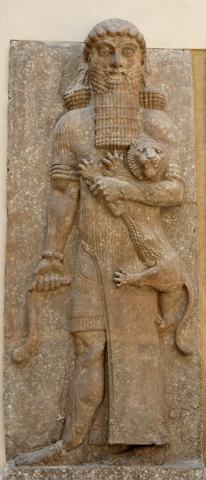
King of Uruk, two-thirds god and one-third man — the hero of the world's oldest surviving epic, who went to the ends of the earth to escape death.
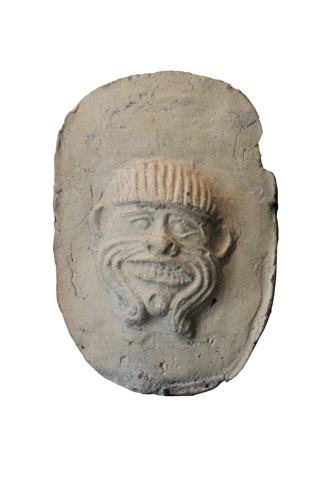
Guardian of the Cedar Forest, killed by Gilgamesh and Enkidu -- and, since a 2015 tablet turned up, a monster who kept court to a chorus of monkeys.
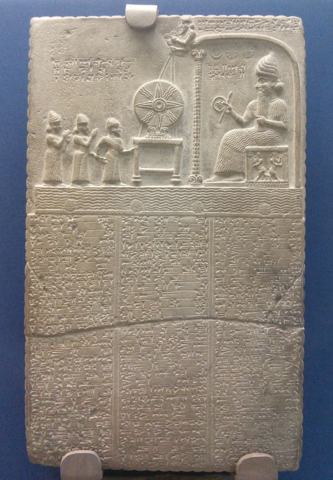
Sumerian Utu, Akkadian Shamash — the sun god who sees everything, judge of heaven and earth, patron of law, oaths, travellers and the diviner's art.
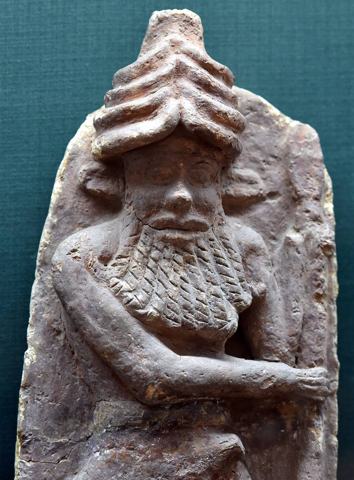
The wild man tamed by Shamhat and bound to Gilgamesh by friendship -- until the gods condemned him to die for the Cedar Forest and the Bull of Heaven.
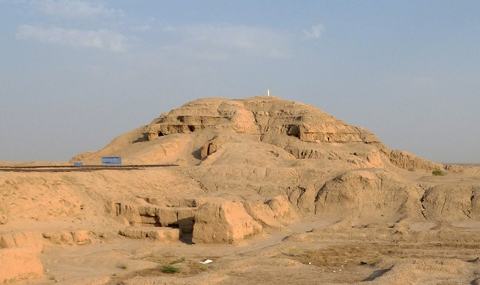
Father of the gods — the Mesopotamian sky, whose written sign meant "god" itself; the source of all authority, and almost never the one who uses it.
Sources & Further Reading
- 1.The Sumerian Bilgames poems: Bilgames and Huwawa, Bilgames and the Bull of Heaven, Bilgames and the Netherworld, The Death of Bilgames (early 2nd millennium BCE).
- 2.The Old Babylonian Gilgamesh tablets (Pennsylvania and Yale tablets, c. 1800 BCE).
- 3.The Epic of Gilgamesh, Standard Babylonian version (Tablets I-XII), Nineveh recension traditionally ascribed to Sin-leqi-unninni.
- 4.George, A.R. The Babylonian Gilgamesh Epic: Introduction, Critical Edition and Cuneiform Texts. Oxford University Press, 2003.
- 5.George, A.R. (trans.). The Epic of Gilgamesh. Rev. ed., Penguin Classics, 2003.
- 6.Tigay, Jeffrey H. The Evolution of the Gilgamesh Epic. University of Pennsylvania Press, 1982.
- 7.Al-Rawi, F.N.H. & A.R. George. 'Back to the Cedar Forest: The Beginning and End of Tablet V of the Standard Babylonian Epic of Gilgamesh.' Journal of Cuneiform Studies 66 (2014), 69-90.
- 8.Foster, Benjamin R. (ed. and trans.). The Epic of Gilgamesh. Norton Critical Edition, W.W. Norton, 2001.
Spot an error or have a source to suggest? Write to info@viseterna.com. We cite primary sources and modern scholarship, and we correct fast.