
The Fisher King
The maimed king who guards the Grail and fishes because he cannot walk. His wound waits on a question no knight thinks to ask.
Perceval arrives at the Grail castle, BnF Francais 12577, fol. 18v, c. 1330 (Bibliotheque nationale de France) · Public domain · source
The King Who Fishes
The Fisher King is the host at the strangest dinner party in medieval literature. In Chretien de Troyes' Conte du Graal, Percival rides down a river valley and finds two men in a boat, one of them fishing; the fisherman directs him to a castle he cannot see, and turns out on arrival to be its lord, reclining on a couch because he cannot stand 1. He gives Percival a sword, and then the procession begins: a bleeding lance, candelabra, and a maiden carrying a graal so bright it dims the candles 1.
Chretien explains the fishing plainly. The king was wounded in battle by a javelin that passed through both thighs, and he cannot ride or hunt; angling from a boat is the only sport left to a man in his condition, and that is why people call him the Fisher King 1. It is the least mystical explanation in the whole tradition, and everything afterwards works to complicate it.
Chretien's Wounded Host
The wound is placed with some care. A blow "through the thighs" is a standard medieval euphemism for a wound to the genitals, and most readers since the nineteenth century have taken it that way, though Chretien never says so and the text can be read literally 1,8. What the poem is explicit about is the cost of Percival's silence: had he asked whom the Grail served and why the lance bled, his host would have been made whole 1.
There is a second king in the same castle. Percival's hermit uncle later reveals that the Grail is carried to an old man in an inner chamber — the Fisher King's father — who has lain there for twelve years sustained by nothing but the single mass wafer the vessel brings him 1. Later writers separated the two figures into a Fisher King and a Maimed King, or Roi Mehaignie, and the resulting family tree became one of the most tangled in Arthurian literature 4,8.
Anfortas
Wolfram von Eschenbach names him Anfortas and makes his suffering a matter of justice rather than accident. In Parzival the Grail king was wounded through the genitals by a poisoned spear in a joust he fought for a lady, in defiance of the Grail's rule that its king takes only the wife the Grail names for him 2. The wound will not close; it worsens at certain phases of the moon; the Grail keeps him alive but will not release him, and the whole Grail community waits, generation after generation, for the appointed knight to arrive and ask what ails him 2.
Wolfram's version supplies what Chretien's fragment lacks: a resolution. Parzival returns, asks the question out of simple pity, Anfortas is healed on the spot, and Parzival succeeds him 2,8. That structure — an inheritance that can only be transferred by an act of compassion — is why the Fisher King has proved so portable outside his original story 8.
Bron, Pelles, and the Grail Dynasty
Robert de Boron gave the figure a biblical genealogy. In his Joseph d'Arimathie the title belongs to Bron, Joseph of Arimathea's brother-in-law, who is called the Rich Fisherman for the practical reason that he caught the fish placed on the Grail table beside the vessel; the guardianship then passes down his line to Percival 3. Here the fishing is a ministry rather than an infirmity, and the resonance with the Gospel image of the fisher of men is obviously deliberate 3,8.
The Vulgate and Post-Vulgate cycles fused these strands into a dynasty of Grail kings at the castle of Corbenic, with King Pelles as its most prominent member and Pellehan or Pellam as the Maimed King, wounded by the Dolorous Stroke that Balin deals with the sacred spear 4,5. Malory keeps this: the blow lays waste three countries, and the king lies maimed for many years until Galahad heals him with blood from the same lance 5. In this version, unusually, the wound is inflicted by an Arthurian knight rather than an enemy, which makes the healing a repair of the court's own damage 5,8.
The Wasteland Question
Popular retellings almost always tie the king's wound to a blighted land: while he is sick, nothing grows. That link is much stronger in the modern imagination than in the earliest texts. Chretien's Conte du Graal does not describe a barren kingdom around the Grail castle at all; the wasteland motif is clear in the Post-Vulgate and in Malory's Dolorous Stroke, and appears in some continuations, but it is not the origin of the story 1,5,8.
Its modern prominence owes most to Jessie Weston's From Ritual to Romance (1920), which argued that the whole Grail complex descends from ancient vegetation and fertility rites in which a wounded king's potency and the land's fertility are one 6. Weston's book shaped T. S. Eliot's The Waste Land and, through it, a century of popular treatment. Specialists have largely abandoned her ritual thesis, and Roger Sherman Loomis, who argued strenuously for Celtic rather than ritual origins, is himself now read as one voice in a long debate rather than its conclusion 6,7,8. Richard Barber and others have pressed the case that the Grail literature is best understood as a medieval Christian invention responding to twelfth-century eucharistic devotion, with Celtic colouring rather than Celtic foundations 8. Scholars continue to disagree, and the honest position is that no single origin has been demonstrated 7,8.
Why He Endures
Whatever his sources, the Fisher King is one of the few mythic figures whose crisis is entirely passive. He cannot heal himself, cannot fight, cannot even explain his own condition; he can only wait for a visitor with enough attention to notice that a man in front of him is in pain and to say so out loud 1,2,8. That is a durable idea, and it is why the character keeps resurfacing far from Camelot — in Wagner's Parsifal, in twentieth-century poetry, and in film — long after the theology around the Holy Grail stopped being common knowledge 6,8.
Continue Exploring
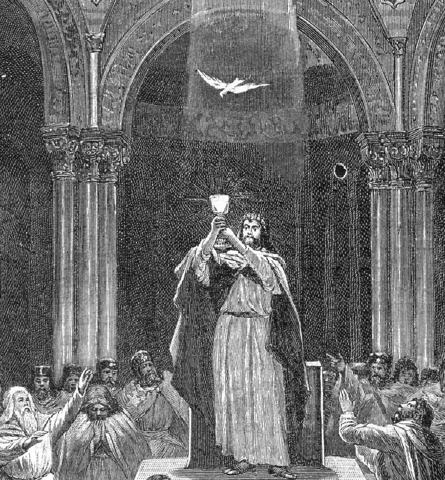
The forest-raised innocent who found the Grail castle and failed to ask the one question that mattered. Arthurian romance's first Grail knight.
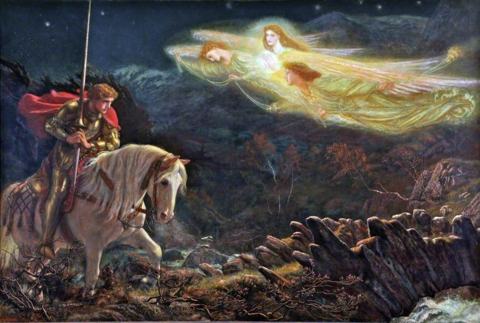
Lancelot's son, invented to succeed where his father failed. The spotless knight who filled the Siege Perilous and achieved the Holy Grail.
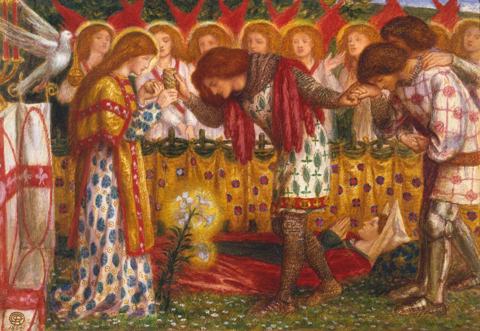
The vessel of the quest: a serving dish in an unfinished French poem that became Christendom's most famous relic and the ruin of the Round Table.
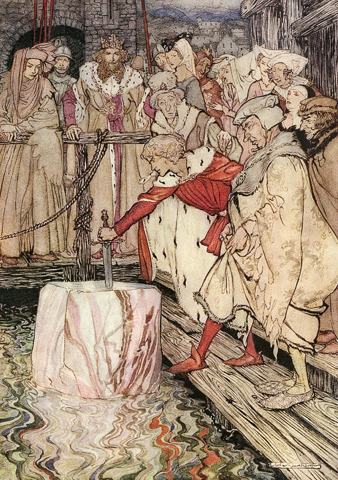
Arthur's chief court: a place named almost by accident in one French poem, which grew into the most famous city that never existed.
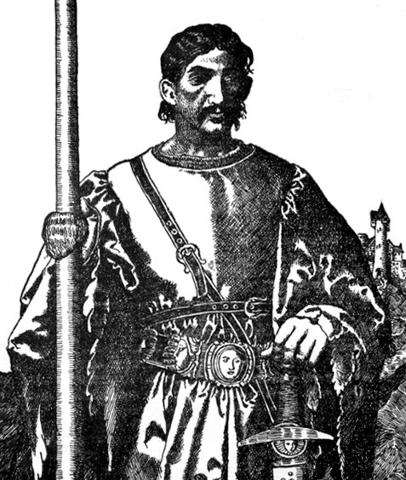
Lancelot's cousin and one of three knights who achieve the Holy Grail, and the only one who lives to tell the court what happened at Sarras.
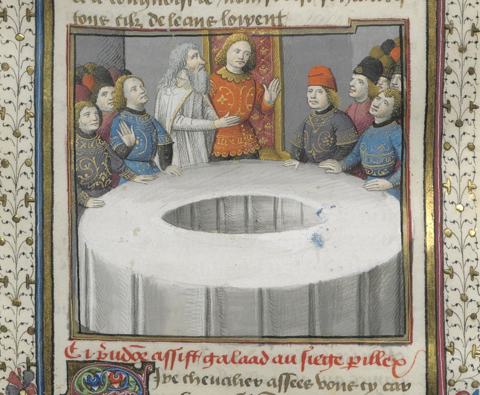
The vacant place at the Round Table that kills any knight who sits in it unworthily, kept for the one who would achieve the Holy Grail.
Sources & Further Reading
- 1.Chretien de Troyes, Perceval, ou le Conte du Graal (Old French verse, c. 1181-1190; unfinished).
- 2.Wolfram von Eschenbach, Parzival (Middle High German, c. 1200-1210).
- 3.Robert de Boron, Joseph d'Arimathie (Le Roman de l'Estoire dou Graal), c. 1200.
- 4.The Estoire del Saint Graal and La Queste del Saint Graal, in the Vulgate Cycle (c. 1215-1235).
- 5.Thomas Malory, Le Morte d'Arthur (completed c. 1469-70; printed by William Caxton, 1485).
- 6.Weston, Jessie L. From Ritual to Romance. Cambridge University Press, 1920.
- 7.Loomis, Roger Sherman. The Grail - From Celtic Myth to Christian Symbol. University of Wales Press, 1963.
- 8.Barber, Richard. The Holy Grail - Imagination and Belief. Harvard University Press, 2004.
Spot an error or have a source to suggest? Write to info@viseterna.com. We cite primary sources and modern scholarship, and we correct fast.