
Venus
Goddess of love and desire — and the divine ancestress of Rome itself, mother of Aeneas and the claimed forebear of the family of Julius Caesar.
Venus Anadyomene, Roman fresco, House of Venus in the Shell, Pompeii, 1st c. AD; photo Tyler Bell, CC BY 2.0 · CC BY 2.0 · source
A Goddess Named After a Quality
Latin has a neuter noun venus meaning charm, allure, or the quality that wins favour — the same root that gives venerari, "to venerate," and venenum, originally a love-charm and later a poison 5,7. The goddess Venus is that abstraction given a person, in the manner of other Roman deities like Fides (good faith), Concordia and Victoria 7.
This has a consequence Roman writers themselves noticed: Venus is not among the archaic priesthoods. She has no flamen, and unlike Jupiter, Mars or Quirinus she is missing from the oldest layers of the state calendar 7,8. Her rise to the centre of Roman public religion is historical and traceable, which makes her one of the best case studies available for how a Roman god actually got made 7.
Erycina and the Second Punic War
Her first great political moment came in disaster. After Hannibal destroyed a Roman army at Lake Trasimene in 217 BCE, the Sibylline Books were consulted and the dictator Fabius Maximus vowed a temple to Venus Erycina — the goddess of Mount Eryx in western Sicily, a shrine of Phoenician as much as Greek character 4. The temple was dedicated on the Capitol in 215 BCE 4.
Importing a foreign Venus into the citadel of Rome during an existential war was not sentimentality. The Eryx cult sat in territory Rome had fought Carthage for, and its goddess was understood as an ancestral protector of the Trojan line; taking her in tied Rome's mythical descent to its current war aims 4,7. A second temple to Venus Erycina followed in 181 BCE outside the Colline Gate, and this one attracted a very different clientele, becoming associated with prostitutes and their festival 7.
An earlier temple, to Venus Obsequens in 295 BCE, had been funded from fines levied on women convicted of adultery — a detail Livy reports without comment, and a reminder that Roman sexual morality and Roman religion funded each other quite literally 4.
The Festivals of April
Ovid gives April to Venus, connecting the month's name to her Greek identification and to aperire, "to open," the month when the year opens 2. On the first day came the Veneralia, honouring Venus Verticordia, "the changer of hearts": women removed the goddess's jewellery, washed and dried her statue, garlanded her with roses, and bathed themselves under myrtle, praying for beauty, character and good repute 2.
On 23 April the Vinalia connected her to wine — a festival Roman antiquarians found confusing, since the vintage properly belonged to Jupiter, and which Ovid reports as being observed both by respectable matrons and by working girls in their own way 2,5. The overlap is characteristic. Venus covered marriage, seduction, and commercial sex without the Romans feeling any need to separate the offices 7.
Mother of Aeneas
The equation of Venus with the Greek Aphrodite brought with it the story that mattered most: Aphrodite's love affair with the Trojan prince Anchises and the birth of Aeneas. Because Aeneas was Rome's mythical founder-ancestor, Venus became the mother of the Roman people 3,7.
Virgil builds the Aeneid on that relationship. Venus meets her son disguised as a huntress, pleads his case before Jupiter, obtains divine armour for him, and operates throughout as the counterweight to Juno's hostility 3. She is not a goddess of romance in the poem so much as a mother running a long political campaign on her son's behalf, and the empire Jupiter promises her is the campaign's result 3.
Lucretius, a generation earlier and no friend of conventional religion, had already opened his Epicurean poem with a hymn to Venus as "mother of the descendants of Aeneas" and as the generative force that drives all living things to reproduce — a philosophical Venus, physics rather than piety, but built from the same Roman raw material 1.
Sulla, Pompey, Caesar
In the late Republic Venus became the personal deity of Rome's warlords, because her favour was a claim to luck and legitimacy at once. Sulla took the surname Felix, "fortunate," and in Greek styled himself Epaphroditos, Aphrodite's man 7. Pompey placed a temple of Venus Victrix, "Venus the Victorious," at the top of the seating of his great stone theatre in 55 BCE, which conveniently made Rome's first permanent theatre the approach to a shrine 7.
Julius Caesar went furthest. The Julian family claimed descent from Iulus, son of Aeneas, and therefore from Venus directly; Caesar used Venus Victrix as his watchword at Pharsalus, and in 46 BCE dedicated the temple of Venus Genetrix, "Venus the Ancestress," as the centrepiece of his new forum 7. Augustus inherited the claim, and the imperial house kept it: the goddess of desire was now, in official terms, the founder of the dynasty 7,8.
Venus and Roma
The last great statement of her Roman career is architectural. Hadrian designed and dedicated the Temple of Venus and Roma beside the Colosseum in 135 CE, the largest temple in the city, housing the goddess and the personified city back to back in a double shrine 7.
The pairing works partly as a pun — Roma reversed is Amor — and partly as a summary of everything Venus had become at Rome 7. Cicero, in a philosophical mood, had already picked apart the many Venuses of cult and asked which of them, if any, an educated man should believe in 6. The Romans had no obligation to choose. The same goddess presided over a lover's charm, a general's luck, an emperor's ancestry, and the city itself 7,8.
Continue Exploring
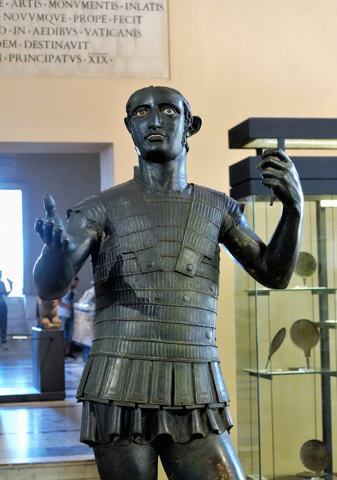
God of war and father of Rome — honoured above almost every other deity, with his own month, his own dancing priests, and the twins he fathered on a Vestal.
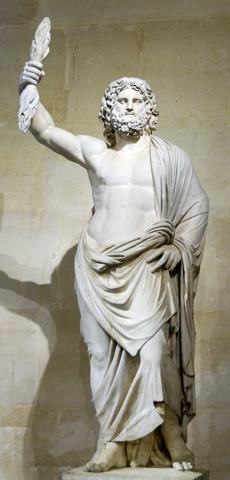
King of the gods and of the Roman state — lord of the bright sky, hurler of the lightning bolt, and the guarantor behind every oath and treaty.
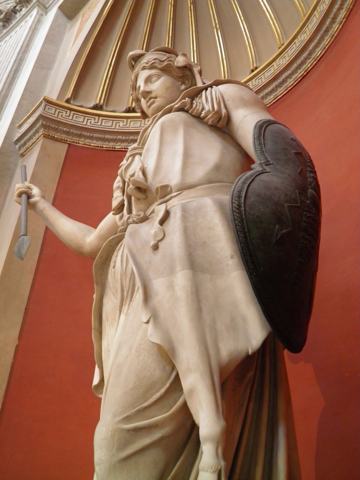
Queen of the gods — Rome's guardian of women, childbirth and the state, whose sacred geese warned the Capitol and whose temple gave us the word money.
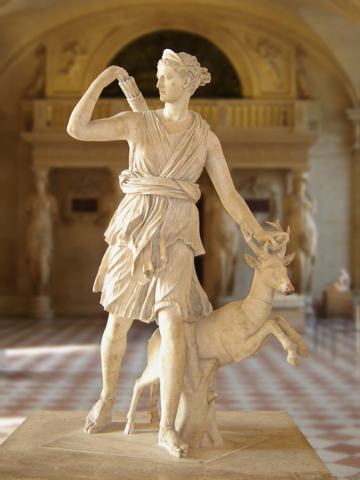
Roman goddess of the hunt, wild places and the moon, whose oldest sanctuary at Lake Nemi was guarded by a priest who held office by killing his predecessor.
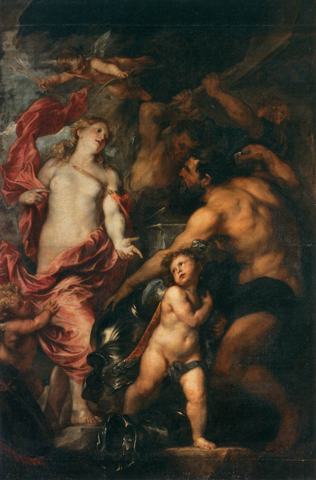
Rome's fire god, honored to keep flame from the wooden city, later remade as the mythical blacksmith who forged arms for gods and heroes.
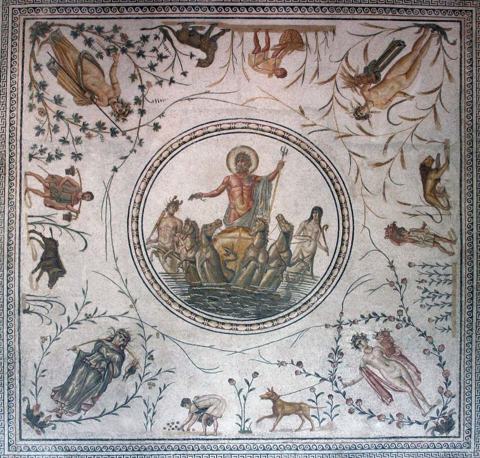
Lord of the sea — though the Romans knew him first as a god of springs and running water, honoured at midsummer when the rivers ran lowest.
Also mentioned inAeneasAphroditeCupid (Amor)
Sources & Further Reading
- 1.Lucretius, De Rerum Natura (c. 55 BCE), Book 1.
- 2.Ovid, Fasti (c. 8 CE), Book 4.
- 3.Virgil, Aeneid (29–19 BCE).
- 4.Livy, Ab Urbe Condita (c. 27 BCE) — esp. Books 10 and 22.
- 5.Varro, De Lingua Latina (1st century BCE).
- 6.Cicero, De Natura Deorum (45 BCE).
- 7.Beard, Mary, John North & Simon Price. Religions of Rome, Volume 1: A History. Cambridge University Press, 1998.
- 8.Scheid, John. An Introduction to Roman Religion. Edinburgh University Press, 2003.
Spot an error or have a source to suggest? Write to info@viseterna.com. We cite primary sources and modern scholarship, and we correct fast.