
Annwn
Wales's Otherworld — a rival kingdom ruled by Arawn, raided by Arthur for a magic cauldron, and only later flattened by Christian Welsh into a word for hell.
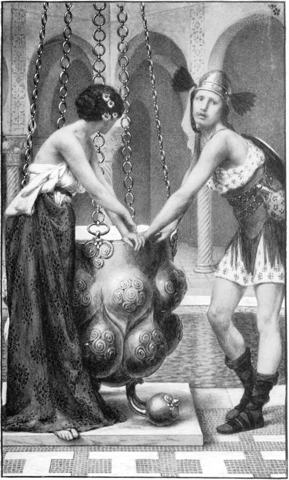
The Cauldron of Inspiration, Ernest Wallcousins, 1912 · Public domain · source
Not Death, But a Rival Kingdom
Annwn (also spelled Annwfn) is medieval Wales's name for the Otherworld, and like its Irish counterparts it is emphatically not a land of the dead. It is a kingdom with a king, an army, hunting dogs, feasts, and treasures worth stealing, located not in any afterlife but alongside the visible world and reachable by ordinary travel, hunting, or accident 1,5,6. The word's origin is debated: the most widely repeated analysis reads it as an- (an intensifying or negating prefix) plus dwfn, "world" or "deep," giving something like "the very deep place" or "the un-world," though Koch's encyclopedia treats the etymology as unsettled rather than solved 6,7.
Arawn's Year
Annwn's fullest medieval portrait comes from the opening of the First Branch of The Mabinogion. Pwyll, prince of Dyfed, is out hunting when his hounds drive off the hounds of a stranger — Arawn, king of Annwn — from a stag they did not kill, a breach of etiquette serious enough that Arawn could rightly claim satisfaction. Instead he proposes an exchange: Pwyll will rule Annwn in Arawn's shape and likeness for a year and a day, sleeping chastely beside Arawn's wife the whole time, and at the year's end must defeat Arawn's rival Hafgan in single combat, a fight Arawn has never managed to win outright himself 1,4. Pwyll keeps every term of the bargain, wins Arawn's lasting friendship and the honorific Pen Annwn, "Head of Annwn," and returns home to Dyfed — where he almost immediately meets Rhiannon riding past his mound at Arberth, so that Annwn effectively bookends his introduction to the story 1.
The Spoils of Annwn
A stranger and more contested Annwn appears in Preiddeu Annwn, "The Spoils of Annwn," a difficult sixty-line poem preserved uniquely in the Book of Taliesin. It describes a raid, led by Arthur and his men in the ship Prydwen, on a chain of Annwn's fortresses — Caer Sidi, Caer Wydyr ("the glass fortress"), and others — to seize a cauldron that will not cook a coward's food and is warmed by the breath of nine maidens; the poem states flatly that only seven men returned 3. Marged Haycock's edition, the standard modern treatment, cautions against reading the poem as a straightforward adventure narrative: its language repeatedly turns back to boasting about hidden knowledge, and she argues it is at least as much about Taliesin's own claimed wisdom as about Arthur's raid, a reading that has shifted scholarly opinion away from the older, more literal "Otherworld heist" interpretation 3. Whether the poem's cauldron and the one Efnysien destroys in Bran the Blessed's war are meant to be connected, echoed, or are simply two unrelated cauldrons that later readers have wanted to merge, is not something the medieval texts settle for us 3,6.
Gwyn ap Nudd and the Hounds
Culhwch ac Olwen adds a guardian: it states that God placed Gwyn ap Nudd in command of the demons of Annwn specifically so that they cannot destroy the present world, a single dense line that implies a much larger story never actually told in the surviving text 2,7. Later Welsh folklore, attested only from the medieval period onward and continuing into modern collection, expands Gwyn into the king of the Tylwyth Teg (the fairy folk) and the master of the Cwn Annwn, spectral white hounds with red ears whose baying in the night sky was taken as a portent of death; this material is genuine and long-lived folk belief, but it is a later accretion layered onto the Otherworld idea rather than something the earliest sources describe in that form 7.
From Otherworld to Hell
Christianity eventually did to Annwn what it could not quite do to the Irish material: it collapsed the distinction between a rival Otherworld and the Christian afterlife. In later medieval and early modern Welsh, annwn increasingly doubles as an ordinary word for hell, and modern Welsh dictionaries list it that way as a primary sense, even though nothing in the First Branch or in Preiddeu Annwn treats the place as a place of torment or punishment 6,7. The older Annwn — a kingdom to trade favours with, hunt in, or raid for treasure — survives mainly in the two medieval texts that never got the memo.
Continue Exploring
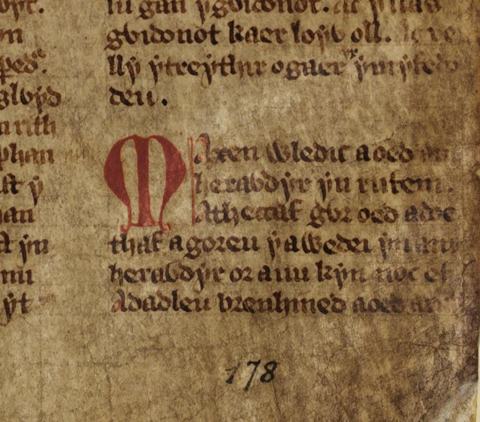
Eleven medieval Welsh tales — Four Branches, native stories, Arthurian romances — bundled under a title that scholars agree is a 19th-century mistake.
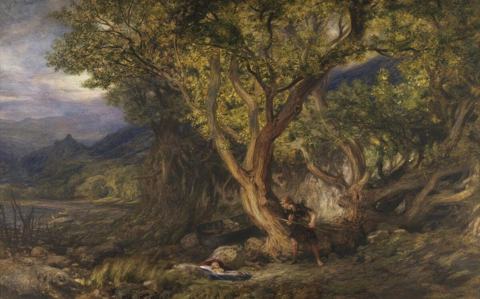
A real sixth-century court poet and a shapeshifting legendary bard reborn from a cauldron share one name, and the tradition never fully separates them.
The horsewoman of the Mabinogi, wrongly accused of killing her son and forced to carry visitors on her back — probably, but not provably, a faded horse goddess.
The giant king of Britain in the Mabinogi, too large for any house, who invaded Ireland to avenge his sister and whose severed head kept talking for decades.
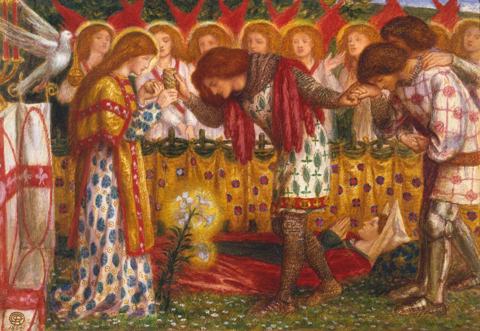
The vessel of the quest: a serving dish in an unfinished French poem that became Christendom's most famous relic and the ruin of the Round Table.
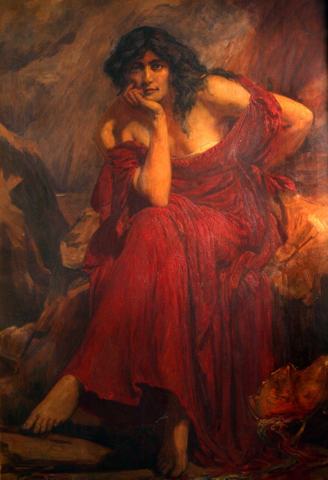
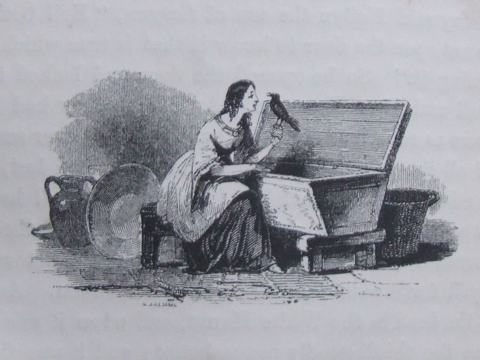
The Welsh enchantress who brewed a year-long potion of pure knowledge, chased the boy who stole it through a chain of animal shapes, and swallowed him whole.
Sources & Further Reading
- 1.Pwyll Pendefig Dyfed (First Branch of the Mabinogi), Middle Welsh prose, in Sioned Davies, trans., The Mabinogion. Oxford University Press, 2007.
- 2.Culhwch ac Olwen, Middle Welsh prose (c. 1100).
- 3.Preiddeu Annwn (The Spoils of Annwn), in the Book of Taliesin, Middle Welsh verse, National Library of Wales, Peniarth MS 2 (early 14th century); ed. and trans. Marged Haycock, Legendary Poems from the Book of Taliesin. CMCS Publications, 2007.
- 4.Williams, Ifor, ed. Pedeir Keinc y Mabinogi. University of Wales Press, 1930.
- 5.MacKillop, James. Dictionary of Celtic Mythology. Oxford University Press, 1998.
- 6.Koch, John T. (ed.). Celtic Culture: A Historical Encyclopedia. ABC-CLIO, 2006.
- 7.Green, Miranda J. Dictionary of Celtic Myth and Legend. Thames & Hudson, 1992.
Spot an error or have a source to suggest? Write to info@viseterna.com. We cite primary sources and modern scholarship, and we correct fast.