
Cerberus
The many-headed hound who guards the gates of the underworld. He fawns on everyone who enters and devours anyone who tries to leave.
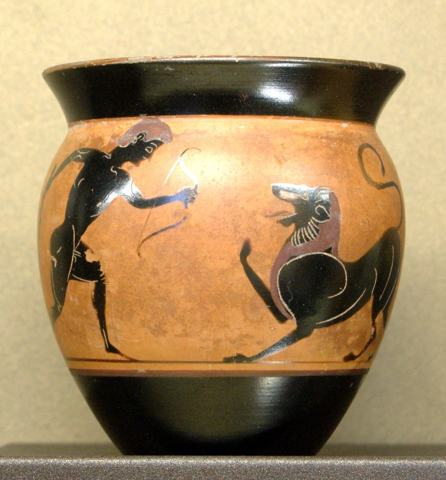
Heracles, Cerberus and Eurystheus, Caeretan hydria attributed to the Eagle Painter, c. 525 BC (Musee du Louvre, Paris, E 701) · Public domain · source
The Monstrous Litter
Cerberus belongs to the most dangerous family in Greek myth. Hesiod makes him the offspring of Typhon and Echidna, and so brother to Orthrus the two-headed hound of Geryon, to the Lernaean Hydra and, in the same passage, kin to the Chimaera 1. It is a lineage of hybrid guardians, and Cerberus is the one assigned to the gate that matters most.
Homer never gives him a name. In the Iliad and the Odyssey he is simply "the hound of Hades", which Heracles was sent to fetch — a story the poet clearly expects his audience to know already 2. The name Kerberos appears first in Hesiod, and its etymology is unknown; a proposed connection with the Sanskrit sabala, an epithet of the two hounds of Yama in the Rig Veda, has been argued as evidence of a shared Indo-European underworld dog, but the phonetics are strained and the comparison is not generally accepted 6,7.
How Many Heads
Hesiod gives him fifty heads, a voice of bronze, and an appetite for raw flesh 1. Pindar was reported in antiquity to have made it a hundred, and Horace speaks of a hundred snakes about his head 6,7. Yet from the earliest surviving vase paintings onward the standard artistic Cerberus has two or three heads — two is common in archaic black-figure, three becomes canonical later — usually with a mane or tail of serpents 6,7.
The discrepancy is not a contradiction so much as a difference of medium: poetry piles on numbers to convey monstrousness, painters need a shape that reads at a glance. By the Roman period three heads is fixed, and later allegorists supply tidy explanations — past, present and future; the three parts of the world — that have nothing to do with archaic Greek belief 5,7.
The Gate That Opens One Way
Hesiod describes his function with unusual precision. Before the house of Hades and Persephone stands a terrible hound, pitiless and cunning: on those who come in he fawns, wagging his tail and dropping his ears, but he will not let them go back out again, and lies in wait to eat anyone he catches trying 1.
That asymmetry is the whole idea. The Greek underworld is not primarily a place of punishment but a place of no return, and Cerberus is that fact given a body 1,8. He is a doorkeeper rather than a torturer, which is why heroes deal with him by getting past him rather than by killing him: Orpheus lulls him with the lyre, and the Sibyl in the Aeneid throws him a honeyed cake steeped in drugged meal, so that all three throats gape for it and the great bulk sprawls asleep across the cave — the origin of the English phrase "a sop to Cerberus" 5.
The Twelfth Labour
Fetching Cerberus is the last and hardest of Heracles' labours, and the only one that requires him to enter the land of the dead. Apollodorus gives the fullest account: Heracles first has himself initiated at Eleusis and purified, descends at Taenarum in Laconia, frightens the ferryman Charon into carrying him, frees Theseus from his seat but fails to move Pirithous, and asks Hades directly for the hound 3. Hades consents on one condition — that he take the animal without using any weapon.
So Heracles wrestles it, gripping it by the throat while the serpent-tail bites him, and drags it up to the daylight. He shows it to Eurystheus, who is so frightened that he hides in a great storage jar sunk in the ground; the vase above shows exactly that moment, with the king's head and arms protruding from the pithos 3,6. Then, having proved the point, Heracles takes the dog back where it belongs. Where the hound first saw the sun, Ovid says, its slaver fell on the ground and grew into aconite, the poison Medea later mixed for Theseus 5.
Rationalisers and Afterlives
Not every ancient reader believed in the hound. Pausanias reports a version in which what Heracles brought up from the cave at Taenarum was not a dog at all but a monstrous venomous serpent, called "hound of Hades" because its bite killed at once — one of many sober rewritings by Greek writers uncomfortable with their own mythology 4,7.
Cerberus survived Greek religion by centuries. He guards the third circle of Dante's Inferno, clawing and flaying the gluttons in the cold rain; he supplies the name of a great many later guardians in fiction and games; and he remains, in ordinary English, shorthand for an implacable doorkeeper. The image the Greeks left is more specific than the modern one, and better: a dog that is delighted to see you arrive 1,5,8.
Continue Exploring
Zeus's mortal son, driven mad by Hera and set twelve impossible labours as penance - the strongest man in Greek myth, who died in agony and rose to Olympus.
The girl carried off in a chariot and the dread queen of the dead. Persephone divides her year between the grain above and the throne below.
The regenerating, poison-blooded serpent of the Lernaean swamp that Heracles killed with fire in his second labor — and that ancient writers already doubted.
Lord of the underworld and of the wealth beneath the earth. Not a devil — a grim, lawful king whose only rule is that no one leaves.
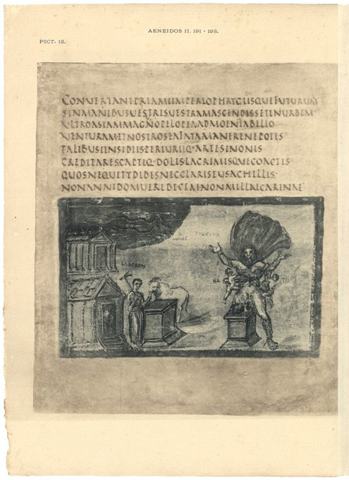
Virgil's unfinished epic of Aeneas's flight from Troy and the founding of Rome — composed for Augustus, nearly burned at its author's own request.
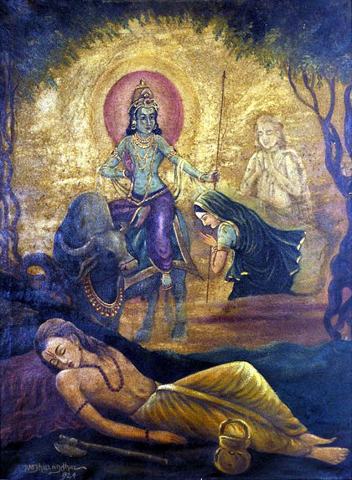
The Rigveda's first mortal to find the path of death, later Lord of the Dead — met by the boy Nachiketas in the Katha Upanishad and once outwitted by Savitri.
Sources & Further Reading
- 1.Hesiod, Theogony — lines 306-312 and 767-774 (c. 700 BC).
- 2.Homer, Iliad Book 8 and Odyssey Book 11 (the unnamed "hound of Hades", c. 8th-7th century BC).
- 3.Apollodorus, Bibliotheca (Library) 2.5.12, 1st-2nd century AD.
- 4.Pausanias, Description of Greece — Book 3.25 (Taenarum), c. AD 160-180.
- 5.Virgil, Aeneid Book 6 (c. 29-19 BC), and Ovid, Metamorphoses Book 7.
- 6.Gantz, Timothy. Early Greek Myth — A Guide to Literary and Artistic Sources. Johns Hopkins University Press, 1993.
- 7.Ogden, Daniel. Drakon — Dragon Myth and Serpent Cult in the Greek and Roman Worlds. Oxford University Press, 2013.
- 8.Burkert, Walter. Greek Religion. Trans. John Raffan. Harvard University Press, 1985.
Spot an error or have a source to suggest? Write to info@viseterna.com. We cite primary sources and modern scholarship, and we correct fast.