
Dazhbog (Slavic Sun God)
Sun god of the Kyivan pantheon and, in the Tale of Igor's Campaign, the mythical ancestor of the Rus' people themselves.
Title page of the first edition of the Tale of Igor's Campaign, Moscow: Senate Press, 1800 · Public domain · source
The Giving God
Dazhbog (Old East Slavic Даждьбогъ) carries a name that is also a small sentence: most philologists read it as dazh' ("give") plus bog ("god"), the Giving God, though a minority derive the first element instead from a root for "day" or "sun" 4,6. Whichever reading is right, every medieval mention of him treats him as a solar deity, and unlike most Slavic gods he comes with an origin story — a rare thing in a religion that otherwise survives only as names on a list 3.
He belongs to the East Slavic record specifically. Dazhbog appears nowhere in Helmold's account of the Baltic Slavs or in Saxo Grammaticus's description of Svetovid at Arkona; his entire documented career runs through Kyivan and Muscovite Rus' texts, which makes him a useful check on how differently the eastern and western branches of Slavic paganism are recorded 4.
Son of Svarog
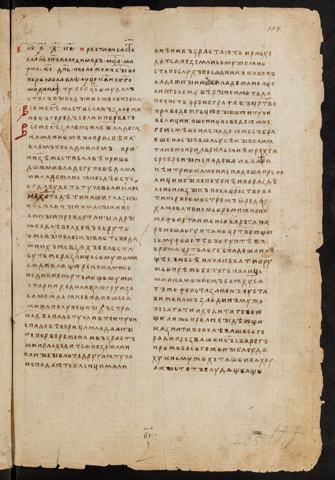
The closest thing to a myth about Dazhbog survives by accident. Under the year 1114, the Hypatian Codex — a later manuscript tradition of the Primary Chronicle — inserts a passage translated and adapted from the sixth-century Byzantine chronicler John Malalas, whose Chronographia recast the Greek gods as ancient Egyptian kings. Where Malalas has Hephaestus ruling Egypt and then handing the throne to his son Helios, the Slavic translator substitutes local names: Hephaestus becomes Svarog, the divine smith, and Helios becomes Dazhbog, "Sun-tsar, son of Svarog" 3.
Kutarev's study of the passage treats it as genuine evidence of an existing father-son pairing in East Slavic belief, onto which the translator mapped a convenient Greco-Egyptian frame, rather than as a story invented from nothing 3. It is nonetheless a translator's gloss embedded in someone else's history, not a native Slavic composition, and it is the only narrative text about Dazhbog that exists 3,5.
Among Vladimir's Idols
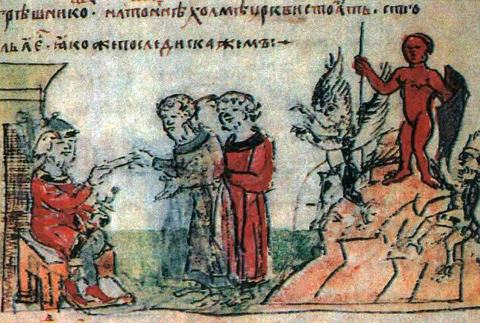
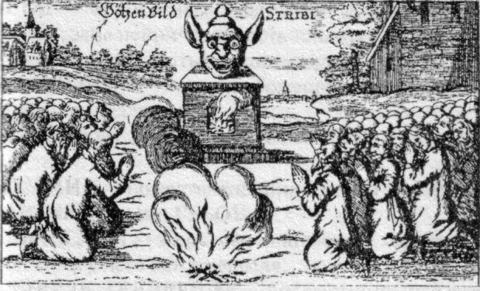
Dazhbog's firmer attestation is administrative rather than mythological. The Primary Chronicle reports that in 980, before his conversion, Prince Vladimir set up a row of idols on the hill outside his Kyiv palace: Perun at their head, and beside him Khors, Dazhbog, Stribog, Simargl, and Mokosh 1. The chronicle gives no description of Dazhbog's image and no explanation of why these six were chosen together; modern scholars generally read the list as Vladimir's attempt to consolidate a state cult rather than a complete inventory of what Rus' pagans actually worshipped 4.
That the chronicler bothered to name him at all, in a text otherwise uninterested in pagan detail, is itself a sign that Dazhbog mattered enough in 980 Kyiv to be worth a prince's public statue 1,4.
Grandsons of Dazhbog
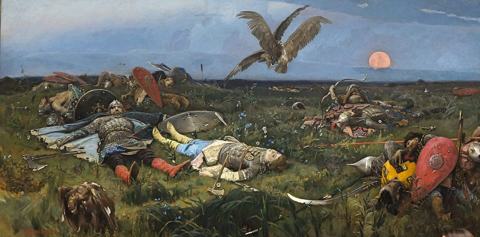
Dazhbog's most evocative appearance is also his latest and least literal. The Tale of Igor's Campaign, an epic poem about a failed 1185 raid against the Polovtsians, twice calls the people of Rus' "Dazhbog's grandsons" 2. The line is not theology so much as poetic genealogy: a solar ancestor lending his light, by implication, to an entire people and their princes 2,4.
By the late twelfth century Rus' had been formally Christian for two hundred years, so the phrase almost certainly survives as literary ornament rather than as a living claim of descent — but its survival at all shows how deeply the sun-god's name had lodged in the language of Rus' identity, long after his cult had ended 2,6.
Dabog in Serbian Tradition
A separate, harder-to-place thread runs through Serbian folk belief. Serbian tradition preserves an underworld figure called Dabog, described in folk sayings as an earthly counterpart to the Christian God — "Dabog is tsar on earth, and the Lord God is in heaven" — and demonized in later material as a devil or demon of the mines 3,6. The name is plainly the same word as Dazhbog, and Kutarev argues the Serbian material preserves a genuine southern branch of the same pre-Christian figure, later recast as a devil under Christian dualism rather than invented separately 3.
That argument is reasonable but not settled; a shared name across the Slavic-speaking world does not by itself prove a single continuous cult, and the two figures — a Kyivan sun-tsar and a Serbian earth-devil — have moved in very different directions by the time either is written down 3,6.
How Much Do We Really Know?
Set the certain material next to the speculative and the certain pile is thin: a name on Vladimir's hill in 980, a borrowed genealogy grafted onto a Byzantine chronicle, an epithet in a martial poem, and a devil's name in Serbian villages centuries later 1,2,3. There is no surviving myth of Dazhbog crossing the sky in a chariot, no described idol, no ritual calendar — details found in popular retellings are filled in from comparative Indo-European sun-god material or invented outright 4,5. What is solid is enough to place him among the handful of Slavic gods with real, multi-source, cross-regional attestation, which is more than can be said for most of the names on Vladimir's hill 1,4.
Continue Exploring
God of fire and the forge — a smith-god known from one glossed line in a Kyivan chronicle, and one of the most over-reconstructed figures in Slavic myth.
God of thunder and the striking bolt — the oak-crowned sky lord of the early Slavs, sworn by in treaties and thrown into the Dnieper at Rus' baptism.
A 12th-century epic of a failed raid, its only manuscript burned in Moscow in 1812, and the two-century forgery debate that followed it.
Wind god of the pagan Kyivan pantheon, remembered in the Tale of Igor's Campaign as the ancestor whose grandsons are the winds themselves.
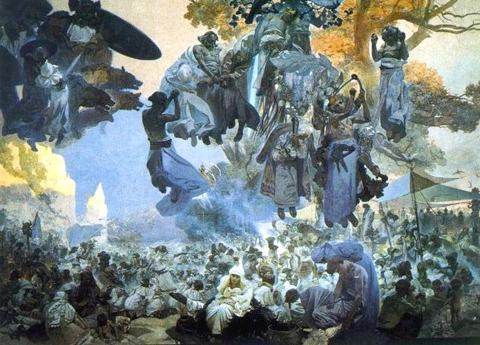
Four-headed war-oracle god of the Rugian Slavs at Arkona, described in unmatched detail by Saxo Grammaticus before Danes destroyed his temple in 1168.
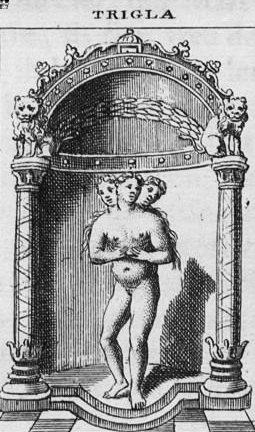
Chief god of the Pomeranian Slavs at Szczecin and Wolin, whose three joined heads were said to rule heaven, earth, and the underworld.
Also mentioned inJarilo (Yarilo)MokoshThe Primary Chronicle (Tale of Bygone Years)The Zbruch Idol
Sources & Further Reading
- 1.The Russian Primary Chronicle (Povest' vremennykh let, c. 1113), trans. Samuel Hazzard Cross & Olgerd P. Sherbowitz-Wetzor. Medieval Academy of America, 1953.
- 2.The Tale of Igor's Campaign (Slovo o polku Igoreve, late 12th century).
- 3.Kutarev, Oleg Vladislavovich. "Dazhbog: The Ancient Slavic Pagan Deity of the Shining Sky." Studia Mythologica Slavica 24 (2021).
- 4.Kalik, Judith & Alexander Uchitel. Slavic Gods and Heroes. Routledge, 2019.
- 5.Machal, Jan. Slavic Mythology, in The Mythology of All Races, vol. III. Marshall Jones, 1918.
- 6.Dixon-Kennedy, Mike. Encyclopedia of Russian and Slavic Myth and Legend. ABC-CLIO, 1998.
Spot an error or have a source to suggest? Write to info@viseterna.com. We cite primary sources and modern scholarship, and we correct fast.