
Svarog
God of fire and the forge — a smith-god known from one glossed line in a Kyivan chronicle, and one of the most over-reconstructed figures in Slavic myth.
Hypatian Codex, folio with the 1114 entry naming Svarog (Hypatian Chronicle) · Public domain · source
One Passage
Svarog rests on a single medieval text. Under the year 1114, the Hypatian Chronicle inserts a passage translated and adapted from the Byzantine chronicle of John Malalas, which narrates the reigns of the Egyptian gods as if they were kings 1. Where Malalas has Hephaistos, the Slavonic translator writes Svarog; where Malalas has Helios the son of Hephaistos, the translator writes Dazhbog, "and Dazhbog was called the sun, the son of Svarog" 1.
That is the entire attestation. A Slavonic scribe, working with a Greek text about Egypt, chose two native god-names as equivalents for a smith-god and a sun-god 1,7. It is real evidence — the translator plainly expected his readers to recognise both names — but it is a gloss, not a myth, and it tells us what a twelfth-century monk thought Svarog was comparable to rather than what pagans in the tenth century believed 7.
The passage supports two things. Svarog was associated with fire and metalworking, and Dazhbog the sun was regarded as his son 1.
Not on Vladimir's Hill
The absence is as informative as the presence. When the Primary Chronicle lists the idols Vladimir raised in Kyiv in 980 — Perun, Khors, Dazhbog, Stribog, Simargl, and Mokosh — Svarog is not among them 4. His son is there; he is not 4.
Various explanations have been offered: that he was an older god already displaced, that he belonged to a different region or social layer, that Vladimir's list was a political selection rather than a complete pantheon 4,7. None can be tested. Kalik and Uchitel's general position applies with particular force here — the Slavic "pantheon" reproduced in popular sources is largely a modern assembly of names collected from scattered and unrelated documents, and Svarog's prominence in it is out of all proportion to the evidence 7.
Svarozhich, the Fire in the Hearth
A related name is much better attested, and in a different place. Svarozhich — a patronymic form, "son of Svarog" — appears in Latin sources describing the pagan West Slavs of the Baltic. Thietmar of Merseburg, writing around 1015, describes a wooden temple at Riedegost in the land of the Redarians, containing idols in helmets and armour, of which the chief is called Zuarasici, attended by sacred horses used for divination and by priests who cast lots 2. Bruno of Querfurt, in a letter to Henry II in 1008, names Zuarasiz diabolus as the god the Liutizi worship 3.
Helmold of Bosau, a century and a half later, describes the same religious world further along the Baltic: sacred groves, oracular horses, and local high gods with their own temples and treasuries 5. The West Slavic evidence is the richest we have for any Slavic paganism, precisely because it was written by hostile churchmen while it was still going on 5,7.
Meanwhile in the East Slavic lands, Svarozhich is the word Old Russian anti-pagan sermons use for fire itself, condemning peasants who "pray to fire, calling it Svarozhich" 6,7. That is a strong link between the name and the hearth, and it is why Svarog is usually described as a fire god rather than a sky god 6,7.
The Smith Who Taught the Forge
Beyond the sources, the Svarog most people encounter is a composite. He is routinely described as the creator of the world, the forger of the sun, the father of the gods, the one who dropped tongs from heaven and taught humanity metalworking, and the establisher of monogamous marriage — a fully articulated biography built out of the Malalas gloss plus later folklore plus comparative guesswork 7.
Some of the raw material is genuine folklore. East Slavic tales of a divine smith who forges a plough, seizes a serpent by the tongue with red-hot tongs, harnesses it, and ploughs a furrow across the land are widely collected, and the "serpent furrows" are pointed out as real earthworks in Ukraine 6. In the recorded versions, however, the smiths are usually Kuzma and Demian, the Christian saints Cosmas and Damian, sometimes merged into a single figure called Kuzmodemian 6. Reading Svarog back into those stories is a scholarly hypothesis, not what the storytellers said 6,7.
The Name
Even the etymology is unsettled. Proposals include a Slavic root svar-, "quarrel" or "heat," and a borrowing from Indo-Iranian svarga, "heaven," the latter attractive because it would make him a sky god and unattractive because the loan pathway is hard to demonstrate 7. The related Romanian sfarog, "something dried or scorched," has been used to support the fire connection 7.
Kalik and Uchitel treat the whole question as unresolved, and note that a name attested once, as a translator's equivalent for a Greek god, is a thin foundation for an etymology carrying that much theological weight 7.
What Can Be Said Honestly
A twelfth-century Kyivan scribe used the name Svarog for a divine smith and made the sun god Dazhbog his son 1. In East Slavic penitential literature, fire in the hearth was called Svarozhich 6,7. Among the Baltic Slavs, a god called Zuarasici was the principal deity of a major temple with armed idols, sacred horses, and lot-casting priests, and German missionaries knew his name well enough to write it down twice 2,3.
Those three facts are compatible with a fire and forge god of some importance, and they do not add up to a creator of the world 7. The gap between them and the Svarog of popular retellings is a good measure of how much of Slavic mythology as commonly presented is reconstruction wearing the confidence of a source 7.
Continue Exploring
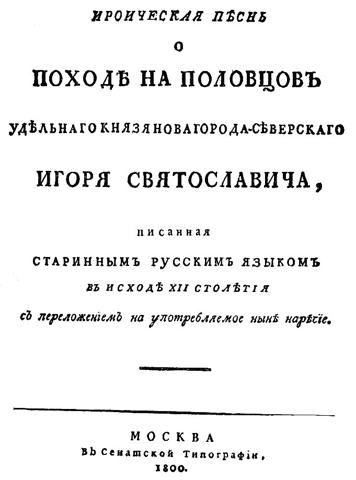
Sun god of the Kyivan pantheon and, in the Tale of Igor's Campaign, the mythical ancestor of the Rus' people themselves.
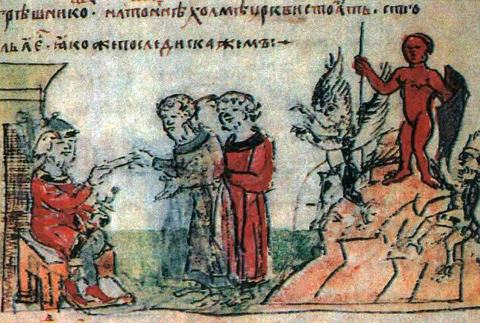
God of thunder and the striking bolt — the oak-crowned sky lord of the early Slavs, sworn by in treaties and thrown into the Dnieper at Rus' baptism.
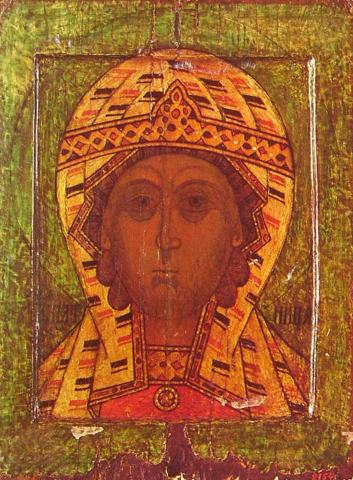
Mother of the damp earth and the spun thread — the only goddess on Vladimir's hill, who outlived her own cult as a night spirit and as Saint Friday.
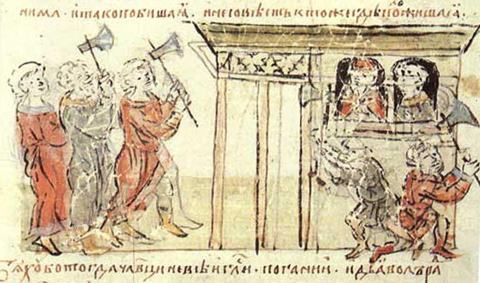
The founding chronicle of Kyivan Rus', c. 1113 - the only narrative source for Vladimir's pagan pantheon of 980 and its fall eight years later.
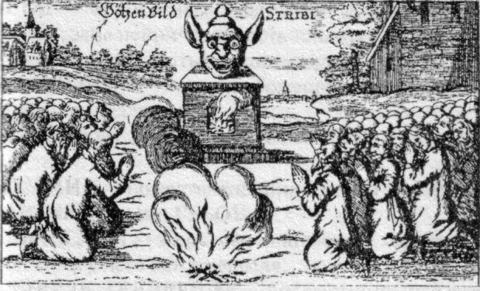
Wind god of the pagan Kyivan pantheon, remembered in the Tale of Igor's Campaign as the ancestor whose grandsons are the winds themselves.
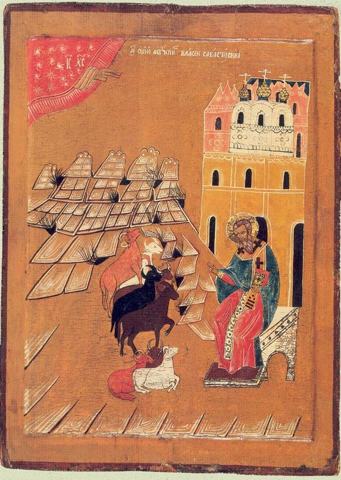
Lord of the cattle and the world below — the second god the Rus' swore by, whose name survived as a curse, a saint's herd, and a beard of grain in the field.
Sources & Further Reading
- 1.The Hypatian Chronicle, entry under the year 1114 — an interpolated Slavonic translation of the Chronicle of John Malalas.
- 2.Thietmar of Merseburg, Chronicon, Book VI (c. 1015) — the temple at Riedegost.
- 3.Bruno of Querfurt, Letter to King Henry II (1008).
- 4.The Russian Primary Chronicle (Povest' vremennykh let, c. 1113) — Vladimir's idols, s.a. 980.
- 5.Helmold of Bosau, Chronica Slavorum (12th century).
- 6.Ivanits, Linda J. Russian Folk Belief. M.E. Sharpe, 1989.
- 7.Kalik, Judith & Alexander Uchitel. Slavic Gods and Heroes. Routledge, 2019.
Spot an error or have a source to suggest? Write to info@viseterna.com. We cite primary sources and modern scholarship, and we correct fast.