
Triglav (Three-Headed Slavic God)
Chief god of the Pomeranian Slavs at Szczecin and Wolin, whose three joined heads were said to rule heaven, earth, and the underworld.
Trigla (Triglav), engraving from Bernard de Montfaucon, L'Antiquite expliquee, 1722 · Public domain · source
Three Heads, Three Realms
Triglav — from tri, "three," and glava, "head" — was the chief god of the Pomeranian Slavs around Szczecin (Stettin) in the early twelfth century, and one of the comparatively small number of West Slavic deities described by an eyewitness rather than reconstructed from folklore 3,5,6. Unlike Perun or Dazhbog, whose entire East Slavic record is a name on a list and a line of poetry, Triglav comes with a described temple, a described idol, and an explanation, attributed by the sources to his own priests, of why he had three heads at all 1,2.
Otto of Bamberg's Mission
The evidence survives because Triglav's cult was destroyed on camera, so to speak. Bishop Otto of Bamberg led two missionary campaigns into recently conquered, still-pagan Pomerania, in 1124–25 and again in 1128, converting the region at the political request of the Polish duke Bolesław III 3,4. Otto's success was thorough enough, and important enough to the church, that he acquired two separate biographers within a few decades of his death: the monk Ebbo, writing around 1151, and Herbord of Michelsberg, writing a Dialogus around 1158, both drawing on eyewitness testimony from Otto's companions 1,2,4. Between them they give Triglav's cult at Szczecin the fullest physical description of any Slavic pagan idol that survives.
The Idol at Szczecin
The two biographers do not fully agree on the idol's material — Ebbo describes it as gold, while a related account attributes silver plating to all three heads — but they agree on its form: three human heads joined on a single body 1,2,5. Herbord reports that a golden veil covered the idol's eyes and mouth, and records the priests' own explanation for the design: Triglav had three heads because he ruled three realms — heaven, earth, and the underworld — and covered his eyes and lips so as not to see or speak of the sins of men 2,3.
Szczecin's temple complex also served, according to the sources, as a civic treasury and included the trappings of hippomancy: a large black horse, kept for the god and led over crossed spears to divine the outcome of upcoming campaigns by which foot it favored, distinct in colour from the white horse recorded for Svetovid at Arkona 1,2,5. Three hills in the town were said to be sacred to him, and Otto's mission reportedly met stiff local resistance before the temple was pulled down 2,4.
Wolin and the Hidden Idol
Triglav was also worshipped at Wolin, on the Baltic coast, and Herbord's account of that city's conversion adds a small, human detail missing from most Slavic pagan narratives: when Otto's party moved to destroy the local temple, the pagan priests are said to have smuggled out the golden image of Triglav and placed it for safekeeping with a widow on an isolated farm, rather than allow it to be seized and desecrated 2. Whether or not the anecdote is precisely accurate, it is a rare glimpse of the cult from the perspective of people trying to preserve it rather than of the missionaries destroying it, and it implies Triglav's worship at Wolin outlasted, at least briefly, its official end 2,4.
Three Realms, One God
Modern scholarship has taken the "three realms" explanation seriously as more than priestly showmanship. Dynda's comparative study situates Triglav among a wider Indo-European pattern of tricephalic or triple deities associated with boundaries, crossroads, and the vertical axis linking sky, earth, and underworld, arguing that the Pomeranian priests' own gloss — heaven, earth, underworld — reflects a genuine cosmological structure rather than a improvised answer to a missionary's question 3. That reading fits Triglav's role as a supreme or near-supreme god at Szczecin: a single figure whose three faces let him see, in principle, every part of a three-tiered universe at once 3,5.
How Much Do We Really Know?
By the standard of Slavic paganism, Triglav is unusually well documented: two independent twelfth-century biographers, a described idol, a named material, a ritual practice, and a priestly explanation of his own iconography 1,2. What is missing is everything that would make him a fully rounded god rather than an idol on record — no myths involving him, no genealogy connecting him to Perun, Svetovid, or Chernobog, and no evidence of how far his cult extended beyond Pomerania before Otto's missions ended it 3,4,5. He is a rare case in this pantheon where the problem is not a lack of a witness, but a lack of everything the witness didn't think to ask.
Continue Exploring
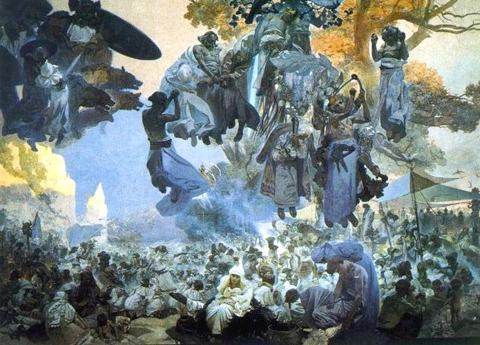
Four-headed war-oracle god of the Rugian Slavs at Arkona, described in unmatched detail by Saxo Grammaticus before Danes destroyed his temple in 1168.
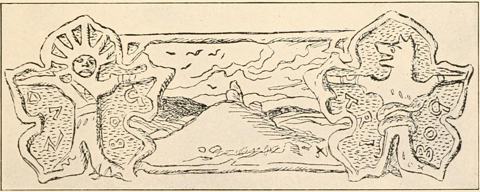
A genuinely attested "black god" of the Baltic Slavs, paired since the 1600s with a "white god" no medieval source actually names.
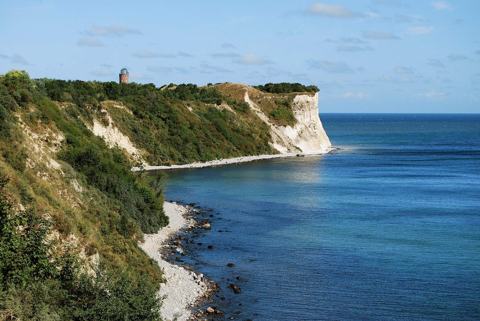
A Rugian temple-fortress with the best-documented pagan cult in the Slavic world - and the site of its most precisely dated destruction, in 1168.
Sun god of the Kyivan pantheon and, in the Tale of Igor's Campaign, the mythical ancestor of the Rus' people themselves.
God of thunder and the striking bolt — the oak-crowned sky lord of the early Slavs, sworn by in treaties and thrown into the Dnieper at Rus' baptism.
Mother of the damp earth and the spun thread — the only goddess on Vladimir's hill, who outlived her own cult as a night spirit and as Saint Friday.
Sources & Further Reading
- 1.Ebbo of Michelsberg, Vita Ottonis Episcopi Bambergensis (c. 1151).
- 2.Herbord of Michelsberg, Dialogus de Vita Ottonis Episcopi Bambergensis (c. 1158).
- 3.Dynda, Jiří. "The Three-Headed One at the Crossroad. A Comparative Study of the Slavic God Triglav." Studia Mythologica Slavica 17 (2014).
- 4.Słupecki, Leszek Paweł. Slavonic Pagan Sanctuaries. Institute of Archaeology and Ethnology, Polish Academy of Sciences, 1994.
- 5.Kalik, Judith & Alexander Uchitel. Slavic Gods and Heroes. Routledge, 2019.
- 6.Dixon-Kennedy, Mike. Encyclopedia of Russian and Slavic Myth and Legend. ABC-CLIO, 1998.
Spot an error or have a source to suggest? Write to info@viseterna.com. We cite primary sources and modern scholarship, and we correct fast.