
Svetovid (Sventovit)
Four-headed war-oracle god of the Rugian Slavs at Arkona, described in unmatched detail by Saxo Grammaticus before Danes destroyed his temple in 1168.
The Celebration of Svantovit on Rugen, Alfons Mucha, 1912 (The Slav Epic) · Public domain · source
The Four-Faced God of Arkona
Svetovid (also Svantovit, Sventovit) was the supreme god of the Rani, a Slavic people of the island of Rügen in the Baltic, worshipped at the clifftop stronghold of Arkona until its destruction in 1168 1,3. His name is generally parsed as svet- ("light" or "sacred") joined to -vid ("seeing" or "lord"), though the exact compound is debated 2,5. He is, by a wide margin, the best-documented god in the entire Slavic pantheon, because he has something almost no other Slavic deity has: a long, detailed, first-generation description written by a named historian rather than reconstructed from later folklore 1.
Saxo's Temple
That description comes from Saxo Grammaticus, the Danish chronicler whose Gesta Danorum devotes a long section of Book 14 to the Danish conquest of Rügen and, within it, an ethnographic account of Arkona's cult that has no real parallel elsewhere in the sources for Slavic religion 1. Saxo describes a wooden temple at the center of the fortified town, richly carved and hung with red textile hangings, containing a massive idol taller than a man: four necks and four heads, two facing forward and two back, all clean-shaven in the Rani style, holding a drinking horn in one hand while the other arm bent and rested against his hip, an oversized silver-hilted sword hung at his side along with a bridle and saddle for a sacred horse kept nearby 1,3. Access to the innermost sanctuary was restricted even to the temple's own priest, who was forbidden, Saxo reports, to breathe inside it, retreating outside to exhale before returning 1.
The White Horse and the Harvest Festival
Arkona functioned as an oracle as much as a shrine. Saxo describes an annual post-harvest festival at which the priest inspected the level of mead remaining in Svetovid's drinking horn to forecast the coming year's abundance, and a war-divination ritual in which a large white horse, believed to belong to the god himself and ridden by no living person, was led over rows of crossed spears; the pattern of its footfall determined whether a planned campaign would go forward 1,3. The temple also held Rani tribute and a levy from every household, along with a corps of mounted warriors dedicated to the god's service, making Arkona as much a political and military center as a religious one 1,3.
That festival is the subject of Alfons Mucha's 1912 painting reproduced above, part of his nationalist Slav Epic cycle — a romantic early-twentieth-century imagining of the scene rather than any kind of period depiction, but a useful reminder of how vividly Saxo's account has continued to fire the historical imagination 4.
The Fall of Arkona, 1168
Arkona's end is as well documented as its cult. In 1168, the Danish king Valdemar I, together with Bishop Absalon of Roskilde, led a campaign against Rügen that culminated in the storming of Arkona and the forced destruction of Svetovid's temple and idol, which was reportedly felled, hacked apart, and burned in front of the assembled Rani, who were then compelled to accept baptism 1,3. It is one of the very few moments in the whole history of Slavic paganism where a named idol's construction, cult practice, and destruction are all attested by a single continuous narrative source, rather than pieced together from scattered mentions 1.
The Zbruch Idol Problem
A famous four-faced limestone pillar, pulled from the river Zbruch on the Ukrainian-Galician border in 1848 and now in the Archaeological Museum in Kraków, is popularly identified with Svetovid, and is often illustrated beside him for exactly that reason 2,5. The identification is old — it goes back to the idol's earliest students in the nineteenth century — but it is geographically and culturally awkward: Svetovid, as described by Saxo, belonged to the West Slavic Rani of Rügen, while the Zbruch Idol was recovered deep in East Slavic territory, with no textual link connecting the two 2. Other scholars have proposed the pillar represents an entirely different multi-aspect deity, or even a composite scheme of several separate gods carved onto one shaft rather than a single four-faced figure at all; the identification with Svetovid remains a popular convention rather than a settled scholarly conclusion 2.
How Much Do We Really Know?
Compared to Perun, Triglav, or Chernobog, Svetovid is unusually secure: a named source, a physically detailed idol, a described priesthood and ritual calendar, and a dated destruction 1,3. The gaps that remain are still real — no version of his mythology survives, nothing explains why he has four faces where Triglav has three, and his supposed East Slavic image, the Zbruch Idol, is more likely a separate tradition wearing a famous name than an actual portrait of the god Saxo saw at Arkona 2,5. Even the best-documented Slavic god, in other words, is documented as a temple and a downfall — not as a mind.
Continue Exploring
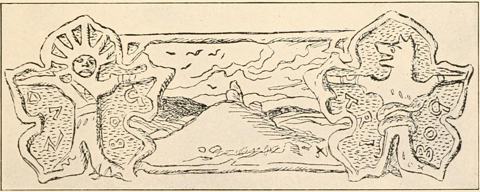
A genuinely attested "black god" of the Baltic Slavs, paired since the 1600s with a "white god" no medieval source actually names.
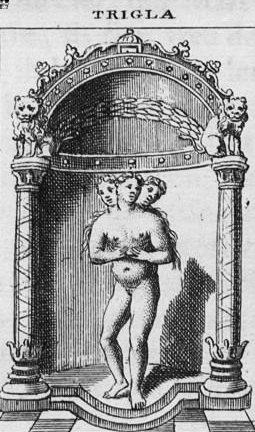
Chief god of the Pomeranian Slavs at Szczecin and Wolin, whose three joined heads were said to rule heaven, earth, and the underworld.
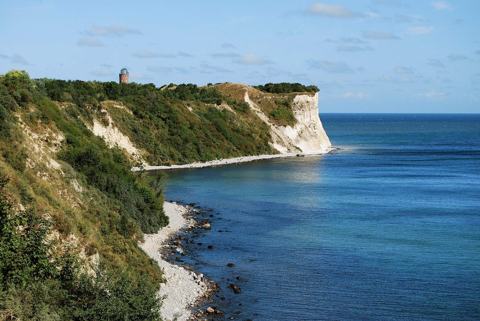
A Rugian temple-fortress with the best-documented pagan cult in the Slavic world - and the site of its most precisely dated destruction, in 1168.
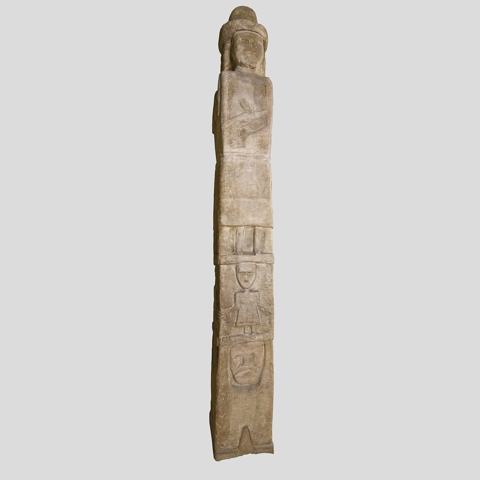
A carved limestone pillar recovered from the Zbruch river in 1848, popularly called Svetovid - though some scholars now argue it may be a 19th-century fake.
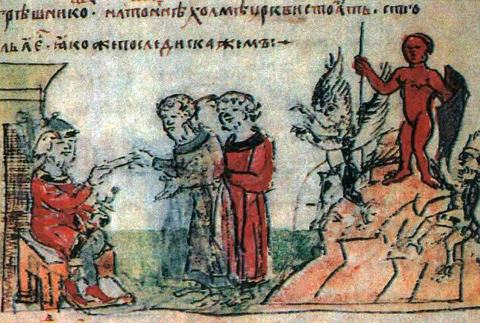
God of thunder and the striking bolt — the oak-crowned sky lord of the early Slavs, sworn by in treaties and thrown into the Dnieper at Rus' baptism.
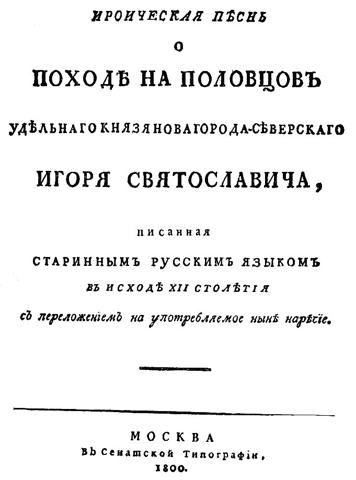
Sun god of the Kyivan pantheon and, in the Tale of Igor's Campaign, the mythical ancestor of the Rus' people themselves.
Also mentioned inBuyan (the Enchanted Island)
Sources & Further Reading
- 1.Saxo Grammaticus. Gesta Danorum, The History of the Danes, Book 14. Ed. Karsten Friis-Jensen, trans. Peter Fisher. Oxford University Press, 2015.
- 2.Kalik, Judith & Alexander Uchitel. Slavic Gods and Heroes. Routledge, 2019.
- 3.Słupecki, Leszek Paweł. Slavonic Pagan Sanctuaries. Institute of Archaeology and Ethnology, Polish Academy of Sciences, 1994.
- 4.Machal, Jan. Slavic Mythology, in The Mythology of All Races, vol. III. Marshall Jones, 1918.
- 5.Dixon-Kennedy, Mike. Encyclopedia of Russian and Slavic Myth and Legend. ABC-CLIO, 1998.
Spot an error or have a source to suggest? Write to info@viseterna.com. We cite primary sources and modern scholarship, and we correct fast.