
Houyi (Hou Yi)
The archer who shot nine of the ten suns out of the sky, won the elixir of immortality, and lost it to his wife Chang'e.
Hou Yi Shooting an Arrow, Xiao Yuncong, 1645 (from Tianwen tu, Illustrations to the Heavenly Questions) · Public domain · source
Who Houyi Is
Houyi (后羿), also simply Yi (羿), is the great archer of Chinese myth: the man who shot nine suns out of the sky when ten rose at once and set the world on fire. Hou is not a surname but a title — "lord" or "sovereign" — so the name reads roughly as "Lord Yi" 6. Almost everything else about him is disputed, because at least two and probably three separate figures have been folded into one name across three thousand years of transmission 4,6.
He is the husband of Chang'e, the goddess who flies to the moon with the elixir he had won, and the two stories are inseparable: the archer's greatest achievement is undone by his greatest loss 1.
Ten Suns Over a Burning World
The classic account is in the Huainanzi, compiled at the court of Liu An in 139 BCE. In the reign of the sage-king Yao, ten suns rose together, scorching the crops and the vegetation until there was nothing left for people to eat. Yao charged Yi with setting it right; Yi shot the extra suns down and killed a series of monsters that were preying on the people — Chisel-Tooth, Nine Gullets, Great Wind, the Giant Boar, and the Long Snake among them 1. The world was saved, and Yao was confirmed as Son of Heaven 1.
The Shanhaijing preserves what may be an older layer of the same tradition, in which the god Di Jun gives Yi a vermilion bow and corded white arrows and sends him down "to succour the lands below" — that is, Yi acts as heaven's agent rather than as a mortal hero, and his shooting is a commission, not a rebellion 2,6. In several traditions the suns are three-legged crows that live in the branches of the Fusang tree in the east, which is why Han-dynasty stone reliefs of the scene show birds tumbling out of a tree as the archer draws 2,6.
The Chuci poem "Heavenly Questions" — a catalogue of riddles about myths its audience already knew — asks flatly why Yi shot the suns and why the sun-crows shed their feathers, then goes on to ask about his shooting of the River Lord Hebo and his taking of Hebo's consort 3. The poem's questions confirm that by the Warring States period the archer's deeds were already famous, and already morally awkward 3,6.
The Elixir and the Moon
The other half of his legend also comes from the Huainanzi. Yi asked for and received the drug of deathlessness from Xiwangmu, the Queen Mother of the West, on her mountain in the far west. Before he could take it, his wife Heng E — later called Chang'e — swallowed it and rose to the moon, where she remains 1. The early text is brutally short and gives no motive, which is precisely why later tellers supplied so many: that she took it to keep it from a thief, that she was curious, that she was fleeing a husband who had become a tyrant, or that she meant to save the world from an immortal despot 1,6.
Popular tradition, consolidated in the late imperial period and now attached to the Mid-Autumn Festival, adds the treacherous apprentice Feng Meng, who tries to seize the elixir while Yi is away and prompts Chang'e to swallow it. That detail grows out of a much older notice in the Mengzi, where Feng Meng learns archery from Yi, realises that only his teacher is his equal, and murders him — a passage Mencius uses to argue that Yi bore some of the blame for choosing his student badly 5,6.
The Other Yi: A Usurper in the Xia
Alongside the sun-shooter, early historical texts describe Yi of Youqiong, a lord of the Xia period whose skill at archery is real but whose story is political. The Zuo zhuan reports that he displaced the Xia ruler, neglected government for hunting, trusted his minister Han Zhuo, and was killed by him — after which Han Zhuo took Yi's household and his wife 4. Whether this figure was originally the same as the celestial archer, or a separate ruler whose reputation attracted the older myth, has been argued for a long time; Birrell treats the sun-shooting Yi and the Xia usurper as distinct traditions that later merged under a single name, and notes that the transmitted sources themselves are inconsistent about which deeds belong to whom 4,6. The safest statement is that "Houyi" in later Chinese literature is a composite 6.
Why the Story Lasted
The archer myth carries a specific idea: that the cosmos can go wrong, that the sky itself can become a threat, and that the remedy is a human — or half-divine — being with a bow rather than a prayer. It sits alongside the other great Chinese repair myths, such as Nuwa patching the broken heavens, as a story about restoring a damaged order rather than creating one 6. See Nuwa for the closest parallel.
Its later life is domestic rather than cosmic. The moon at Mid-Autumn belongs to Chang'e; Houyi is the figure standing below it, holding a bow he can no longer use for anything that matters. That the archer is remembered chiefly through his wife's departure is one of the odder outcomes in Chinese myth, and a good illustration of how the tradition kept reweighting a story it never stopped telling 1,6.
Continue Exploring
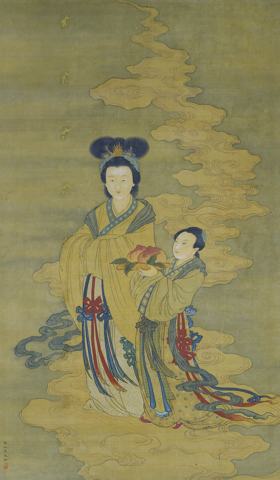
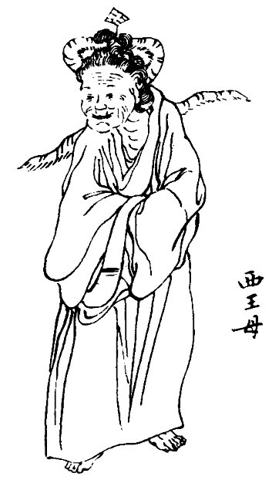
A tiger-toothed mountain spirit who became China's greatest goddess of immortality, keeper of the peaches that ripen once in three thousand years.
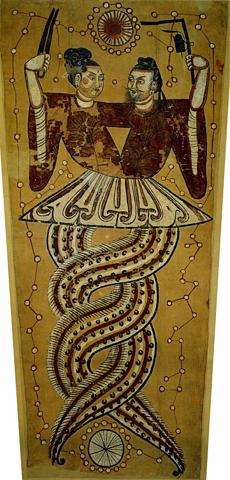
The serpent-bodied creator goddess who shaped the first humans out of yellow earth and patched the broken sky with five-coloured stone.
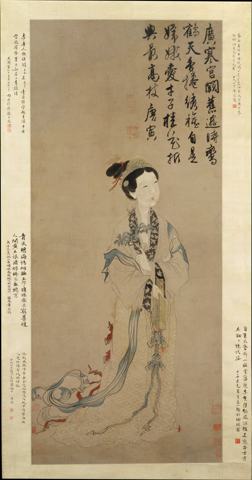
The moon goddess who swallowed the elixir of immortality and rose beyond reach — honoured each Mid-Autumn Festival with mooncakes and lanterns.
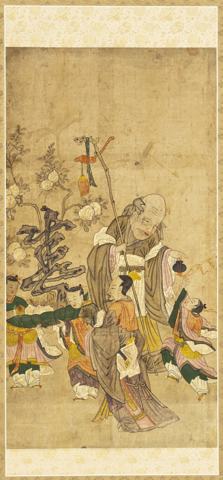
The fruit that ripens once every three thousand years in the Queen Mother's orchard — eaten by the wrong guest, it triggered heaven's most famous brawl.
China's oldest surviving catalogue of mountains, monsters, and gods — a text nobody can name an author for, and half this Codex's bestiary depends on.
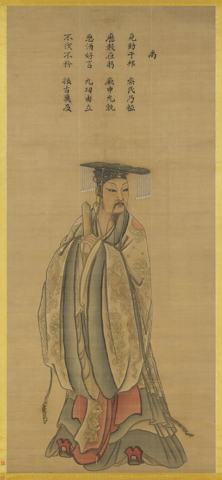
The hero who ended China's great flood by dredging channels instead of damming them, walked the Nine Provinces, and founded the Xia — if he existed at all.
Sources & Further Reading
- 1.Huainanzi (139 BCE), chapters 'Benjing' and 'Lanming'; trans. John S. Major, Sarah A. Queen, Andrew Seth Meyer and Harold D. Roth, The Huainanzi, Columbia University Press, 2010.
- 2.Shanhaijing — The Classic of Mountains and Seas (compiled c. 4th century BCE – 2nd century CE); trans. Anne Birrell, Penguin Classics, 1999.
- 3.Chuci — The Songs of the South, esp. 'Tianwen' (Heavenly Questions); trans. David Hawkes, The Songs of the South: An Anthology of Ancient Chinese Poems, Penguin Classics, 1985.
- 4.Zuo zhuan, Duke Xiang year 4 (the account of Yi of Youqiong); trans. Stephen Durrant, Wai-yee Li and David Schaberg, Zuo Tradition / Zuozhuan, University of Washington Press, 2016.
- 5.Mengzi (Mencius) 4B.24 (Yi and his pupil Feng Meng); trans. D. C. Lau, Mencius, Penguin Classics, 1970.
- 6.Birrell, Anne. Chinese Mythology: An Introduction. Johns Hopkins University Press, 1993.
Spot an error or have a source to suggest? Write to info@viseterna.com. We cite primary sources and modern scholarship, and we correct fast.