
Chang'e
The moon goddess who swallowed the elixir of immortality and rose beyond reach — honoured each Mid-Autumn Festival with mooncakes and lanterns.
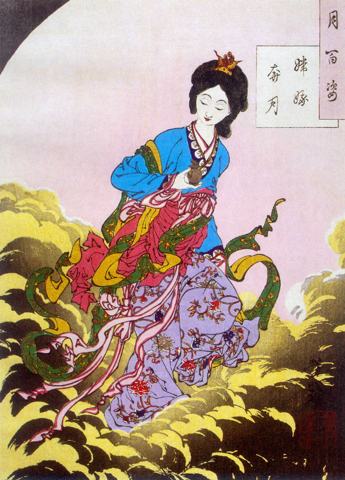
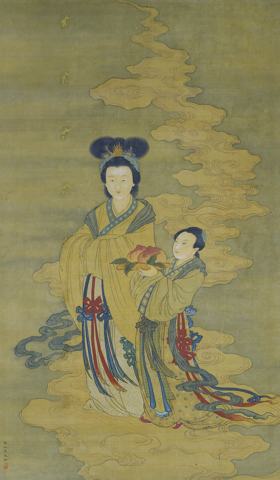
The Moon Goddess Chang E, unidentified Chinese artist, Ming dynasty (Metropolitan Museum of Art) · Public domain · source
Who Chang'e Is
Chang'e (嫦娥) is the goddess who lives on the moon — the most widely known female figure in Chinese myth and the presiding presence of the country's second-largest festival 4,5. Her name was originally written Heng'e (姮娥); it was changed to avoid the personal name of Emperor Wen of the Han, and the altered form stuck 4,5.
Her story is short, and its meaning has been rewritten repeatedly. In the oldest surviving version she is a thief who abandons her husband. In the version told to Chinese children today she is a heroine who sacrifices herself. Both are real parts of the tradition, and the distance between them is the most interesting thing about her 4,5.
The Archer and the Elixir
The setup belongs to her husband, Yi — Houyi, "Lord Archer" — the greatest marksman of Chinese myth 4,5. In the Huainanzi and related sources, ten suns rise together in the sky, scorching the crops, melting the metal and stone, and leaving the people to starve; Yi shoots nine of them down and leaves one, which is the sun we have 1,4.
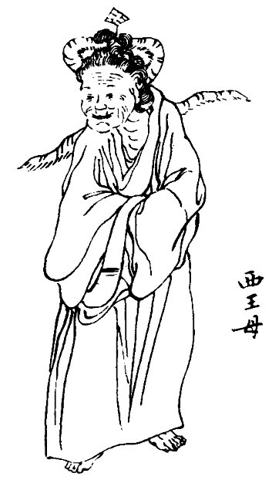
For his services he is given, by the Queen Mother of the West — Xiwangmu, the goddess who commands the drugs of deathlessness on her mountain in the far west — a portion of the elixir of immortality 1,6. The Huainanzi is explicit that it is enough for one 1. Loewe's study of Han funerary art shows how central Xiwangmu and the quest for immortality were to the period's religious imagination, which is the world this story comes out of 6.
The Theft
The oldest surviving account is a single sentence, and it is unsentimental. Yi obtained the elixir from the Queen Mother of the West; Heng'e stole it and fled with it to the moon 1,4.
A second-century commentary attributed to the astronomer Zhang Heng adds detail. Before fleeing, Heng'e had the matter divined; the oracle told her the omens were auspicious, that she would fly west alone into darkness and should not be afraid, and that great prosperity would follow. She swallowed the drug and went to the moon — where, on arrival, she was transformed into a toad 2,4.
That ending startles modern readers, but it is well grounded. The three-legged moon toad is a fixture of Han iconography, appearing on tomb banners and bronze mirrors alongside the moon rabbit, and Han writers treated the toad in the moon as an ordinary fact of the sky 4,6.
The Palace, the Rabbit, and the Cassia Tree
Later tradition gave the moon a proper household. Chang'e dwells in the Guanghan Palace, the Palace of Vast Cold, a place of white jade and unbroken silence 5. With her is the jade rabbit, Yutu, forever pounding herbs in a mortar to make the elixir of immortality 4,5.
And there is Wu Gang, a man punished for some offence during his pursuit of immortality by being set to cut down the great cassia tree that grows on the moon — a tree that heals every cut as soon as the axe is withdrawn, so that the labour never ends 5. The Chinese moon is not a romantic vacancy: it is a cold palace, a treadmill, and an exile 4,5.
Birrell also notes an older figure who may lie behind Chang'e: Chang Xi, who in the Classic of Mountains and Seas gives birth to twelve moons and bathes them — a lunar mother whose name is close enough to have invited comparison, though the relationship remains conjectural 3,4.
From Theft to Sacrifice
The story most people are told now runs differently. Yi entrusts the elixir to Chang'e for safekeeping. While he is away, his treacherous apprentice Feng Meng breaks in and demands it, and rather than let an unworthy man become immortal she swallows it herself — rising helplessly to the nearest heavenly body, the moon, so as to stay as close to her husband as she can. Grieving, Yi sets out her favourite fruits and cakes in the courtyard under the full moon, and the neighbours do the same 5.
This is a genuine part of the tradition and the version that carries the festival's meaning, but it is a much later shaping of a much colder original 4,5. Yang and An document a whole spread of variants — Chang'e as greedy, as curious, as coerced, as noble — and treat the multiplicity as normal rather than as corruption: Chinese myths circulate in oral versions that adjust to what a community wants the story to mean 5.
The Mid-Autumn Festival
Chang'e is inseparable from Zhongqiu Jie, the Mid-Autumn Festival, held on the fifteenth day of the eighth lunar month when the harvest moon is at its fullest 5. Families gather, lanterns are lit, and round mooncakes are shared — roundness standing for reunion and the full moon alike. Offerings of fruit and cakes are set out facing the moon, and in many households the offering is made to Chang'e by name 5.
It is one of the most widely observed festivals in China, Taiwan, and the Chinese diaspora, and a public holiday in several countries 5. Whatever the myth's earliest cruelty, the festival built on it is about being together.
Chang'e in Orbit
The name has left the folklore. China's lunar exploration programme is called Chang'e, its first rover was named Yutu after the jade rabbit, and successive Chang'e missions have orbited, landed on, and returned samples from the moon — including the far side 5.
There is also a well-documented exchange from July 1969, when mission control in Houston passed the Apollo 11 crew a note about a Chinese girl who had been living on the moon for four thousand years with a large rabbit, and asked them to look out for her. Buzz Aldrin agreed to keep an eye out 5.
Continue Exploring
China's harvest-moon festival of family reunion, mooncakes, and lantern-lit nights under the fullest moon — inseparable from the goddess Chang'e.
China's oldest surviving catalogue of mountains, monsters, and gods — a text nobody can name an author for, and half this Codex's bestiary depends on.
A tiger-toothed mountain spirit who became China's greatest goddess of immortality, keeper of the peaches that ripen once in three thousand years.
The fruit that ripens once every three thousand years in the Queen Mother's orchard — eaten by the wrong guest, it triggered heaven's most famous brawl.
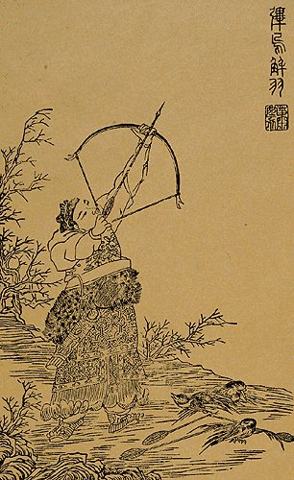
The archer who shot nine of the ten suns out of the sky, won the elixir of immortality, and lost it to his wife Chang'e.
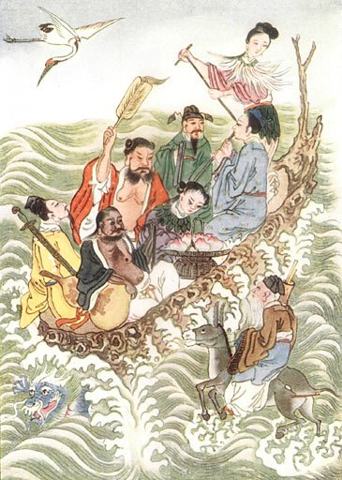
Eight Daoist immortals — a beggar, a drunk, a girl, a courtier, a flute player — who cross the sea by their own strange powers instead of by boat.
Sources & Further Reading
- 1.Huainanzi (139 BCE); trans. John S. Major, Sarah A. Queen, Andrew Seth Meyer & Harold D. Roth. Columbia University Press, 2010.
- 2.Zhang Heng, Lingxian — The Spiritual Constitution of the Universe (2nd c. CE).
- 3.Shanhaijing — The Classic of Mountains and Seas; trans. Anne Birrell. Penguin Classics, 1999.
- 4.Birrell, Anne. Chinese Mythology: An Introduction. Johns Hopkins University Press, 1993.
- 5.Yang, Lihui & Deming An. Handbook of Chinese Mythology. ABC-CLIO, 2005.
- 6.Loewe, Michael. Ways to Paradise: The Chinese Quest for Immortality. Allen & Unwin, 1979.
Spot an error or have a source to suggest? Write to info@viseterna.com. We cite primary sources and modern scholarship, and we correct fast.