
Diana
Roman goddess of the hunt, wild places and the moon, whose oldest sanctuary at Lake Nemi was guarded by a priest who held office by killing his predecessor.
Diana of Versailles, Roman marble after Leochares, 2nd century AD (Musee du Louvre, Paris); photograph by Eric Gaba (Sting), 2005 · CC BY-SA 2.5 · source
Name and Nature
Diana's name belongs to the same Indo-European family as dius and divus — brightness, daylight, sky — which makes her, etymologically, a goddess of light before she is a goddess of the moon 7,8. Roman poets writing under Greek influence identified her thoroughly with Artemis and gave her that goddess's family: daughter of Jupiter and Latona, twin sister of Apollo, armed with the bow, sworn to virginity, ranging the mountains with a company of nymphs 2.
Her Italian core, though, is older and rougher than the Greek overlay. Diana belongs to the nemus — the sacred grove — and to the boundary between cultivated land and wild. She is the goddess of the hunt and of wild animals, of woodland and of the uncleared places, and in Italy she is also strongly associated with women, with childbirth, and with slaves 6,7.
Catullus's hymn shows the range compactly: Diana as Latonia, as guardian of mountains and green woods, as Juno Lucina in childbirth, as Trivia, and as the moon called by a borrowed name 1. That triple identification — Diana, Luna, Hecate — produced the Diana triformis of later art and poetry, a goddess of heaven, earth and underworld shown as three figures back to back 1,2,6.
The Grove at Nemi
Diana's most important Italian sanctuary was not in Rome. It stood on the northern shore of Lake Nemi in the Alban Hills, below Aricia, and it belonged to the Latin communities collectively rather than to Rome alone 6,7. Excavations there have produced the pattern typical of an Italian healing and fertility sanctuary: enormous quantities of votive terracottas, including anatomical models and figures of mothers with infants, alongside dedications made by women and by freed slaves 6.
Two further figures share the grove. Egeria, a water nymph and the legendary counsellor of King Numa, was associated with its spring; and Virbius, whom Virgil identifies with the resurrected Hippolytus, brought there by Diana after his death and hidden in the Italian woods 3. Horses were excluded from the grove, a prohibition Roman writers explained through the story of Hippolytus's death 3,6.
The King of the Wood
The Arician sanctuary is famous for one detail preserved by Strabo, Pausanias and others: its priest, the rex nemorensis, "king of the wood", was a runaway slave who obtained the office by breaking a branch from a particular tree in the grove and then killing the current holder in single combat. He held it until someone did the same to him 4.
Strabo describes the priest as constantly armed and constantly watching, and the office as barbaric and un-Greek 4. The custom was already an antiquarian curiosity by the late Republic, and how old it really was, and whether it functioned as described in any period we can document, is genuinely contested. C.M.C. Green's study argues that the rite has been badly distorted by later readings and needs to be understood within ordinary Latin religious practice rather than as a survival of something primeval 6.
It was James Frazer who made the King of the Wood world-famous, opening The Golden Bough with the scene at Nemi and building an entire comparative theory of dying-and-reviving divine kingship on it. Frazer's framework has been abandoned by anthropologists and classicists alike, but the image he took from Strabo has outlived the argument it was meant to support 6,7.
Diana in Rome
Within the city, Diana's principal temple stood on the Aventine, outside the pomerium — the sacred boundary — which is where Rome usually put gods of foreign or federal character 5,7. Livy credits its foundation to King Servius Tullius in the sixth century BC and, more interestingly, records its political function: the temple housed the charter of the Latin communities, a common sanctuary that acknowledged Rome's leadership among them 5. Modern historians treat the Servian date with caution while accepting that the Aventine cult was old and federal in character 7.
Its dedication day was 13 August, the Ides. That date was a general holiday for slaves — Roman writers call it the servorum dies festus — and in the Alban Hills the same night saw the Nemoralia, when women walked out to Nemi in torchlit procession with garlands and prayers, often in fulfilment of vows made about childbirth 6,7. The two celebrations, urban and Arician, plainly belong together.
Diana also appears, more grandly, in imperial religion. Horace's Carmen Saeculare, sung at the Secular Games of 17 BC, addresses her jointly with Apollo, pairing the twins as patrons of the renewed age; and Augustus's Palatine complex honoured both 7.
Actaeon and the Limits of Looking
The one myth almost everyone knows about Diana is Greek in origin and Roman in its most famous telling. Ovid's Metamorphoses has the hunter Actaeon stumble, by accident, on the goddess bathing in a woodland pool. She flushes with anger, throws water in his face, and he is transformed into a stag — then torn apart by his own hounds, who no longer know him 2.
Ovid is careful to insist that Actaeon's fault was chance rather than crime, which makes the story a study in the arbitrariness of divine power rather than a morality tale. It also fixes an idea that runs through Diana's whole cult: she belongs to a space that is not ours, and entering it uninvited is dangerous. Her sisters in Roman religion, Juno, Minerva and Venus, are all in some sense civic. Diana is the goddess of what lies past the last field.
Continue Exploring
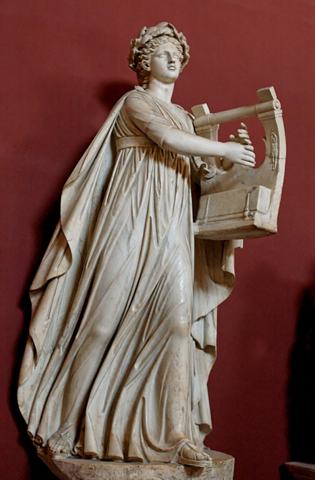
The one great Greek god Rome adopted without renaming him — plague-healer, oracle-giver, and the personal patron Augustus built into the imperial order.
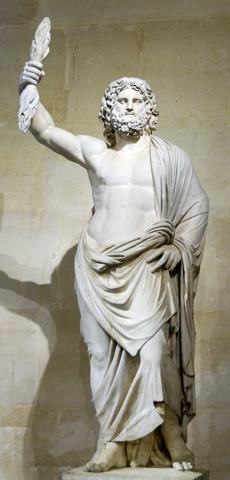
King of the gods and of the Roman state — lord of the bright sky, hurler of the lightning bolt, and the guarantor behind every oath and treaty.
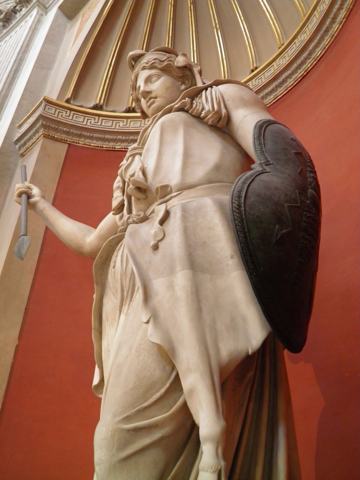
Queen of the gods — Rome's guardian of women, childbirth and the state, whose sacred geese warned the Capitol and whose temple gave us the word money.
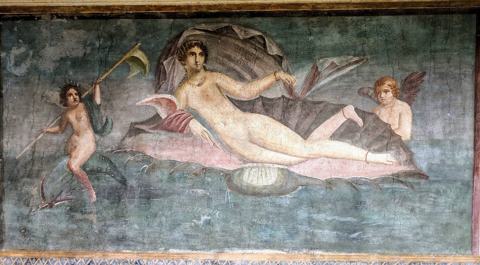
Goddess of love and desire — and the divine ancestress of Rome itself, mother of Aeneas and the claimed forebear of the family of Julius Caesar.
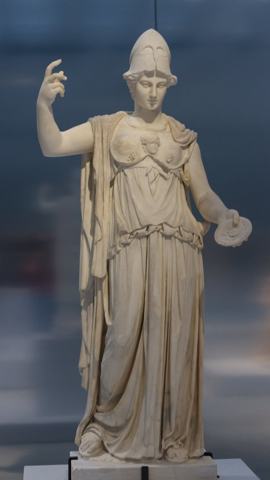
Goddess of wisdom and the crafts — third of the Capitoline Triad, and Rome's patron of every skilled trade from weaving and teaching to medicine.
Ovid's 15-book Latin epic of transformation myths — the single work that shaped how the post-classical West came to know Greek and Roman mythology.
Sources & Further Reading
- 1.Catullus, Poem 34 (hymn to Diana, c. 55 BC).
- 2.Ovid, Fasti — Book III, lines 259-275, and Metamorphoses — Book III (Actaeon), c. AD 8.
- 3.Virgil, Aeneid — Book VII, lines 761-782 (Virbius and the grove of Diana).
- 4.Strabo, Geography — Book V.3.12 (the priest of the Arician grove).
- 5.Livy, Ab Urbe Condita — Book I.45 (Servius Tullius and the Aventine temple).
- 6.Green, C.M.C. Roman Religion and the Cult of Diana at Aricia. Cambridge University Press, 2007.
- 7.Beard, Mary, John North and Simon Price. Religions of Rome. 2 vols. Cambridge University Press, 1998.
- 8.Scheid, John. An Introduction to Roman Religion. Trans. Janet Lloyd. Indiana University Press, 2003.
Spot an error or have a source to suggest? Write to info@viseterna.com. We cite primary sources and modern scholarship, and we correct fast.