
Cupid (Amor)
The winged god of desire, son of Venus — best known through Apuleius's tale of his secret marriage to the mortal Psyche and the trials Venus set her.
Psyche Revived by Cupid's Kiss, Antonio Canova, 1787-1793 (Musee du Louvre) · Public domain · source
Not Quite the Greek Eros
Latin cupido simply means "desire," and Cupid, son of Venus, is that desire personified — the god who makes mortals and gods alike fall in love whether they consent to it or not 3. Once Roman poets settled into treating their gods as versions of the Greek pantheon, Cupid absorbed Eros's parentage, his bow, and his taste for mischief wholesale 3. Latin usage kept a distinction the myths themselves mostly ignore: Amor, "Love," turns up in weightier poetry — Virgil uses it almost exclusively for the god who appears in the Aeneid — while Cupido stayed the name for the impish boy of lighter verse, the one who ambushes people with arrows for sport 2,3. Unlike his mother, Cupid held no state cult, no temple, and no place on Rome's official festival calendar; he belonged to poetry, private shrines and decorative art, never to the priesthoods that structured Roman public religion 7.
The Two Arrows
Ovid gives Cupid's power its clearest mechanics. In the opening book of the Metamorphoses he arms the god with two kinds of arrow drawn from the same quiver: one gold and sharp, which fills its target with desire, and one blunt and tipped with lead, which fills its target with revulsion 3. Ovid uses the pair to explain why Apollo's pursuit of the nymph Daphne goes nowhere — he is struck by gold, she by lead — and the device became Cupid's defining trait in later art and literature, more central to his identity than any single myth about him 3. He reads less like a god with a biography than a mechanism other people's stories run on.
A Cameo in the Aeneid
Virgil puts that mechanism to openly political use. In Aeneid Book 1, Venus, worried for her son's shipwrecked Trojans, has Cupid take on the shape of Ascanius, Aeneas's young son, and sit in Queen Dido's lap at a Carthaginian banquet, breathing desire into her while wearing a child's face 2. It is Venus manipulating a foreign queen through her own hospitality, and it sets up the love affair whose collapse will end in Dido's suicide once Aeneas sails on toward Italy. Amor is doing here exactly what Cupid does in Ovid's lighter poems — loosing an arrow no one else can see — but Virgil's context turns a stock device of love elegy into an act of state-level manipulation with real casualties 2.
The Marriage Apuleius Told
Cupid gets an actual story only once, embedded in the North African writer Apuleius's Latin novel the Metamorphoses, better known as The Golden Ass, written in the second century AD and framed as a tale told by an old woman to comfort a kidnapped bride 1,6. Running to four books, it is the longest connected myth involving the god to survive from antiquity 1,6.
A king's youngest daughter, Psyche — "Soul" — is so beautiful that people neglect Venus's own cult to admire her instead. Venus, offended, sends Cupid to make Psyche fall in love with something vile, and he falls in love with her himself. Psyche is married to an unseen husband in a palace of invisible servants, forbidden ever to look at him; her jealous sisters convince her he must be a monster, and she lights a lamp to check while he sleeps, only to prick herself on one of his own arrows and fall permanently, helplessly in love with the god she has just betrayed and lost 1. Cupid flees; Psyche wanders the earth and eventually falls into Venus's hands, who sets her a sequence of impossible tasks — sorting a mountain of mixed grain, shearing wool from murderous golden sheep, drawing water from the river Styx, and finally carrying back a jar of beauty from the underworld itself — each completed only with help Psyche does not expect 1. Jupiter finally intervenes, makes Psyche immortal, and sanctions the marriage; their daughter is named Voluptas, "Pleasure" 1.
An Allegory Everyone Has Read Differently
Ancient and modern readers alike have struggled to leave the story alone as a story. Its heroine is literally named Soul, her trials read like an initiation ordeal, and the tale sits inside a novel that is itself deeply concerned with spiritual transformation — the narrator Lucius spends most of The Golden Ass turned into a donkey before being saved by the goddess Isis 6. Kenney's edition surveys readings running from Platonic allegory, the soul's ascent toward divine love through suffering to reunion, to a more skeptical view that treats the tale mainly as a virtuoso fairy story dressed in epic and elegiac borrowings, with the philosophy layered on afterward by readers rather than built in from the start 4. Harrison's study of Apuleius as a self-consciously literary performer, steeped in the rhetorical culture of the Roman Greek world, leans toward the second reading without dismissing the first — Apuleius, he argues, wrote for an audience that could enjoy catching both games at once 5.
After Antiquity
The marriage of Cupid and Psyche became one of the most painted and sculpted stories in Western art partly because it supports either reading — a fairy tale of a mortal girl who wins a god, or an allegory of a soul purified by suffering. Neoclassical sculptors returned to it often; Antonio Canova's marble group, showing Cupid reviving the unconscious Psyche with a kiss after her final ordeal in the underworld, is among the most reproduced works to survive the eighteenth century, and its composition still supplies the image most people picture when they hear the story's name 4. The god himself outlived the myth in a thinner form: the winged cherub with a bow, still doing on greeting cards exactly what Ovid described two thousand years earlier, minus the leaden arrow and the body count 3.
Continue Exploring
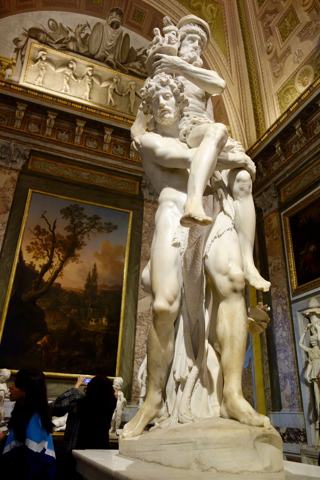
The Trojan prince who escaped burning Troy carrying his father and household gods, wandered the Mediterranean, and became Rome's mythical ancestor.
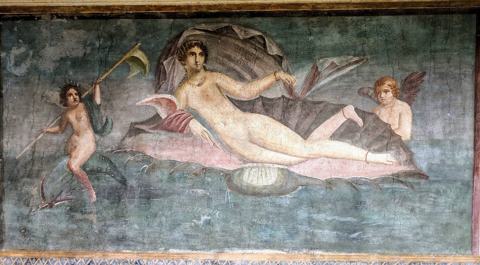
Goddess of love and desire — and the divine ancestress of Rome itself, mother of Aeneas and the claimed forebear of the family of Julius Caesar.
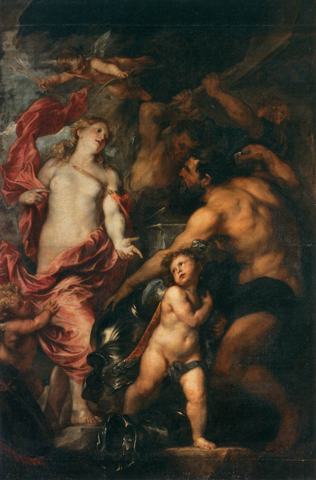
Rome's fire god, honored to keep flame from the wooden city, later remade as the mythical blacksmith who forged arms for gods and heroes.
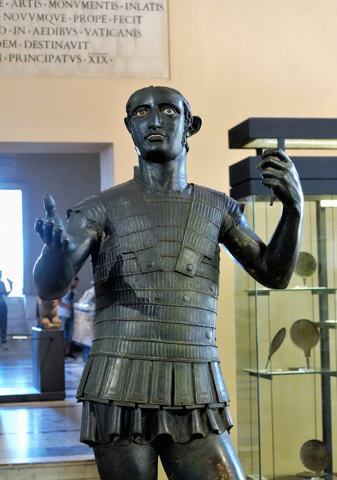
God of war and father of Rome — honoured above almost every other deity, with his own month, his own dancing priests, and the twins he fathered on a Vestal.
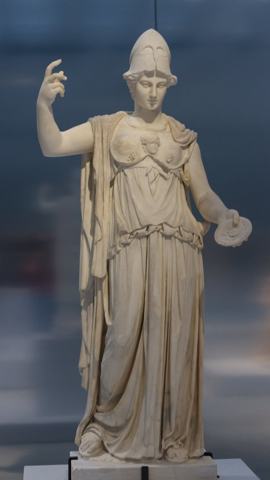
Goddess of wisdom and the crafts — third of the Capitoline Triad, and Rome's patron of every skilled trade from weaving and teaching to medicine.
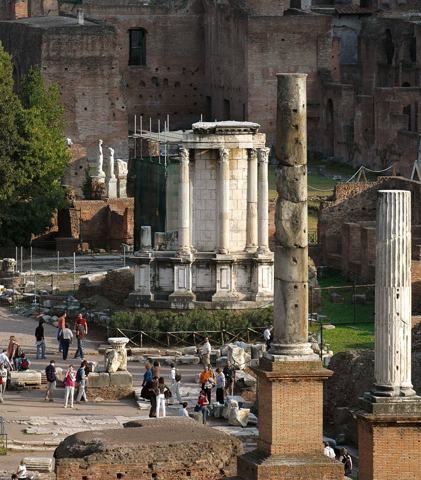
Rome's hearth goddess, worshipped as a living fire rather than a statue, tended in the Forum by six priestesses for over a thousand years.
Sources & Further Reading
- 1.Apuleius, Metamorphoses (The Golden Ass), c. 158 AD — Books 4-6.
- 2.Virgil, Aeneid (29-19 BCE), Book 1.
- 3.Ovid, Metamorphoses (8 AD), Book 1.
- 4.Kenney, E. J., ed. Apuleius: Cupid and Psyche. Cambridge University Press, 1990.
- 5.Harrison, S. J. Apuleius: A Latin Sophist. Oxford University Press, 2000.
- 6.Walsh, P. G., trans. Apuleius: The Golden Ass. Oxford University Press (Oxford World's Classics), 1994.
- 7.Beard, Mary, John North & Simon Price. Religions of Rome, Volume 1: A History. Cambridge University Press, 1998.
Spot an error or have a source to suggest? Write to info@viseterna.com. We cite primary sources and modern scholarship, and we correct fast.