
Mars
God of war and father of Rome — honoured above almost every other deity, with his own month, his own dancing priests, and the twins he fathered on a Vestal.
Mars of Todi, Etruscan bronze, late 5th c. BC (Museo Gregoriano Etrusco, Vatican Museums); photo Slices of Light, CC BY-SA 4.0 · CC BY-SA 4.0 · source
Not Ares in a Toga
Greek Ares is a figure his own family dislikes: violent, unreliable, and repeatedly humiliated in the poems. Mars occupies the opposite position at Rome. He is second only to Jupiter in the old priestly hierarchy, he has a dedicated flamen Martialis, he owns a month of the calendar and a whole field outside the city walls, and no Roman source treats his patronage as anything but an honour 7,8.
The equation with Ares was made early and imported the Greek stories along with it, so that Latin poetry can give Mars a love affair with Venus and a walk-on part in Olympian quarrels 2,4. Underneath that literary layer sits an older, more austere Italic god known chiefly through ritual 7,8.
The Farmer's Prayer
The single most important early text about him is not a myth but a form. Cato the Elder, writing a practical handbook for landowners around 160 BCE, gives the exact wording for the lustratio of the fields: an ox, a sheep and a pig are led three times around the boundary, and the owner prays to "Father Mars" to keep away disease, ruin, storm and barrenness, and to preserve his crops, his herds, his household and himself 3.
Nothing in that prayer is martial. Scholars have argued for a century about what it means — an originally agricultural god who later took up arms, or a god of armed defence whose protection naturally extended to the farm's boundary 7,8. The second reading now has the better of it: Mars guards the edge of things, and both the ploughland and the frontier are edges 8. Either way, Cato shows that a Roman farmer with no interest in war still spoke to Mars every year, out loud, by name 3.
Father of Romulus and Remus
Rome's foundation story makes Mars the ancestor of the Roman people. The Vestal Rhea Silvia, forced into the priesthood by her usurping uncle, bears twins and names Mars as their father; Livy notes drily that she may simply have found a god a more respectable explanation than the truth 1. The infants are exposed by the Tiber and saved by Lupa, the she-wolf, with a woodpecker bringing food — and both animals were sacred to Mars, which is the story quietly identifying its own author 1,5.
This gives Roman military ideology an unusually direct claim. Romans were not merely favoured by the god of war; by descent from Romulus they were his, and Roman writers from Livy to Virgil use the relationship to explain both the city's success and its appetite for conflict 1,4.
March, the Salii, and the Shields
The Roman year originally began in Martius, his month, when campaigning weather returned 2,6. Its rituals are among the oldest attested at Rome and among the most peculiar.
Twelve priests called the Salii, patrician young men in archaic bronze armour, crested helmets and short cloaks, processed through the city on set days in March, beating their shields and performing a leaping war dance to a hymn so ancient that by Cicero's time nobody could reliably understand it 2,5,6. They carried the ancilia: twelve figure-of-eight shields, one of which was said to have fallen from the sky in Numa's reign as a pledge of Rome's survival, with eleven copies made so no thief could identify the original 2,5.
The season closed on 19 October at the Armilustrium, when the arms were purified and stored 2,6. Between those dates came horse races, the Equirria, and the Tubilustrium, the purification of the war trumpets 2. The bracketing is exact: Roman religion opened and shut the fighting year with ceremony, and Mars presided over both ends 7,8.
Spears, Horses, and the Campus Martius
In the Regia, the small building in the Forum that housed some of Rome's oldest cults, spears sacred to Mars were kept. If they moved on their own it was reported as a prodigy, and a commander leaving for war is said to have shaken them with the words Mars vigila — "Mars, wake up" 7. On 15 October the right-hand horse of the winning chariot team was sacrificed to him on the Campus Martius, and its head was fought over by two neighbourhoods, the tail carried at a run to the Regia so its blood could drip on the hearth 2,7.
The Campus Martius, his field on the Tiber flood plain outside the sacred boundary of the city, is where citizens mustered under arms, where the census closed with a purification sacrifice, and where the assembly that elected consuls met 7,8. Armed force belonged outside the pomerium; so did its god 8.
Mars Ultor and the Emperors
Augustus made Mars the centrepiece of his religious rebuilding. He vowed a temple to Mars Ultor, "the Avenger," before Philippi in 42 BCE while pursuing Julius Caesar's assassins, and dedicated it in 2 BCE at the heart of his new Forum 7. The building became the place where the Senate debated war, where young men formally received the toga of manhood, where provincial governors set out from, and where the legionary standards recovered from Parthia were displayed 7.
Beyond Italy, Mars proved unusually absorbent. Provincial worshippers attached his name to local gods across Gaul, Britain and the Rhineland — Mars Lenus, Mars Loucetius, Mars Nodens and many others — sometimes producing a healing deity with a war god's name, which shows how little the Latin label constrained the cult underneath it 7,8.
Continue Exploring
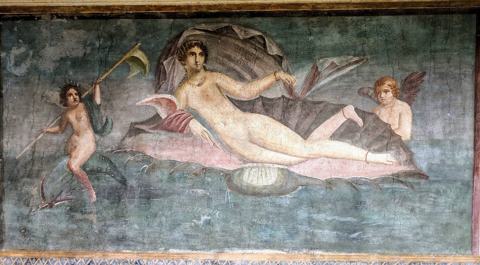
Goddess of love and desire — and the divine ancestress of Rome itself, mother of Aeneas and the claimed forebear of the family of Julius Caesar.
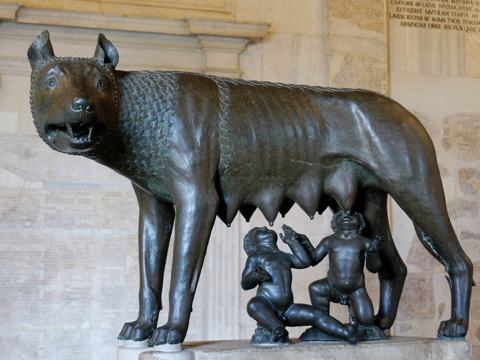
The she-wolf of Rome — the beast that suckled the abandoned twins Romulus and Remus, and the most durable emblem the city ever gave itself.
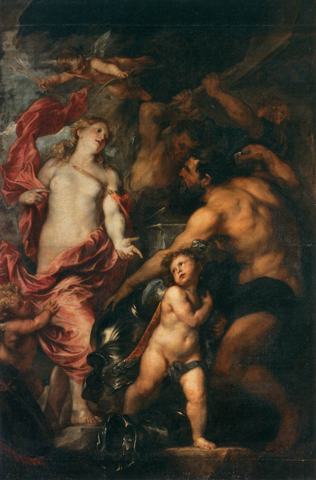
Rome's fire god, honored to keep flame from the wooden city, later remade as the mythical blacksmith who forged arms for gods and heroes.
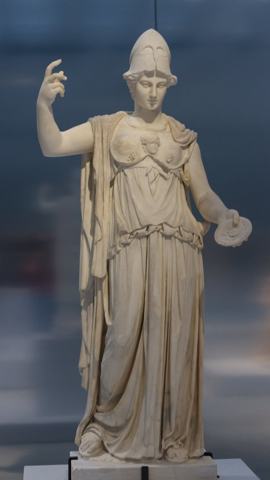
Goddess of wisdom and the crafts — third of the Capitoline Triad, and Rome's patron of every skilled trade from weaving and teaching to medicine.
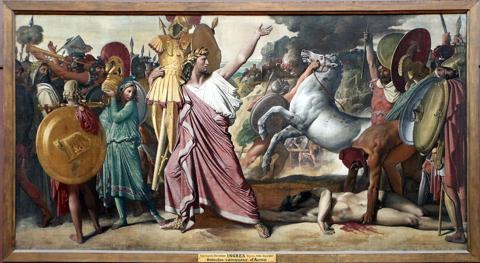
Twin sons of Mars, saved by a she-wolf and raised by shepherds, who quarreled over where to found Rome — a quarrel that ended with only one of them ruling it.
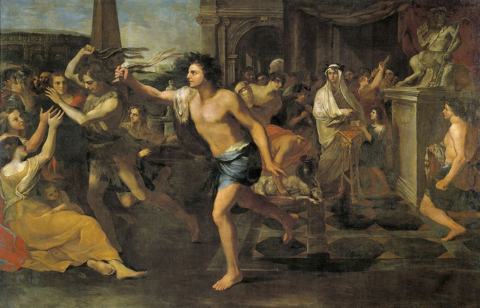
Rome's February fertility rite at the wolf's cave, where near-naked priests struck bystanders with goat-hide thongs — its link to Valentine's Day is unproven.
Also mentioned inAresBellona (Roman War Goddess)
Sources & Further Reading
- 1.Livy, Ab Urbe Condita (c. 27 BCE) — esp. Book 1.
- 2.Ovid, Fasti (c. 8 CE) — esp. Books 2–3.
- 3.Cato the Elder, De Agri Cultura (c. 160 BCE), ch. 141.
- 4.Virgil, Aeneid (29–19 BCE).
- 5.Dionysius of Halicarnassus, Roman Antiquities (late 1st century BCE).
- 6.Varro, De Lingua Latina (1st century BCE).
- 7.Beard, Mary, John North & Simon Price. Religions of Rome, Volume 1: A History. Cambridge University Press, 1998.
- 8.Scheid, John. An Introduction to Roman Religion. Edinburgh University Press, 2003.
Spot an error or have a source to suggest? Write to info@viseterna.com. We cite primary sources and modern scholarship, and we correct fast.