
Aeneas
The Trojan prince who escaped burning Troy carrying his father and household gods, wandered the Mediterranean, and became Rome's mythical ancestor.
Aeneas, Anchises and Ascanius, Gian Lorenzo Bernini (with Pietro Bernini), 1618-1619 (Galleria Borghese, Rome) · CC BY 2.0 · source
From the Iliad's Margins
Aeneas starts out as a minor figure in someone else's war. In the Iliad, he is a Trojan prince, son of Anchises and the goddess Venus, who fights well but not spectacularly and is twice pulled out of mortal danger by the gods — once by his mother, once by Poseidon, of all people, who has no reason to love Troy but saves Aeneas anyway because fate has decreed that his line, not Priam's, will go on ruling Trojans in some form after the city falls 1. Homer never says what that survival looks like. Everything built on top of that single prophetic line — a refugee's voyage, a new city, an empire — belongs to writers who came centuries later and had very different stakes in the answer 5.
The Flight from Troy
Virgil's Aeneid opens the story properly with the fall of Troy itself. As the city burns, Aeneas carries his elderly father Anchises out on his shoulders, leads his young son Ascanius by the hand, and follows behind carrying Lares and Penates, the household gods of the Trojan royal line, entrusted to Anchises to keep safe 2. His wife Creusa is lost in the chaos and appears afterward only as a ghost, telling him to go on without her — the poem's first quiet acknowledgment that founding a new nation is going to cost this family more than the city they are leaving 2. The image of a son carrying his father through a burning city became the single most reproduced scene from the entire poem, copied in Roman art for centuries afterward and again by sculptors like Bernini over a thousand years later 2,6.
Seven Years to Italy
The middle of the poem is a wandering epic in the mould of the Odyssey: storms, a doomed love affair with Queen Dido of Carthage that ends in her suicide when Aeneas sails on at the gods' command, a stopover in Sicily, and finally a landing near Cumae, where the Sibyl guides Aeneas through the underworld to meet his father's ghost 2. Anchises shows him a procession of unborn Roman heroes waiting to be born, ending with a description of Rome's destiny to rule through justice and mercy rather than the arts the Greeks excelled in — the poem's clearest statement of what it thinks Rome is for 2.
War in Latium
The second half trades wandering for war. Aeneas reaches Latium, is promised marriage to the local princess Lavinia, and finds himself fighting her scorned first suitor, Turnus, in a conflict that Virgil deliberately makes morally uncomfortable rather than triumphant — Aeneas kills Turnus in the poem's final lines in a fit of rage at the sight of a dead friend's belt, and the epic simply ends there, without the reconciliation a reader might expect 2. Out of this war comes the city of Lavinium, named for his new wife, and — after Aeneas's own death and deification as the local god Indiges — the later foundation of Alba Longa by his son Ascanius, also called Iulus, the city from which Romulus and Remus would eventually spring several generations on 3.
Making a Roman Ancestor
Roman historians treated this material as history to be reconciled, not myth to be enjoyed. Livy lays out the descent from Aeneas to Romulus as a straightforward king list, complete with an aside noting scholarly disagreement over whether the Ascanius who founded Alba Longa was Creusa's son or a later child of Aeneas and Lavinia 3. Dionysius of Halicarnassus, writing for a Greek audience, goes further, working to show that Rome's founders were not foreign upstarts but essentially Greek by ancestry, which made Roman power easier for his readers to accept 4. The stakes were not antiquarian. The Julian family, and so Julius Caesar and Augustus after him, claimed direct descent from Aeneas through Iulus, which made Aeneas's mother Venus the ancestress of the ruling house and turned a Trojan refugee's legend into a live piece of first-century BCE politics 7.
An Old Story Given a New Job
Erskine's study of the Troy legend shows that Rome did not invent Aeneas's usefulness. Greek cities around the Mediterranean had been using claimed Trojan ancestry diplomatically for centuries before Rome existed as a power worth flattering, trading on mythical kinship to smooth relations with whichever city currently mattered; Rome's version was an unusually successful late entry into a tradition already well established, not a lone piece of Augustan propaganda invented from scratch 5. Horsfall's survey of Virgil scholarship shows the same caution applied to the poem itself: readings of the Aeneid have swung between treating it as an optimistic celebration of Roman destiny and a work quietly troubled by the human cost of founding an empire, and Horsfall argues both extremes oversimplify a poem that keeps both readings available on purpose 6.
Continue Exploring
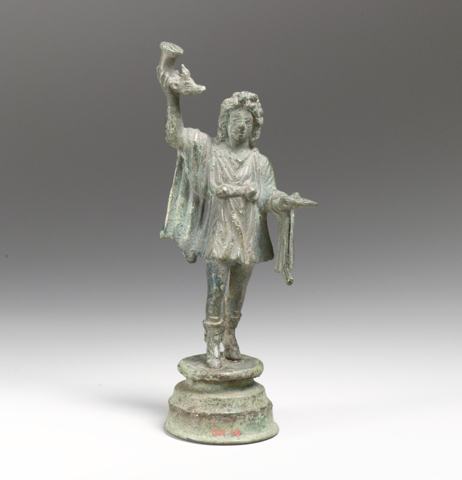
The small gods of the Roman house — the Lares who guard the family line and the Penates who guard its stores, worshipped daily at a shrine by the hearth.
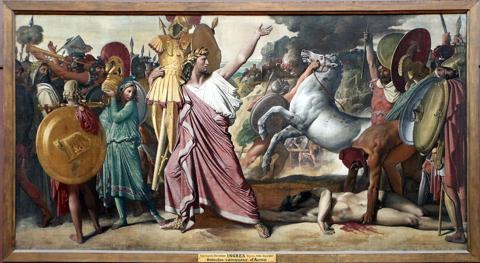
Twin sons of Mars, saved by a she-wolf and raised by shepherds, who quarreled over where to found Rome — a quarrel that ended with only one of them ruling it.
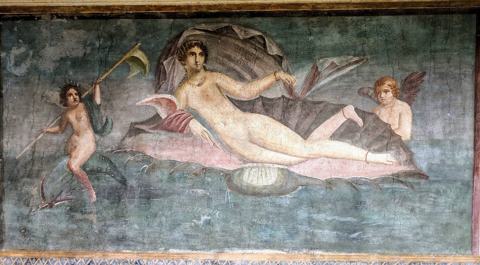
Goddess of love and desire — and the divine ancestress of Rome itself, mother of Aeneas and the claimed forebear of the family of Julius Caesar.
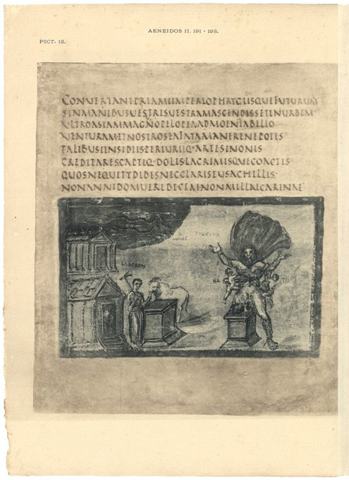
Virgil's unfinished epic of Aeneas's flight from Troy and the founding of Rome — composed for Augustus, nearly burned at its author's own request.
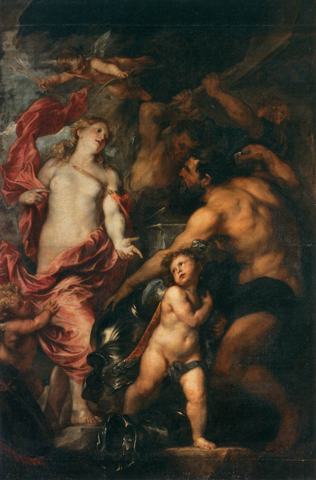
Rome's fire god, honored to keep flame from the wooden city, later remade as the mythical blacksmith who forged arms for gods and heroes.
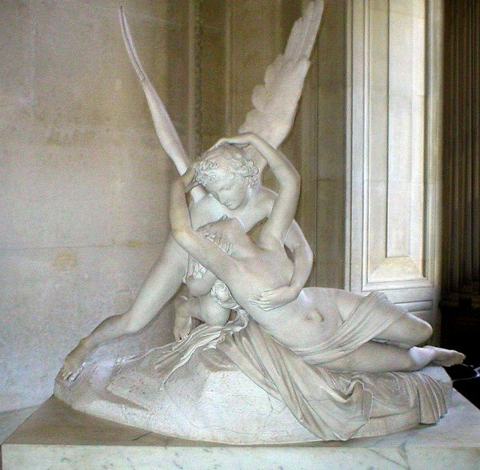
The winged god of desire, son of Venus — best known through Apuleius's tale of his secret marriage to the mortal Psyche and the trials Venus set her.
Also mentioned inMinervaThe Trojan WarVesta and the Vestal Virgins
Sources & Further Reading
- 1.Homer, Iliad (8th century BCE), Book 20.
- 2.Virgil, Aeneid (29-19 BCE).
- 3.Livy, Ab Urbe Condita (c. 27 BCE), Book 1.
- 4.Dionysius of Halicarnassus, Roman Antiquities (late 1st century BCE), Book 1.
- 5.Erskine, Andrew. Troy between Greece and Rome — Local Tradition and Imperial Power. Oxford University Press, 2001.
- 6.Horsfall, Nicholas, ed. A Companion to the Study of Virgil. Brill, 1995 (2nd ed. 2000).
- 7.Beard, Mary, John North & Simon Price. Religions of Rome, Volume 1: A History. Cambridge University Press, 1998.
Spot an error or have a source to suggest? Write to info@viseterna.com. We cite primary sources and modern scholarship, and we correct fast.