
Vulcan (Roman God of Fire)
Rome's fire god, honored to keep flame from the wooden city, later remade as the mythical blacksmith who forged arms for gods and heroes.
Venus Asks Vulcan to Cast Arms for her Son Aeneas, Anthony van Dyck, c. 1630-1632 · Public domain · source
A God Worshipped to Keep Him Away
Vulcan is one of Rome's oldest gods, but unlike most of the old di indigetes his cult is organized almost entirely around avoidance rather than request. Roman fire was constant and dangerous in a city built largely of wood, and Georges Dumezil argued that Vulcan represents specifically the fire that must be kept from consuming the community — prayed to not so that he would act, but so that he would stay contained 5,7. That logic shaped the one clear rule ancient sources give about his worship: his shrines, and his one attested temple, stood outside the city's sacred boundary, the pomerium, deliberately separated from the houses his fire could otherwise reach 6,7. For most of the Republic, Rome also had no organized firefighting force at all; the corps of nightwatchmen who doubled as firemen, the vigiles, was not established until Augustus's reign, which left ordinary households dependent on ritual precaution and private bucket-lines rather than any public safety apparatus 6,7.
The Volcanal and the Small Fish
The oldest of those shrines, the Volcanal, sat at the foot of the Capitoline in the Roman Forum itself, and Dionysius of Halicarnassus credits its founding to Titus Tatius, the Sabine king said to have ruled Rome jointly with Romulus — making it, by Roman tradition, older than the city's single-king monarchy 2. There the flamen Volcanalis, one of Rome's minor priests dedicated to a single god, presided every 23 August over the Volcanalia, when heads of households threw small live fish into an open fire, a substitution Varro records without fully explaining and which later writers took as a symbolic offering of life to fire in place of a human one, timed to the hottest and driest stretch of the Roman summer, when accidental blazes were most likely 3,6.
A Wife Named Maia, Not Venus
Vulcan's other odd ritual link is to Maia, not to Venus, the wife later poetry gives him. Roman antiquarian tradition held that the flamen Volcanalis sacrificed to Maia — an old Italian growth goddess, distinct from the Greek Maia who mothers Mercury — on the Kalends of May, a pairing modern scholars read as a fossil of an earlier arrangement in which Vulcan's household looked very different from the version Roman poets eventually settled on 5,7. Ovid's own calendar-poem marks Vulcan's other festival day, the Tubilustria on 23 May, when the sacred trumpets used in state ritual were ceremonially purified 4. That older Maia arrangement barely survived contact with Greek myth: Latin poetry gave the smith-god Aphrodite's Roman equivalent as his wife instead, importing the whole uncomfortable story of her affair with Mars along with the marriage 6,7.
Forging Arms for Aeneas
By the time Virgil wrote the Aeneid, Vulcan had absorbed the Greek smith-god Hephaestus almost completely, workshop and all. In Book VIII, Venus asks her husband to forge armor for her mortal son Aeneas, and Vulcan agrees, waking his Cyclopes under Mount Etna to hammer out a shield decorated with scenes from Rome's future history, from the she-wolf and twins to the battle of Actium 1. The scene fixed the image most people now associate with the god: not a Forum priest averting housefires, but a divine blacksmith ringed by giant assistants, a picture later painters — Velazquez among them — returned to again and again 1,6.
Legacy: From Housefire to Volcano
Vulcan's two identities never fully merged in Roman practice the way Mercury's did with Hermes: the fire-averting Forum god of the Volcanalia and the epic armorer of the Aeneid are drawn from different sources and serve different purposes, and Roman religion seems to have carried both without much concern for consistency 5,6,7. English still keeps the split alive without knowing it: volcano, from the same root, remembers the god as an eruptive, dangerous fire loose under the earth, while vulcanize remembers him as the patient craftsman at the forge 5,7.
Continue Exploring
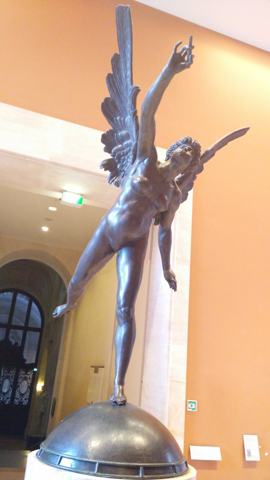
Rome's god of trade, profit and messages, later fused so completely with Greek Hermes that the two are barely distinguishable.
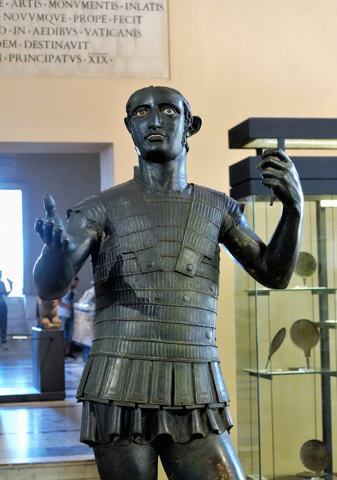
God of war and father of Rome — honoured above almost every other deity, with his own month, his own dancing priests, and the twins he fathered on a Vestal.
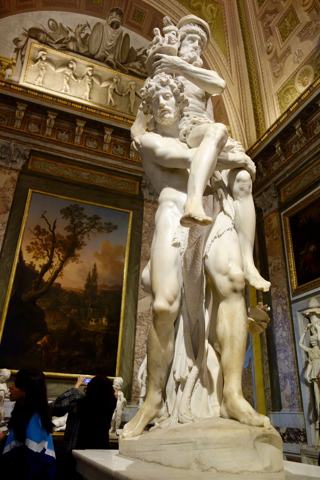
The Trojan prince who escaped burning Troy carrying his father and household gods, wandered the Mediterranean, and became Rome's mythical ancestor.
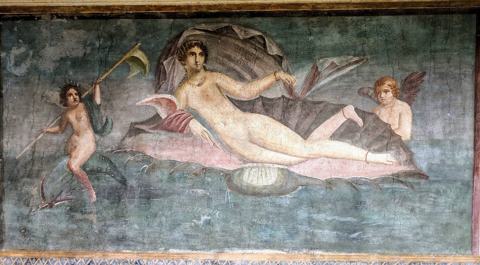
Goddess of love and desire — and the divine ancestress of Rome itself, mother of Aeneas and the claimed forebear of the family of Julius Caesar.
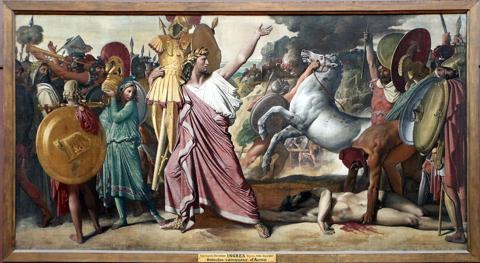
Twin sons of Mars, saved by a she-wolf and raised by shepherds, who quarreled over where to found Rome — a quarrel that ended with only one of them ruling it.
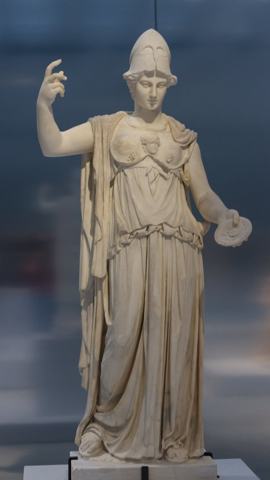
Goddess of wisdom and the crafts — third of the Capitoline Triad, and Rome's patron of every skilled trade from weaving and teaching to medicine.
Sources & Further Reading
- 1.Virgil, Aeneid — Book VIII (c. 19 BCE).
- 2.Dionysius of Halicarnassus, Roman Antiquities — Book II (late 1st century BCE).
- 3.Varro, De Lingua Latina — Book VI (1st century BCE).
- 4.Ovid, Fasti — Book V (c. AD 8).
- 5.Dumezil, Georges. Archaic Roman Religion. Translated by Philip Krapp. Johns Hopkins University Press, 1996 (orig. 1966).
- 6.Beard, Mary, John North & Simon Price. Religions of Rome, Volume 1: A History. Cambridge University Press, 1998.
- 7.Scheid, John. An Introduction to Roman Religion. Edinburgh University Press, 2003.
Spot an error or have a source to suggest? Write to info@viseterna.com. We cite primary sources and modern scholarship, and we correct fast.