
Konohanasakuya-hime
The cherry-blossom princess who married the heavenly grandson, proved her sons' birth by fire, and became the kami worshipped on Mount Fuji.
Konohanasakuya-hime, Katsushika Hokusai, 1834 · CC BY-SA 4.0 · source
A Bride Chosen at First Sight
When Amaterasu's grandson Ninigi-no-Mikoto completes his descent from Takamagahara and settles at Cape Kasasa in the land of Himuka, the first thing the chronicles have him do is fall for a woman he meets on the shore. She identifies herself as Konohanasakuya-hime, "the princess who blossoms like the flowers of the trees," daughter of Oyamatsumi, the kami of mountains in general 1,2. Ninigi asks her father for her hand, and Oyamatsumi, delighted at the match, sends her to him — along with a second gift Ninigi did not ask for and will come to regret refusing 1.
The Sister Refused, and the Cost
Oyamatsumi sends both daughters together: Konohanasakuya-hime, and her elder sister Iwanagahime, "princess long as the rocks." Ninigi, finding Iwanagahime plain to the point of ugliness, sends her back to her father and keeps only the younger sister, spending a single night with her 1,2. Oyamatsumi's response, relayed back to Ninigi, turns the whole episode into an origin story for human mortality: he had sent the two sisters together deliberately, Iwanagahime so that the heavenly grandchild's line would endure unchanging as stone, and Sakuya-hime so that it would flourish like blossoming trees. By rejecting the rock and keeping only the blossom, Ninigi has doomed his descendants to lives as brief as flowers rather than as enduring as rock — the Kojiki's own explanation for why the imperial line, and by extension human life generally, does not last forever 1. It is a striking thing for the text to say so plainly, and later commentators have treated it as one of the Kojiki's few explicit attempts to explain mortality through myth rather than simply assume it 1,4.
Proof by Fire
A single night is enough: Konohanasakuya-hime conceives immediately, and when she tells Ninigi he doubts the child could be his, suspecting an earthly kami instead 1,2. Insulted, she seals herself inside a doorless birthing hut and sets it alight, declaring that if the child is not Ninigi's it will die in the flames, and if it is, the fire will do it no harm 1. She gives birth successfully as the hut burns around her, to sons whose names the Kojiki ties directly to the stages of the fire — Hoderi, born as the flames flared up; Hosuseri, born at their height; and Hoori, born as they died down, with the Nihon Shoki preserving additional variant orderings of the same birth 1,2. The trial proves nothing evidentially — a hut set alight by its own occupant is not an impartial test — but within the myth it functions exactly as intended, and no character in either chronicle questions the children's legitimacy again 1,2.
Mother of the Line to the First Emperor
Of the three sons, Hoori, also called Yamasachihiko, carries the genealogy forward. His own story, the tale of the lost fishhook and his journey to the sea god's palace, ends in marriage to Toyotama-hime, daughter of the sea deity Ryujin; their son in turn fathers Jimmu, presented in the chronicles as Japan's first emperor 1,2. Konohanasakuya-hime is therefore not a peripheral figure in the imperial genealogy but a load-bearing one, the great-grandmother of the line the Kojiki and Nihon Shoki were compiled to legitimize, reached through a marriage that also, in the same breath, explains why that line's members die like everyone else 1,4.
Goddess of the Mountain
Outside the genealogy, Konohanasakuya-hime is known above all as the kami of Mount Fuji, worshipped as the deity of the mountain at Fujisan Hongu Sengen Taisha and at shrines of the same Sengen (or Asama) network ringing its base, a shrine-branch structure of the kind Breen and Teeuwen describe as typical of how a single cult multiplied across the country 3,5. Earhart's study of Fuji's religious history describes this identification as a gradual settlement rather than an original given: the mountain's own volcanic kami was, in earlier centuries, a more ambiguous and dangerous presence, propitiated with shrine-building after eruptions such as the major one of 864, and only over the medieval and early modern periods did that presence become firmly and specifically identified with the blossom princess of the chronicles 3. The pairing has an obvious visual logic — a mountain famous for the brief, cherry-blossom-timed beauty of its snow-capped silhouette, given a goddess whose own myth is about blossoms and the shortness of things — whether or not that logic drove the original identification 3,4.
Fuji-ko and the Climbing Pilgrims
By the Edo period, devotion to Fuji and its goddess had organized itself into Fuji-ko, lay pilgrimage confraternities that funded group ascents of the mountain and built miniature earthen "Fuji-zuka" mounds in city neighborhoods for members who could not make the full climb themselves; Edo was said, with some exaggeration, to have as many of these confraternities as there are stars in the sky 3. For much of that history women were barred from climbing the mountain itself under a prohibition, nyonin kinsei, not formally lifted until 1872 — an arrangement that left the mountain's own resident kami female while closing the peak to living women, a contradiction Earhart notes without fully resolving it, since the sources give no single official justification that has held up under later scrutiny 3. Today the climb is open to everyone, and Sengen shrines at both the mountain's base and its summit still keep Konohanasakuya-hime as the deity climbers are, formally, coming to visit 3,4.
Continue Exploring
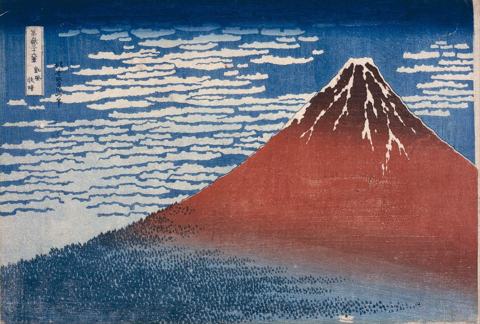
Japan's tallest, most sacred peak, home to a blossom goddess and climbed by pilgrim confraternities for centuries — a UNESCO site for its art, not its geology.
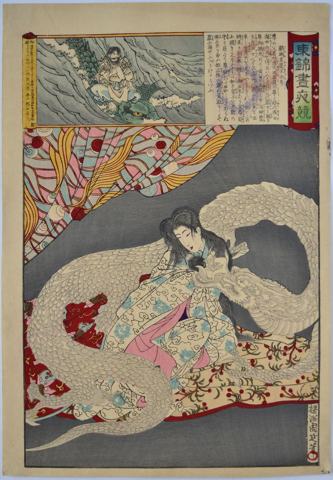
Japan's dragon king of the sea, ruling the palace Ryugu-jo with tide-jewels that command the ocean and a daughter who nearly kept the imperial line undersea.
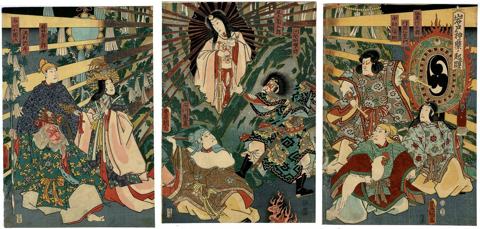
The Plain of High Heaven — where the first kami came into being, where the gods hold council, and from which Amaterasu's line descended to rule the islands.
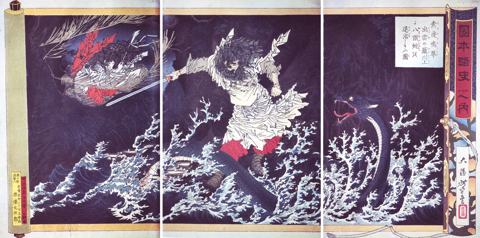
The raging kami of sea and storm — expelled from heaven for wrecking his sister's fields, then redeemed in Izumo by slaying an eight-headed serpent.
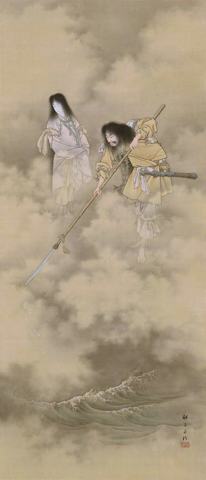
The creator pair of Japanese myth: they stirred the first island out of the sea, bore the land itself, and were parted forever by death.
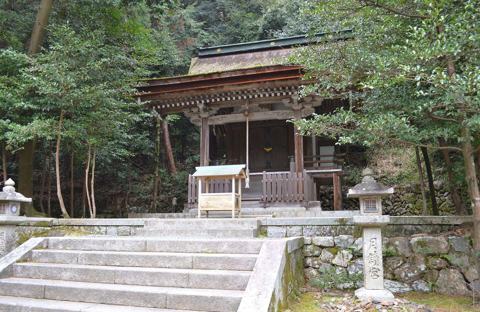
The moon kami born from Izanagi's right eye — ruler of the night, whose single recorded act of violence set the sun and moon forever apart.
Sources & Further Reading
- 1.Kojiki (Records of Ancient Matters, 712), trans. Donald L. Philippi. University of Tokyo Press, 1968.
- 2.Nihon Shoki (Chronicles of Japan, 720), in W.G. Aston, trans., Nihongi. Kegan Paul, 1896.
- 3.Earhart, H. Byron. Mount Fuji: Icon of Japan. University of South Carolina Press, 2011.
- 4.Hardacre, Helen. Shinto: A History. Oxford University Press, 2017.
- 5.Breen, John & Mark Teeuwen. A New History of Shinto. Wiley-Blackwell, 2010.
Spot an error or have a source to suggest? Write to info@viseterna.com. We cite primary sources and modern scholarship, and we correct fast.