
Mount Fuji (Sacred Mountain)
Japan's tallest, most sacred peak, home to a blossom goddess and climbed by pilgrim confraternities for centuries — a UNESCO site for its art, not its geology.
Fine Wind, Clear Morning (Red Fuji), from Thirty-six Views of Mount Fuji, Katsushika Hokusai, c. 1830-1832 · Public domain · source
A Mountain With a Goddess
At 3,776 meters, Mount Fuji is Japan's tallest peak, a near-symmetrical stratovolcano straddling Shizuoka and Yamanashi prefectures about a hundred kilometers from Tokyo, and it has been an object of worship for as long as it has been a landmark 2,3. Its enshrined deity is Konohanasakuya-hime, the blossom princess who in the Age of the Gods marries the heavenly grandson Ninigi after his descent from Takamagahara and gives her name, by long association, to the mountain's beauty and its violence alike, since her myth cycle also involves fire 2,3. Roughly thirteen hundred Sengen shrines across Japan carry her worship outward from the mountain itself, headed by Fujisan Hongu Sengen Taisha at the southern foot, which historically claimed ownership of the summit crater by imperial grant, and by a small subsidiary shrine, the Okumiya, actually built at the top 2,3.
Ascetics, Confraternities, and the Fuji-ko
Devotional climbing became organized practice through Shugendo, the mountain-ascetic tradition that treated a difficult climb as a path to purification, and Mount Fuji's central promoter was Hasegawa Kakugyo, an ascetic of the sixteenth and early seventeenth centuries credited with founding the devotional lineage that grew into the Fuji-ko, lay confraternities organized to fund and undertake pilgrimage climbs together 2. The Fuji-ko movement expanded enormously through the Edo period, and later teachers within it, including the ascetic Jikigyo Miroku, became venerated figures in their own right after extreme acts of devotion on the mountain 2. For city dwellers who could not make the journey, communities built Fujizuka, miniature mounds constructed from real volcanic rock carried down from Fuji itself and climbable in an afternoon — a substitute pilgrimage that Earhart reads as evidence of how deeply the mountain's symbolic weight had penetrated ordinary urban life, independent of the physical climb 2.
Women Barred, Then Not
For most of this devotional history, women were formally barred from climbing above certain stations on the mountain, a restriction rooted in Shugendo's association of female presence with ritual impurity on sacred ground, and enforced at other major pilgrim mountains such as Omine in the same period 2,5. The ban was not absolute in practice — one well-attested account describes a woman climbing to the summit in male dress in 1832 — but formal exclusion held until 1872, when the new Meiji government, as part of a broader modernizing reform of religious practice, issued an edict abolishing the prohibition on women climbing sacred mountains 2.
A Name Wrapped in Legend
Fuji's own name has no settled derivation, and the tradition has never let that stop it from proposing one. One of Japan's oldest surviving tales ties the mountain to the word fushi, "immortality" or "deathlessness": in it, an emperor, left with an elixir of eternal life he no longer wants without the woman who gave it to him, orders it burned on the tallest mountain near the capital, and smoke is said to have risen from the summit ever since 2. Earhart treats the story less as etymology than as evidence of how early the mountain had already become a fixture of literary imagination, its meaning contested even in its own name 2. The mountain's place in verse is older still: the Man'yoshu, Japan's earliest great poetry anthology, preserves eighth-century poems in Fuji's honor, including work attributed to the court poet Yamabe no Akahito, describing snow falling on the peak even in summer as a sign of the mountain's more than ordinary nature 1.
A World Heritage Site — For Its Culture, Not Its Rock
In 2013 UNESCO inscribed Fuji on the World Heritage List not as a natural site but as a cultural one, under the title "Fujisan, sacred place and source of artistic inspiration" 4. That distinction was not incidental: an earlier bid to list the mountain under natural-heritage criteria had stalled over concerns about litter and unmanaged development on its slopes, and the successful nomination instead built its case on the mountain's unbroken record as an object of religious pilgrimage and as the subject of major art, an argument UNESCO's own citation makes explicit in its wording 4. The listing covers twenty-five component sites, including shrines, lava-tube caves used in Shugendo ritual, and the Fujizuka nearest the capital, rather than the summit alone 4.
Fire and the Mountain's Modern Face
Fuji's last eruption, the Hoei event, began in December 1707 and burned for roughly two weeks, opening a new secondary crater still visible today, high on the southeastern flank, and dropping volcanic ash as far as the streets of Edo 2. No eruption has followed in the more than three centuries since, and the mountain today is climbed by hundreds of thousands of people each summer season along routes that trace the old pilgrimage paths almost exactly, even for climbers who have never heard of Konohanasakuya-hime or the Fuji-ko 2,3. Hokusai's and Hiroshige's print series carried the mountain's image around the world in the nineteenth century, and the mountain that inspired them remains, by both UNESCO's judgment and its own tradition, less a fixed piece of geology than a continuously renewed act of devotion and representation 2,4. Unlike Ise Grand Shrine, rebuilt every twenty years, or Izumo Taisha, founded as the price of a divine surrender, Fuji's sanctity was never built at all — it is the one major Shinto holy place that the tradition simply found already standing 2,3.
Continue Exploring
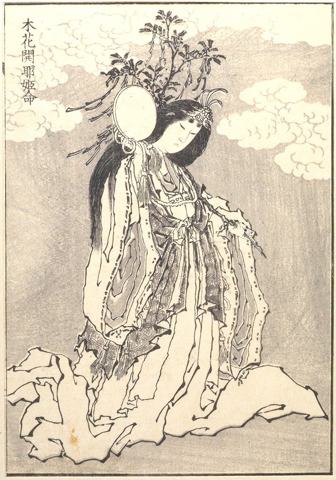
The cherry-blossom princess who married the heavenly grandson, proved her sons' birth by fire, and became the kami worshipped on Mount Fuji.
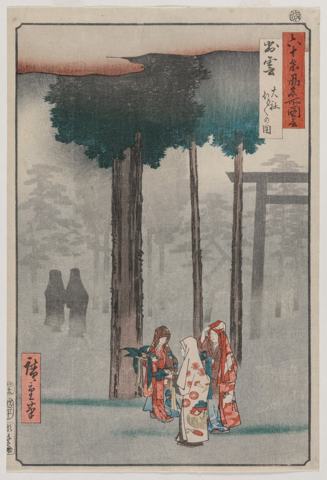
The shrine built, myth says, as the price for the land — where every kami in Japan is believed to gather each autumn, beneath a hall once among Japan's tallest.
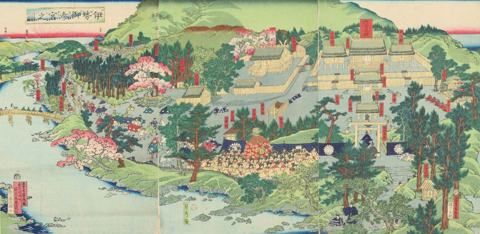
Shinto's holiest site, home to the sun goddess's mirror — rebuilt on an adjacent plot every twenty years so nothing there is ever allowed to age.
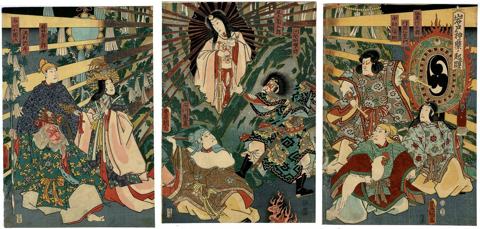
The Plain of High Heaven — where the first kami came into being, where the gods hold council, and from which Amaterasu's line descended to rule the islands.
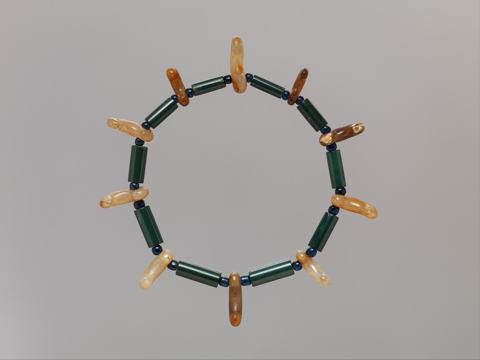
One of Japan's three imperial regalia: a string of curved jewels born at the heavenly rock cave, handed down from Amaterasu, and kept with the emperor unseen.
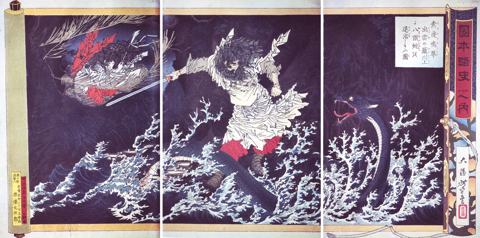
The raging kami of sea and storm — expelled from heaven for wrecking his sister's fields, then redeemed in Izumo by slaying an eight-headed serpent.
Sources & Further Reading
- 1.The Man'yoshu: The Nippon Gakujutsu Shinkokai Translation of One Thousand Poems (8th century). Columbia University Press, 1965.
- 2.Earhart, H. Byron. Mount Fuji: Icon of Japan. University of South Carolina Press, 2011.
- 3.Hardacre, Helen. Shinto: A History. Oxford University Press, 2017.
- 4.UNESCO World Heritage Centre. "Fujisan, sacred place and source of artistic inspiration." World Heritage List, 2013.
- 5.Breen, John & Mark Teeuwen. A New History of Shinto. Wiley-Blackwell, 2010.
Spot an error or have a source to suggest? Write to info@viseterna.com. We cite primary sources and modern scholarship, and we correct fast.