
Temple of the Inscriptions
Palenque's funerary pyramid, raised over the tomb of King Pakal and carved with one of the longest surviving Classic Maya hieroglyphic texts.
Temple of the Inscriptions, Palenque, Chiapas, Late Classic Maya, 675-683 CE (photograph by Bernard Dupont) · CC BY-SA 2.0 · source
A Mountain Built Over a King
The Temple of the Inscriptions dominates the plaza at Palenque, an eight-tiered pyramid roughly 27 metres high, its narrow stairway climbing to a five-doorway shrine under a mansard roof and roof comb of the kind standard to Palenque's Late Classic architecture 3,6. It was raised largely under the direction of K'inich Janaab Pakal, who ruled Palenque, known to its own people as Lakamha', from 615 to 683 CE, and it functioned as both a temple platform and — as later excavation would prove — his tomb 3,5,6.
Construction seems to have begun well before Pakal's death and to have been completed by his son and successor, K'inich Kan Bahlam II, which is itself informative: the building was planned from the start as the king's funerary monument, not converted to that purpose afterward 3,5.
Six Hundred and Seventeen Glyphs
The temple's rear interior wall carries three long panels of Maya hieroglyphic text, 617 glyph blocks in total, one of the longest inscriptions to survive from the Classic period 4. It sets out Palenque's dynastic history stretching back through mythological founding figures, records Pakal's own accession and the katun-ending rituals he performed across his long reign, and closes with a calendrical calculation projecting forward to a period-ending in the year 4772 CE — a date more than three thousand years after the text was carved, treated by its authors as a real point on a continuous, unbroken calendar rather than a symbolic flourish 4.
Linda Schele and Peter Mathews read the text as, in large part, an argument: a justification of Pakal's right to rule, and of his son's, framed as a continuation of divine and ancestral order rather than as a simple king-list 4. The building the text is carved into is one of seven Schele and Mathews chose to organize their account of Maya kingship and temple architecture, a measure of how central it is to the field 4.
The Secret Stairway
For nearly twelve centuries, nothing beyond the inscriptions themselves suggested what lay beneath the temple floor. That changed in 1949, when the Mexican archaeologist Alberto Ruz Lhuillier, excavating for Mexico's national anthropology institute, noticed a stone slab in the floor of the temple's rear chamber pierced with a row of finger holes — a detail too deliberate to be accidental 1.
Lifting the slab revealed a stairway packed solid with rubble, descending into the body of the pyramid. Ruz's crew spent four field seasons, from 1949 to 1952, clearing it a barrow-load at a time, an unglamorous and physically dangerous excavation that had to be shored and drained as it went 1,6. Partway down they found a small stone box holding jade beads, shell, and pearls — a dedicatory offering, and confirmation that whatever lay at the bottom had been built with real intention 1,3.
Into the Tomb
On 15 June 1952 the stairway finally reached a chamber below the level of the plaza outside, sealed behind a triangular stone door 1,3. Inside was a vaulted room with red-painted walls, nine stucco figures modelled along its sides usually read as the nine lords who preside over the nights of the Maya underworld, and a single massive sarcophagus carved from one block of limestone, its lid covered in relief 1,2,6.
The discovery was, and remains, one of the most important in Maya archaeology: proof that Classic Maya pyramids could be built as royal tombs and temples together, at a scale and with a level of planning comparable to the great funerary monuments of other early civilizations 3,6. Inside the sarcophagus lay Pakal's skeleton, adorned with a jade mosaic mask and jade jewellery — the objects, and the carved lid above them, are treated as a separate entry in this Codex 2,3.
The "Psychoduct"
A narrow stone conduit runs from the tomb chamber up alongside the stairway to the temple floor above, an unusual feature that has attracted its own modern nickname, the "psychoduct" — a term coined well after Ruz's excavation, not a Maya one 1,3. Popular writing sometimes presents it as a channel built to let the dead king's spirit travel and communicate with priests above; the more cautious reading, favoured by Stuart and Stuart, is that its function is genuinely unclear, and that reading a modern spiritualist vocabulary directly into the archaeology outruns the evidence 3.
What is secure is the building's overall logic: a temple standing for the living cult of a divine king, built directly over the physical tomb of that same king, in a design deliberately connecting funerary rite and dynastic legitimacy across generations — the same close weave of the mythic and the political visible at other great Classic capitals such as Tikal and, later, in the northern lowlands at Chichen Itza 5,6. Pakal's tomb chamber remains closed to visitors to protect it; the temple and plaza above it do not 3.
Continue Exploring
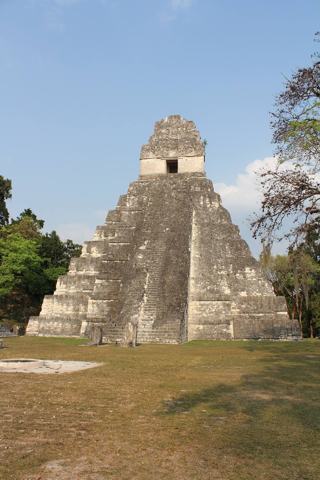
The great Classic Maya city of the Peten rainforest — a dynasty two thousand years deep, a war with Calakmul, and a king's tomb built as a mountain.
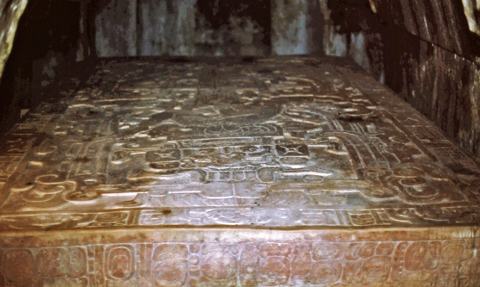
The carved limestone lid over King Pakal's tomb at Palenque — a scene of death and rebirth at the World Tree, and the most misread monument in Maya art.
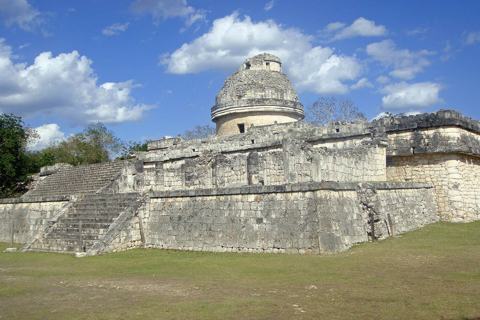
The great Postclassic Maya city of Yucatan — home to Kukulkan's pyramid and the Sacred Cenote, and a decades-long argument over how "Toltec" its art really is.
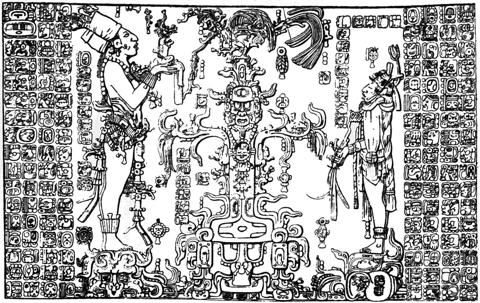
The great ceiba that joins underworld, earth and sky in Maya cosmology — carved at Palenque's Temple of the Cross and reborn each time maize is planted.
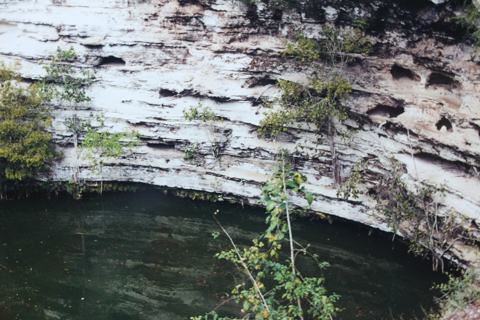
The natural sinkhole at Chichen Itza where the Maya threw offerings of jade, gold, and people, dredged by an American consul in the early 1900s.
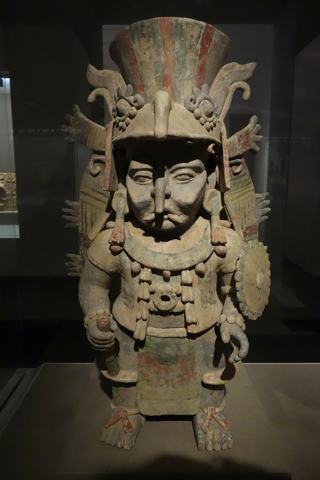
The rain god who splits the clouds with a lightning axe — one god and four, the most frequently depicted deity in the surviving Maya books.
Sources & Further Reading
- 1.Ruz Lhuillier, Alberto. El Templo de las Inscripciones, Palenque. Instituto Nacional de Antropologia e Historia, 1973.
- 2.Robertson, Merle Greene. The Sculpture of Palenque, Volume I: The Temple of the Inscriptions. Princeton University Press, 1983.
- 3.Stuart, David & George Stuart. Palenque: Eternal City of the Maya. Thames & Hudson, 2008.
- 4.Schele, Linda & Peter Mathews. The Code of Kings: The Language of Seven Sacred Maya Temples and Tombs. Scribner, 1998.
- 5.Martin, Simon & Nikolai Grube. Chronicle of the Maya Kings and Queens, 2nd edition. Thames & Hudson, 2008.
- 6.Sharer, Robert J. with Loa P. Traxler. The Ancient Maya, 6th edition. Stanford University Press, 2006.
Spot an error or have a source to suggest? Write to info@viseterna.com. We cite primary sources and modern scholarship, and we correct fast.